Showing posts with label contemplative science. Show all posts

Tuesday, January 02, 2024

My favourite podcasts about ballet and contemplation

Now for a more practical blog: what podcasts would I recommend? I have started to listen to quite a few podcasts that inspire me a lot! Many of them are about ballet, kind of obviously ;-) But I think also the ballet ones teach me quite a bit about life in general. Let me walk through my current facvourites, sorted by topic:

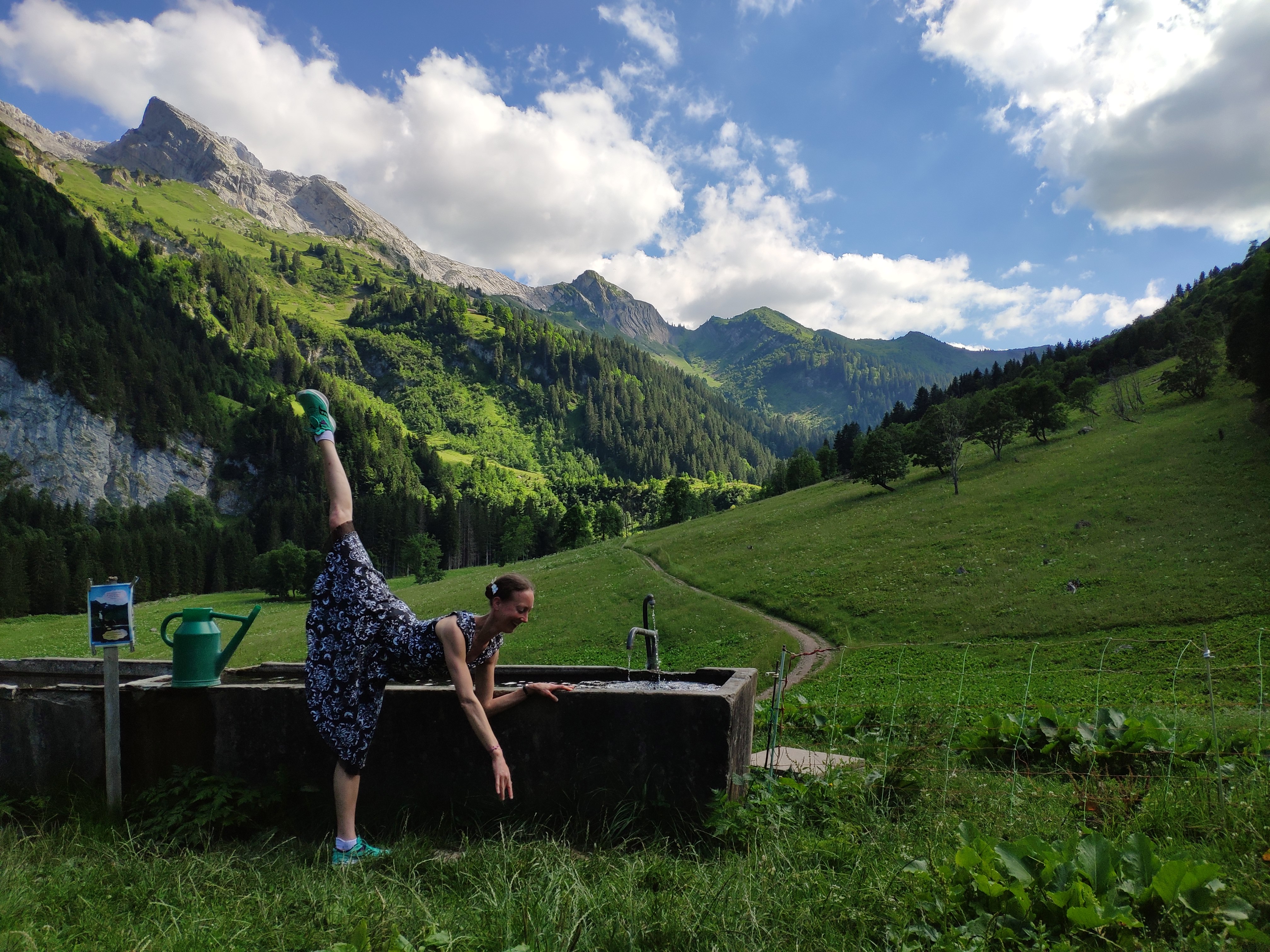
Picture  by Michel Le Photography 
at Morlaix Ballet camp

Contemplation

- Mind & Life podcast (I was super-honoured to be featured on this one myself!) in which people are interviewed that work on the intersection of research and contemplative practice. I find these always such fascinating conversations!

- Open Question by Elisabeth Mattis-Namgyel, an amazing Buddhist teacher who presents a no-nonsense approach to asking deep questions in life

- The kind heartfulness podcast by Gomde Austria, an interesting series of conversations with Buddhist teachers and practitioners.


Ballet

- A dancer's mindset by Isabella McGuire, who talks about the mindset that is required to be successful at anything, but especially from the perspective of ballet. Lots of good advice, although I don't always agree with everything. I think she forgets that not everything can be controlled

- Athletistry by Shane Wuerthner, another ballet mindset podcast, which is also useful to anyone engaged in a difficult pursuit, such as academia

- Ballet Rising by Casey Herd: fascinating stories about people trying to bring ballet to the communities that not always get access to it, e.g., ballet in India and Africa

- Hard Corps podcast by Romee Adair, who talks with guests about the general dance industry and especially challenges within it. It's fascinating to learn more about how the dance industry works.

- The adult ballet studio by Elisabeth Blosfield, a series of conversations with people trying to make a space for amateur adult ballet dancers. So inspiring!

- The balanced ballerinas podcast by Georgia Dostal, a series of interviews with so many amazing people in the dance world. Again, so many interesting things to learn!

- Artists Becoming, another series of conversations with dance professionals, but this one is specifically focused on bringing out the artists, and challenges to that

- Moving Moments by Alicia Graf Mack: more conversations with dance arists. I just love hearing the person behind the dance artist!

- The turning: Room of Mirrors: a really interesting deep dive into the ballet choreographer Georges Balanchine. Very interesting although this one is a bit on the sensationalist side

- Broche banter by Julie Gill/Leung: all things adult ballet, including interviews with adult amateur ballet dancers. Lots of insightful stuff about how adults learn ballet


Academia

- Degrees of freedom by  Tassos Sarampalis and Marcello Seri: lots of philosophy and practical tips about teaching in academia.


I hope some of these are inspiring to you, and maybe you find some new ones to listen to!

Monday, January 01, 2024

What is a contemplative life?

I wrote this blog when I just attended the Mind & Life Europe Retreat and the European Summer Research Institute (ESRI), also from Mind & Life Europe. Both events took place in Pomaia, Italy. For me, these events are always very good because they make me ask what the role is of contemplation in my life, and other big questions about being human.

In fact, this time I started to ask a lot of questions about my identity. When asked who I am, I usually say something like "neuroscientist" or "computational cognitive neuroscientist". Yet, in the MLE retreat, and more frequently this past summer, my identity has become also "dancer". Of course I don't get paid to do it, but yet, there is such a strong force in me that makes me dance, and I have in recent time been able to do more and more things with professionals. Then in the MLE retreat and the European Summer Research Institute, I suddenly also became a "contemplative", when I taught the meditation and contemplative dance practices. As someone who has been trying to follow the path of a scientist-practitioner, this was a really interesting experience, which I am still feeling into.

Picture from Morlaix Ballet camp
By Michel Le Photographe
What does it mean to be a contemplative? During the retreat we talked about "continuous practice". With my busy job, I don't have the time to spend hours a day practising meditation, although I certainly practise meditation every day. But there is much more that bringing meditation into your life can mean. For example, I try to be aware of my motivation for doing things, and where possible bring this into an altruistic motivation, intending that whatever I do be for the benefit of all beings. At the end of the day, I try to dedicate my efforts also to the benefit of all beings. In addition, I try to take short moments of meditation during the "lost moments" of the day--when walking somewhere, when waiting for the traffic light, and so on.

Inspired by the MLE retreat and ESRI, one of my more recent practices is also trying to bring awareness of interdependence into my action. There is this interesting concept of "enaction", which means in my limited understanding something like that whenever you take action, you are just moving around in the sea of interdependence, you are never able to have a fully independent action.

In addition to continuous practice, another feature of a contemplative is some amount of renunciation. In the old days, contemplatives would live in monasteries. However, monasteries are not so compatible with a modern life. Nevertheless, during ESRI Martijn van Beek talked about new alternative structures such as Vaekstcenteret where he lives in Denmark. And even if you are not entering a very specific community, you can also live a monastic life at home. For example, Misha Belien talks about being a monk with a family in this very inspiring documentary. Also I myself try to live a simple life, without too many distractions. The monks of yore would say "ora et labora" (pray and work), and in some sense, that is what I try to do.

Sunday, August 28, 2022

Remembering the important things

I just got back from a Buddhist retreat in the south of France (the beautiful Tibetan Buddhist temple of Lerab Ling). It's such a gift to be able to spend a good week just thinking about the Buddhist teachings and the meditation. The focus of the retreat was meditation, and there was lots of space and time for practice, which for me is the most important thing. I feel like I already received so many teachings, but I don't have the time to put them into practice. 
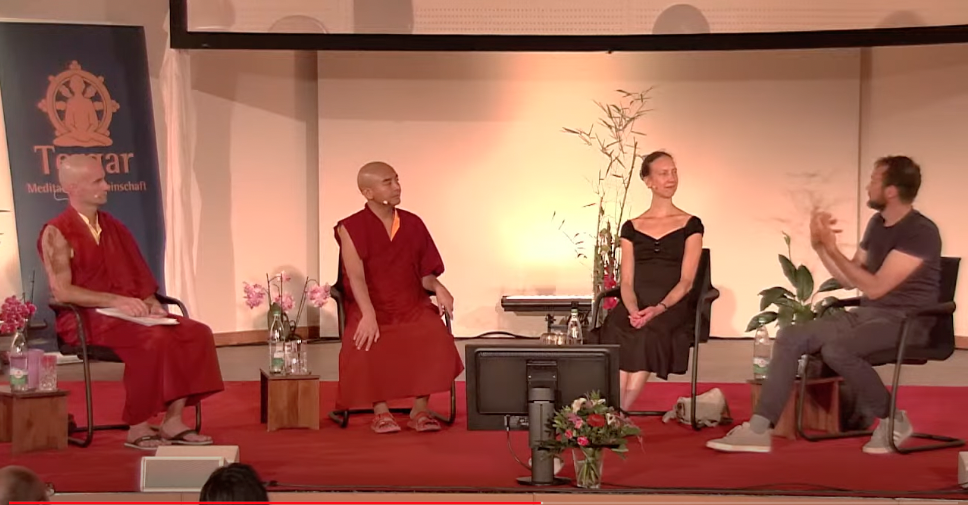
Impression from the dialogue with Mingyur Rinpoche

 Every day I started by going for a run, allowing me to move my body. The first day was kind of exciting, because it had been a good 4 years since I had last been to this retreat centre, so I didn't know whether the running path still existed, and whether I still remembered it. Thankfully my body still remembered it, and actually it was easier than I remembered: usually on the big hill somewhere at the end of the round I would need to stop halfway to catch my energy, and this time I was up before I knew it (maybe it was all the zhemfit I have been doing?). 

My favourite spot to practice on top of the hill
 What I found very interesting was that being in this space really made it so easy for me to completely disconnect: to ignore my email and my social media and the news (not that I completely forgot about the news: I did send a lot of prayers to Ukraine in the prayer sessions and also though about Salman Rushdie, who had been attacked just prior to me leaving for retreat). Having the space to simply be and enjoy the nature and the practice was just so much more rewarding than these other things (I remember this being much more challenging previously when I did my retreat at home). 

During a gorgeous day at Lerab Ling
This reminds me of the next #lojongchallenge slogan, number 46, which says "meditate on the three things that must not detoriorate". The three things the slogan refers to are the connection to the spiritual teacher, the enthusiasm for practice, and the sense for what actions are right and wrong. Now enthusiasm for practice is so much easier when you are in a space dedicated to practice, where all that is expected is doing the practice, and everything else is taken care of. What a luxury! Now the challenge will be to go back to busy everyday life, where I myself need to convince myself that practice is important, despite the millions of other things that are expected of me. Hopefully my happy memories of the profound sense of well-being and spaciousness will help me here. 

 Another thing that can help me remember my enthusiasm for practice is an experience I had in the middle of the retreat, when the centre was hit by severe thunder storms (thankfully I was staying in a wooden cabin, so unlike people staying in their own tents, I was very safe). Earlier in the day, I had been sitting on my favourite meditation spot on top of the hill, and I felt the strong winds, but despite all of that my mind felt quite settled and stable. Then I went down to the temple for teaching and practice, and we heard the news that the major had sent a warning to the retreat centre that a major storm, possibly hurricane, would hit the centre, and we needed to be prepared (people in personal tents were asked to sleep over in the temple to ensure their safety). What was interesting that now my mind completely jumped all over the place, even though at that point the weather was almost the same: now I started to worry a lot about things like whether my running shoes would fly away (they were hanging out at the door of my cabin). It's amazing how our mind dramatizes things so much, and creates a lot of suffering that way. But that's why we do the practice: to become aware of this pattern, and instead of mindlessly following it, to gentle observe it and let it go instead. 


View from my run 

Impression from Lerab Ling


 The second thing that the slogan asks us to remember is the spiritual teacher. In the Buddhist teachings, the teacher plays a crucial role, as an embodied role model for the path to enlightenment. They are so inspiring because they live in the same world as we do, and give us examples in how to deal with that more sanely. Sometimes even thinking of the teacher can put you in a more sane and wise state of mind. In fact, that is the essence of the Tibetan Buddhist practice of guru yoga. One teacher who currently really inspires me is Mingyur Rinpoche, whom I had the tremendous honour to dialogue with just prior to my retreat. In his way of being, he shows how to maintain a joyful mind no matter what happens to you (I could really use that reminder in a very rough train journey on my way to the retreat, where I arrived with 4 hours delay at 2 am in Montpellier, the city closest to the retreat centre...). If you want to know some more concrete examples, I highly recommend his book In love with the world or the movie about his wandering retreat Wandering but not lost (we also got to watch this after the dialogue: what a treat!). 

 The final thing to remember from the slogan is how to behave as a decent human being. The Buddhist teachings are actually very simple in this: rather than giving you a list of rules, the simply ask you to do not harm others, and where possible to help. Of course in reality this is not so simple, because sometimes helping in the short term can be harming in the long term--something I reflect on a lot in the context of climate change (hence my frequent train journeys and avoidance of flying where possible). It's so important to keep reflecting on your actions. I try to remember (not always successfully) to take some time at the end of my day to reflect on what I did, and whether that is in line with my values, and also at the beginning of the day to set my intention to be of benefit. When I do manage to remember these things, I certainly feel so much more fulfilled...
Impression from Nurnberg

Saturday, July 09, 2022

Inter-subjectively exploring intersubjectivity in the French Alps

 In the last week, I had the good fortune to be part of Mind & Life Europe's ENCECON meeting. In this meeting, philosophers, neuroscientists, psychologists, meditators and more get together to discuss how we can study first-person experience and bring this full experience together with objective, third-person methods. This year's theme was "inter-subjectivity", which we explored through a series of meditation exercises, interviews and discussions. The interviews were not any interviews, but ==microphenomenological interviews, which is a method to explore experience in a very detailed way, trying to focus on the experience itself, leaving out our habitual theorizing. Another important characteristic of microphenomenological interviews is that they invite us to slow down, and repeatedly relive our past experience, so we become more aware of the details of these experiences, using more of our senses than we typically report on. What i found really interesting as a scientist was to observe the so-called evocation state, in which people show signs of being disengaged from the current context, something which we in the mind-wandering literature term "perceptual decoupling". The interviewees at this point slow down their speech, may close their eyes and sometimes repeat gestures from their past experience. What is challenging about this method, is that to explore a few minutes, or even less, of experience, you typically have an interview that lasts 30-60 minutes. At the same time, this is a state of pure contemplation--engaging in a reliving without judgment. Yet, this makes it very difficult to combine with other methods of research such as neuroimaging, because for most of these experiments, we need many repetitions of the same instance of experience. So, we had a lot of discussions about this.

What amazed me during this meeting is the profundity of the experiences that could be evoked by very simple meditations. On the first day, we were asked to simply bring to mind a person whom we felt grateful to. I kind of missed this instruction because I was so tired that I fell asleep during the meditation! On the second day, we sat next to one other person, and were asked to open ourselves up to the presence of the other person. It was fascinating to see how many people reported sensations of profound connection or even merging with the other person, as if they had a single body. On the third day, we were sitting together with the full group, and first we were asked to open ourselves up to the presence of the others, and then to hold each other's hands. In this moment, many people felt completely connected to the others, and lost a bit of their sense of self.


Many of our discussions revolved around the topics of how these practices helped to melt down the boundary between self and other. This was profoundly effected by the meditation practices we did, and of course by the fact we were staying together in a beautiful place in the French Alps. What this reminded me of is how helpful these simple practices could also be for reducing our destructive emotions, something that the next Lojong slogan talks about, which says "Train in the 3 difficulties". What this refers to is first the difficulty of becoming aware of your negative emotions, then secondly the difficulty of applying antidites to these negative emotions, and thirdly the difficulty of making the first two a habit so they change the way you are. Now when you are as profoundly connected as we were during the practices, the interesting thing is that negative emotions such as anger, jealousy and craving do not have even a chance to arise--they simply dissolve in the void. How wonderful would it be to do these practices together more often!

We also reflected on the role of the body in all this, because we found that touching each other's hands during the meditation practice had a profound effect. It dramatically amplified the feeling of having a single body with each other. Interestingly, this mirrors my findings from a dance experiment that I hope to write up soon, in which we found through working with dancers that the most powerful ways we can connect through movement is not by synchronizing our movement with another, but rather by moving as if we have a single body, or by engaging in a movement dialogue. So, it may be quite interesting to study more about how moving together can affect our thinking, and how such simple instructions ask bringing to mind the presence of others can do so. I am also curious whether we can use the perceptual decoupling state to better determine when microphenomenological interview information is reliable, and when it is less reliable (because people are not actually reliving their past experience, but rather theorizing about it). Finally, I am curious whether we can apply the experience of microphenomenology in zooming in on lived experience, and staying away from our theories about what's going on, to improve our societal discourses, which are so often stranded in these theories and stories, rather than simply being present with the facts. And the stories are what we know results in so many destructive emotions...

Sunday, August 16, 2020

Exploring together-apart mind and reality in times of COVID-19

Last week I attended the European Mind and Life Summer Research Institute. I have been lucky enough to attend many such events over the course of my career, and it is safe to say they have shaped my career as a contemplative scientist. During these Summer Research Institutes, scientists and contemplatives get together to discuss about issues in the field of contemplative science, but also do a lot of contemplation themselves. Unsurprisingly, this year's edition took place online.

I was not sure how an online version of this event would work out, but I was pleasantly surprised at the amount of connection that I felt with the other attendees. This was achieved by some quite inventive meeting formats. Before the meeting itself, the faculty had recorded brief (20-30 min) lectures that you could watch and ask questions about. These questions were collected on a board that allowed for upvoting of your favorite questions. Participants who presented posters had submitted PDFs and 2-minute video presentations of their posters and all gotten a Slack channel to discuss these posters during the meeting. Every day of the meeting started with contemplative practices: a choice of meditation, and a choice between chi gong, yoga and juggling. I ended up mostly not following those but taking a ballet class instead. After that, the first session was a plenary meeting with the faculty in which they briefly recapped the essence of their talks, followed by a panel discussion, partly driven by the submitted questions. There was also a brief period in which we were put in breakout rooms to discuss possible questions to ask. I must confess that during most of these sessions I ended up instead just talking to the others about their fascinating work! In the afternoons, we then had breakout groups with the day's speakers in which we discussed a bit more deeply. Before that, we would often have a fun activity, for example answering a question with one word on mentimeter that then transformed into a word cloud. The afternoon ended by bringing everyone back together with reports from the breakout groups and more general discussion. As the week progressed, there were also more and more self-organized zoom meetings for discussions and chats. As usual, there was a much-needed silent meditation day in the middle of the week which also featured a teaching by Mingyur Rinpoche, who talked about his wandering retreat and meditation in general.

Now the contents of the meeting. We started the first day by talking about perception: how do we derive knowledge from the world? This questions was approached from neuroscientific, philosophical and contemplative directions. Michel Bitbol for example argued that our experience of the world is just the part we need, which is an optimal way to perceive the world, but we should remember that that is not reality. There were many discussions about how we continuously make up stories about the world, and then confuse them for reality. Yet even if science is just another story, Michel Bitbol argued that it is a very efficient way towards knowledge, for example in the case of a search for a COVID-19 vaccine.

The second day was dedicated to interoception and emotions. Holger Yeshe talked about how the Buddhist teachings give us tools to investigate where our suffering, and our negative emotions (which are the source of this suffering) come from. Micah Allen talked about interoception--the feeling of our body from the inside, and argued that many psychiatric disorders are accompanied by problems in interoception. There have been claims that meditation improves interoception, but the evidence for this is not unequivocal. He also argued that we need more replication in the field of meditation reserarch and called for a Many Labs experiment in this field. I fully agree, and I am working on a project to work towards that! On a more poetic note, Giovanna Colombetti argued that emotions are not a feeling of the body but a feeling through the body. A lot to think about!


Thursday was dedicated to embodying knowledge. All too often, we think that knowledge is just in our heads, but dancers will know that you can also know and investigate through the body--a perspective that was also shown by Asaf Bachrach and Hsuan-Hsiu Hung. Asaf Bachrach showed an intriguing experiment in which people were moving in virtual reality, where he found that people felt very calm, and he noticed that when people moved slowly, they felt more together than when moving quickly. Despite the wisdom there is to be found in movement, Guiseppe Pagnoni argued that by keeping body and mind still during meditation practice, you can detect changes in the body-mind complex with much greater precision, which affords you to be less enslaved in your habits.

The last day was dedicated to artificial intelligence. Luisa Damiano argued that in addition to the empirical cycle of scientific research, we need the synthetic cycle in which we simulate the world and explore the world in-silico. Father Tiso discussed how artificial intelligence allows us to appreciate the sphere of interconnected minds through the internet (as was indeed happening there and then during the summer research institute!). Venerable Aileen Barry summed up the Ai day very beautifully by arguing that behind every AI there is a human, and a motivation, and we should watch this motivation.

Altogether, the ESRI was a very rich and beautiful exploration of what it means to know, and what it means to connect as humans--through technology. My head was spinning by the end, and there was as always too little time to explore this richness in ideas, but it was definitely a beautiful experience. And now it is time to take that wonder into my own retreat.

Sunday, February 23, 2020

Contemplating sustainable happiness in Vienna

I decided to contemplate the next slogan--"always maintain only a joyful mind" during a trip to Vienna. Now you might say: that is really easy: Vienna is a gorgeous city, so it's no challenge to be happy. This is certainly true. However, it was not that trivial. I went there for work: to discuss the future of Mind and Life Europe. Mind and Life is an organization that grew out of a series of dialogues between the Dalai Lama and scientists. So how does work relate to maintaining a joyful mind?


Let's first unpack the slogan. Maintaining only a joyful mind does not mean that you always need to be smiling and ignore all the sadness and difficulty that is abound in life. It does mean that you do not completely wallow in feeling sorry for yourself. After all, as His Holiness the Dalai Lama says, when there is something to solve a problem, do it, and when there is nothing you can do, it does not help to feel sad about it either. So this attitude of maintaining a joyful mind is the mind that considers everything as workable. Usually this attitude makes even difficult things easier. I got to practise this today on my flight back from Vienna. The flight was kept on an indefinite hold because of stormy weather in Amsterdam. Thankfully enough, my mind actually was quite OK throughout it all. It's not actually that bad to hang out at the airport if you just focus on the moment (and happily plough through the infinite amount of work that is always present). And as I am writing this, I am sitting on the plane, which now has gotten a delayed departure time after all.

Nevertheless, the more important dimension of maintaining a joyful mind became clear to me over the course of the meeting. We were reflecting on what makes Mind and Life events so special. I felt that a crucial ingredient is that it connects us to a dimension of life that we find deeply meaningful. While eating a Sachertorte, which we also did during the meeting, is lovely, this pleasure is only very temporary. In contrast, when you are engaging into work that puts into practice your deepest human values (which for a Buddhist practitioner is mostly cultivating compassion for all living beings, as well as wisdom), this feels very gratifying. When my academic work aligns with these values, in which wisdom may be operationalized as simply learning more about the nature of the human mind, and compassion as doing research that matters and brings benefit to beings, or teaching that gives insight and knowledge to others, then I feel happy for a much longer time. Moreover, by breaking down the boundaries between work and spiritual practice, there is less of a feeling of stress because work becomes just another way to engage in spiritual practice, rather than a competitor for our time. In this way, I think figuring out a way to align one's work to true human values is a way to "always maintain a joyful mind", and also a recipe against burnout.

Monday, June 17, 2019

Plunging in the deep of consciousness at the European Neurophenomenology, Contemplative, and Embodied Cognition Network meeting

Last week I attended the European Neurophenomenology, Contemplative, and Embodied Cognition Network meeting at Schloss Buchenau in Germany. This year we explored similarities and differences between the practices of meditation, hypnosis, trance and psychedelics. I must confess that up to that point I had always been quite skeptical of hypnosis, trance and psychedelics, feeling that they are kind of "out there" and I did not quite want to touch them. At the meeting, we got to explore some of these methods (trance and hypnosis) ourselves, and my ideas changed quite a bit. In fact these methods are not as strange as they sometimes appear, and certain forms of meditation also share some features with these other practices. And importantly, they can really benefit people!
Picture by Ute Brandes. Some of the results of the trance

In general, in many forms of meditation you bring your attention to an object of interest, and you monitor metacognitively where your attention goes, and whether it is still on the object. In some forms of meditation, you drop the object, and instead just monitor with kind attention where your awareness is. In some other forms of meditation, the object is more dynamic, for example it is a thread of philosophical thinking. In yet other forms of meditation, you visualize an entire environment and you incorporate all sensory impressions in this visualisation. For example, you may visualize a buddha, and then whatever sounds you are hearing may be reinterpreted as a mantra. This kind of practice actually shares quite some similarities with hypnosis in which you also construct a different narrative about the environment, and reinterpret thoughts and sense stimuli in this sense. Quite a powerful example of this was a video by Marie-Elisabeth Faymonville who showed how suggestion was used to alleviate pain during an operation. A patient who received large blows on their nose as part of nose surgery was led to interpret this as the shocks involved in skiing a mountain. And amazingly, this allowed them to undergo the operation with only local aneasthetics and substantial comfort.
Picture by Ute Brandes. Me giving my presentation

Similarly, in some practices of meditation you just allow your mind to accept whatever thoughts and emotions occur. When the faculty of monitoring disappears completely, and you just pursue whatever thoughts and emotions arise, then this becomes similar to the trance state (at least in my experience). During the meeting we were led into a trance state by listening to some very powerful deep drum sounds interspersed with animal sounds and more. We were encouraged to simply follow our impulses and to drop our cognitive control. To facilitate the latter and go with the flow, we were encouraged to make whatever sounds arose in our minds. In the beginning I think all of us felt a bit timid, but as we led go more, we entered this pure flow of experience. I myself felt quite compelled to move, and while I normally am a ballet dancer, now for the first time floorwork movements just manifested from my body automatically. To ensure people weren't harming themselves or others, an experienced team was watching over the trance and guided people gently as needed. After the end of one trance state, we were also invited to turn our experience into a painting. It was quite amazing to see what pieces of art came out! I wonder what the connections are between this state of effortless awareness where monitoring is almost completely abandoned and states of meditation practices that involve a nondual flow of awareness as well.

The meeting ended with trying to formulate a vision for a joint paper outlining some of these similarities and differences between the practices we discussed and experienced. While the communities of scientists studying these practices has traditionally been quite separated, I think it could really benefit from cross-talk to learn from each other's methods, roadblocks and more. For example, meditation research has a strong tradition of using pain to study the effects of the practice, but this has not been much considered in psychedelics. Hypnosis has a strong tradition of examining how people's suggestibility affects the results, and this could potentially be informative in studies of meditation as well. I could also imagine that comparative studies between the practices could be very helpful, because they engage, as I sketched above, to some extent similar mechanisms, but to some extent also different ones.
Picture by Steven Laureys. Group picture.

Picture by Ute Brandes. One of the many discussions.

Real German houses!


Monday, October 22, 2018

Viewing monastic debate through the lens of Western psychology and neuroscience: what can we learn?

I recently submitted a paper co-authored with probably more Tibetan monks than any paper in history (you can read a preprint here). The main point of the paper is to explain that while meditation research in the West has mostly focused on a narrow range of meditation practices such as mindfulness, there are many more practices out there, one of which is analytical meditation and debate. Why are analytical meditation and debate so interesting? As the Dalai Lama pointed out a few weeks ago in his talk in the Netherlands, reasoning and study, of which analytical meditation is the method, may be the best way for Westerners to engage with the Buddhist teachings. Even for a secular ethics that would be available for people from all religions, such analytical meditation could be useful.

So what is analytical meditation and what is debate? Analytical meditation is a practice of studying a text and contemplating it, asking questions such as "do I really understand what it means? How does that relate to other things I know? What follows from this statement? What is it consistent with? What is it inconsistent with?". In debate, you ask these questions to another person. In the tradition, such debates have a very distinct physical manifestation. You can find some videos and pictures from monastic debates a the website of the project.

In our paper, we describe what cognitive mechanisms we think are involved in the practice of debating. First you need to keep track of all the things that have been discussed so far, and this requires working memory. As the debate goes on, cognitive load increases. This may reflect in increasing engagement of a neural network called the fronto-parietal attention network, and this may also be associated with increasing inwardly-turned attention. In EEG measurements, such inwardly-turned attention is likely to be reflected in increasing brain waves in mid-frontal areas. Debating may also increase your speed of processing information, because if debaters do not respond quickly enough, then they are made fun of by their opponents. Furthermore, debate may promote mental flexibility, since winning a debate requires you to look at things from many different angles, and try to find an angle that your opponent has not yet found. Experienced debaters also say this is the most satisfying aspect of debating: it is a kind of research that may give you more insight into the topic when you consider the implications of looking at it in a particular way. This suggests to me as a neuroscientist that debate may require strong engagement of areas such as the anterior cingulate cortex and prefrontal cortex. Debating also is a strong motivator for memory training, since you can not go back to your textbook in the debate courtyard. Indeed we found that during a type of debate called "counting debate", in which the debaters review the texts and definitions, it happened more often that one of the debaters had "difficulty remembering" than during the logic debates, but even there difficulty-remembering could occur. Since debate uses logical reasoning as a foundation, it may also train this cognitive skill. We are now measuring that with reasoning tasks (stay tuned for results!). But debating is not just a cognitive practice: it also requires resilience to strong emotions such as anger, anxiety and more. Once you lose your cool, you are likely to lose the debate. Especially during logic debates, the debaters face many self-reported difficulties. Nevertheless, in some preliminary data from a questionnaire, we found that more experienced monks reported fewer difficulties in regulating their emotions (also stay tuned for this). Finally, debate is a highly social form of meditation, and in another paper we report how inter-brain synchrony, thought to reflect mentally tuning into each other, changes over the different phases of the debate.

So why is all of this interesting? Maybe some of the techniques that the debaters use can also be helpful in our education system. For example, the movement aspect could be used to make the students more physically active. The technique of continually questioning everything that is being put forward and carefully examining its logical consequences could help to cultivate critical thinking. However, a significant challenge in this is that our education system in the West relies on covering a large amount of material cursorily and learning skills for managing information rather than really knowing a detailed area by heart. This makes it much more difficult to apply the techniques learnt in debate. But I continue to think about this idea. If you have any suggestions, let me know!

Monday, September 17, 2018

Happier classrooms - some ideas from the Dalai Lama (and others)

Today His Holiness the Dalai Lama visited the Netherlands to give some talks and lectures. I was fortunate enough to attend one of these, a Buddhist teaching on the Eight Verses for Training the Mind, which is actually a Lojong text as well! In conjunction with this event, Mind and Life Europe also organized a workshop entitled Education of the Heart. In this blog I share some of what I learnt at these meetings.

First the Dalai Lama gave a good tip relevant to those following the #lojongchallenge: if you have a flight delay, read the Eight Verses of Training the Mind text to yourself. Presumably another Lojong text would also do, but the main thing is to use the time for something useful, instead of getting frustrated about the delayed flights. The Dalai Lama also mentioned that you can also acquire a glimpse of the understanding of how phenomena are empty by looking at present-day quantum physics. However, in quantum physics they then go on to state that there is no objective reality at all, which is not in accord with Buddhism, which does assert an objective reality--things do appear--but just not in the way we usually perceive it. He ended by mentioning that the teachings on emptiness can really help to free the mind, because they reduce the self-centredness that causes anxiety and anger and ruin our health.


So how can we train in these skills? For this we need education. Sander Tideman mentioned that in a previous Education of the Heart meeting, one important point was that compassion is not just empathy but involves critical thinking as well. Just like His Holiness the Dalai Lama, he mentioned how compassion and warm-heartedness can overcome stress and anxiety. Geshe Lobsang Tenzin Negi from Emory University talked about the Social Emotional and Ethical Learning program they have developed at Emory University tries to implement the vision of His Holiness the Dalai Lama from his books on secular ethics (e.g., Ethics for the New Millenium) into a curriculum, which so far focuses on K-12. The curriculum includes attention training, compassion and care, systems awareness (becoming aware of the larger context of which you are a part), and ethical engagement. Crucial in this is that teachers embody these skills themselves. The program includes a lot of scientific perspectives as well as reflective practices such as journaling. Early findings suggest the program results in more self-compassion, a calmer classroom and better prosocial skills.

Also in higher education there are some initiatives. Rob van Tulder described his work in bringing the heart into the business school of the Erasmus University of Rotterdam. He shared an inspiring quote of how rare it is to find people with a cool head, even rarer those with a warm heart, and the rarest of all are those who use the warmth of their heart to keep their head cool. Quite an inspiring quote! He mentioned how more of these ideas are worked out in his book Skill sheets which I have not had the chance to check out. Nevertheless, one important challenge they are facing is distraction by too much information, social media, etc. I agree that this is a challenge. I think this is where structural teaching of mindfulness practices could be useful, because they could help people to acquire a sense of meta-awareness of where their attention is.

Finally, Katherine Weare presented the new initiative of the Contemplative Education hub of Mind & Life Europe, because there are many initiatives on contemplative education, but little coordination. Such coordination could allow the different initiatives to learn from each other, but also in advocacy on a societal level, and to deal with challenges such as "how to incorporate the wisdom traditions in an authentic way, yet remain open to people of all religious and non-religious backgrounds?" She ended on a happy note, reminding us that true mindfulness is not only a path to happiness, but happiness is this moment. Maybe contemplative education can help us to build happier schools, and universities. Wouldn't that be marvellous?

Tuesday, April 17, 2018

(Some) monks enjoy statistics and other lessons from a recent India trip

Kalden presenting our research in Allahabad
I recently went to India again to continue my collaboration with the monks of Sera Jey monastic university, who are learning to become scientists. This time, we started the visit with the International Conference on Meditation Research, at the University of Allahabad. For the first time, three of the monastic collaborators presented our joint EEG research on Tibetan monastic debate. It was amazing to see them present in a real scientific forum, which was even covered by the Times of India. As one of the monks reminisced, it was also quite historic that the presentation was held in a location quite close to the ancient Buddhist university of Nalanda. The conference also hosted many Indian and international scientists who talked about topics ranging from computational models of meditation (myself) to Hindu philosophy of meditation and its clinical use.


Video scoring in action

Getting our project overview ready


After this exciting meeting I flew to Bangalore, where I gave a few talks, followed by the most important part of the trip: a visit to Sera Jey monastic university. This time, the main goals of our journey were to start a questionnaire study and to improve the rating system of our EEG videos. When we record EEG during a monastic debate, we ask one of the monks to press buttons to indicate events such as agreement, disagreement, distraction, and more. But of course, a problem with this approach is that we do not know how reliable such ratings are. In scientific studies, it is then important to compute inter-rater reliability. We talked about this concept, and then proceeded to re-rate the videos of the EEG sessions we collected, such that it is possible to look at the agreement between raters. This turned out to be quite an interesting experience that led to a lot more discussion between the monks about how to decide when to press a certain button.

Talking about statistics
During this visit, we also had another important realization: that we actually never talked very much about project management. To accomplish a complex team project of the type we are working on, it is crucial to actually divide tasks between individuals, and to have a shared vision on what needs to be accomplished and when. Once we realized this, we put together a big scheme that is now decorating the walls of the Sera Jey science centre, which indicates what the questions are that we are trying to answer, and who is responsible for what part of the work. Such discussions are probably even more necessary when you are working with a multicultural team of Tibetan monks and Western scientists compared to when you are working in a small collaboration with a PhD student at a Western university, because there are just so many more hidden assumptions. Moreover, work cultures are very different, where the West tends to have fixed schedules and predictability, in the Tibetan monastery things happen when they happen, and it is hard to plan ahead (especially given things like power outages).

Despite all this, what was the most surprising thing I learnt this trip? Maybe it's that Tibetan monks like statistics (at least the ones we have been working with). They did not only seem to enjoy geeky conversations during the conference in Allahabad, but also were excited about statistics lessons we ran at the Science Centre.

Saturday, August 19, 2017

Science at the monastery gets real


I just returned from another study visit to Sera Jey Monastery in Bylakuppe, India. We are studying the effects of monastic debate and analytical meditation on emotion and cognition. Since this was already the fourth visit of the project, it was time to get real and get down on scientific rigour. In our EEG study, instead of just exploring different types of debate, we now developed a procedure in which each pair of debaters debated the same topic (a text on bodhicitta), got some chance to refresh their memory before the debate by studying the text for 15 minutes, and we used a standard classification for the triggers that the observing monks were using to score the debate. We even asked our observers to give the debates a grade, so we can in the future see whether the quality of the debate is related to some patterns of brain activity. In addition, the most interesting new feature of our EEG studies was more related to the frequent power outages: we bought a big car battery to run our EEG system off of!
We also took major strides in standardizing the behavioral tasks that we have been running by filming one of the monks explaining it while demonstrating on a tablet, and then showing this same video to all of our participants. The video demonstrations nicely combine standardization of explanation with a hands-on demonstration.
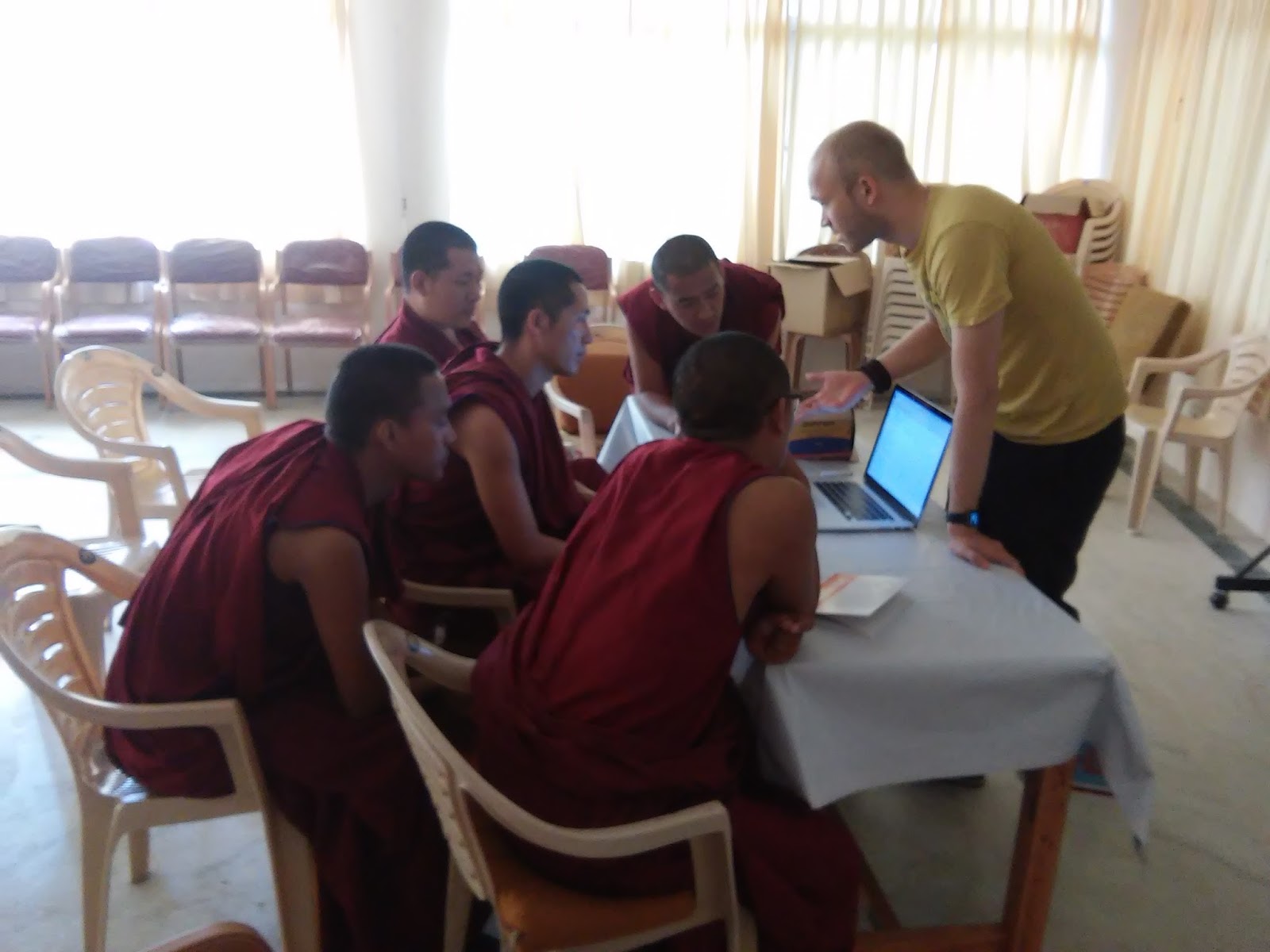
Monks pouring over a computer running JASP in stats class


In addition to spending time on standardizing experiments, we also spent quite a bit of time making predictions with the monks. This was a significant challenge, because obviously monks do not have the same space of possibilities in their heads that we Western scientists do (e.g., things either differ in their magnitude or there is a linear or non-linear relation between them). The monks found it a challenge to make predictions--maybe because guessing is not really encouraged in monastic debate you are drilled to be absolutely certain of what you are talking about (and in predictions you can never be). Nevertheless, we managed to get some predictions, and at least some of the EEG predictions were actually borne out! This is always a major happy moment for a scientist.

monks getting ready for EEG
Of course predictions are not always borne out, and we are also still sorting through a lot of confusing data that we still have to make sense of. Actually, the hard part of doing psychological science is that when you present a person with a task, quite often do they behave in quite a different way than we expected. This is mostly because the tasks we use to learn about the mind are really mostly geared towards Western college students (see this paper for a great discussion of that issue). As we slowly see all these interpretations of the tasks happen, we develop more appropriate instructions, and hopefully in the future also new tasks that are made more for our target population. As a first step in preparing for this, we held a methods and statistics class, which was actually met with tremendous enthusiasm: almost the whole monastic core team showed up voluntarily for this class on their free day! We had a lot of fun talking about t-tests, anovas and different kinds of variables, and we even played around with Bayes Factors in JASP!

This trip also was one of lots and lots of discussions. Actually one of the things that became obvious to me this time around is that the most insightful discussions actually happen when you are working one-on-one, not when having a large group discussion. For example, I spent a good amount of time sitting with my monk-colleagues to translate the debates (well, they translated, I wrote down the translations). In the course of this process I learnt a lot of tricks that happen while debating, such as interpreting a question differently when you do not know the answer to this question.
behavioural testing in action

This time we also met for the first time some Western monks studying at Sera Jey. Both with them, and with some members of our monastic collaborator team who studied in the West, I had some really interesting conversations about how monastic university training differs from Western university training. One thing that differs is the extent to which it actually informs how one practises and lives one's life. In addition, the debate training is a tool that is very confrontational: if you do not know something in great detail then there is no place to hide. This has as a result that you learn to really understand things in depth, but probably also that you build up quite an emotional resilience to being continually challenged. In short, it was a very illuminating visit, and such a precious chance to get to hang out in the peaceful monastery environment and the amazing group of monastic collaborators!
Last but not least: our study was featured in the Times of India!

Sunday, April 23, 2017

What happens when you try to transplant cognitive science to a Tibetan monastery

After a short night on the plane from Frankfurt to Bangalore, and a long drive to the monastery, we arrived safe and sound from hustling and bustling in India to the quaintness of a Tibetan monastery. Our mission? Trying to learn about the effects of the debating that Tibetan monks engage in on their cognitive and emotional functioning. But (obviously) none of it was as easy as that may sound.
cow in front of Sera Jey's science centre, where we conducted our studies

a visit by NIMHANS scientists


Doing research in India reminds you of how we take so many things for granted: drinkable water flowing from the tap, warm water to take a shower, steady internet, and electricity. The first few days, internet was mostly absent and electricity was intermittent. This meant we were really coding like monkeys, because apart from talking to our monastic collaborators, there was no distraction! We had brought a few tasks that we routinely use in our laboratories to study logical reasoning, working memory, and decentering (this is the ability to realize that your thoughts are just thoughts, and then to step outside a train of thought). We thought that translating the tasks and their instructions would be quite trivial, since it mostly involved common words like 'shoebox' and 'baseball bat.' But of course, shoeboxes and baseball bats are actually not that common in a Tibetan monastery! So we had to had long conversations about what the best Tibetan equivalent for a particular word would be. This really makes you realize how western-centric the psychology tasks that we normally use are! Another example of that came up in a working memory task that we use, in which you have to intersperse memorizing a visual object and making decisions about words. As it turns out, monks are really not used to doing two things at the same time (or maybe we should say: Westerners are chronic multitaskers). So is this actually a good measurement of working memory?

a testing session in action (with a visiting dog)
But doing research in India is not only being a crazy coding monkey: relationships with people are also very important. We received a visit from Prof. Shantala Hegde and Shivarama Varambally from the prestigious National Institutes of Mental Health And Neuroscience in Bangalore. They gave talks to the monastic core team about their work on how music affects emotions, and what goes wrong in patients with schizophrenia. And imagine, the tasks had to be improvised without slides because we still had no power! Nevertheless, we had a wonderful time together and learned a lot. We also were invited by the abbott of the monastery. What was very exciting was that some of the monastic collaborators actually presented the data and graphs single-handedly to the abbott, who was very inspired, and gave his blessing to the project. Not unimportant for a project that takes place at a monastery...

After a few days, and lots of struggles with Tibetan fonts, we got the tasks to show up on the little tablets we brought and we were able to start testing (victory!). We started doing our usual thing: trying to rush through the tasks to get in as much data as possible. However, this just doesn't work for the monks. As we slowed down, we realized the process was much more pleasant for everyone (and much more informative!) if we took a break after every task and asked the monks about their experience in doing the tasks--what worked, what didn't, whether it was related to things do would do in their debating or analytical meditation practice, and so on. We also quickly discovered the meaning of "Indian time"--groups of monks could show up 15, 30, 45, or even 60 minutes late! On the other hand, it is also quite rewarding when your participants tell you that a boring task is "good mind training." Even more rewarding was the fact that our monastic collaborators really manifested and single-handedly took charge of the testing sessions.
Monks taking charge of the testing sessions!

Altogether, it was a wonderful gift to hang out with my monastic collaborators once again. They are some of the most kind, funny, and joyful people I know. Quite illustrative for this was Easter, which fell in the period that we were visiting to conduct some studies. My collaborator Amir and I hid some chocolate easter eggs, and the monks playfully went around searching for them, and even rehiding some of them after they had found them!

Monday, January 30, 2017

A new way of dieting or other habit changes: quantifying your wants

There is a cool new research project called qwantify.org in which some of my friends from the Mind and Life Institute participate. The project seeks to investigate what people think about and want and how those things influence each other. They do this study by means of a smartphone app, which everyone with a smartphone can download and try out. I downloaded it and have found it very insightful.

I often find myself wanting things, ranging from food to consuming media to--in fact--consuming anything. The app prompts you to investigate these wants. A few times a day, it buzzes you and asks you whether you want anything, a question that is immediately followed by questions like: how do you want to feel? (e.g., accomplished, comfortable, connected...).This is fascinating because it draws the connection between what you want immediately and why you might want that. For example, often I may want to check the twitter or consume other media. But why? Do I want to feel comfortable? Connected? Or actually, is feeling accomplished more important? If so, is social media the best thing to want right now? The app also asks you about your emotions and your social situation. For example, it asks you whether you feel content, angry, etc. It also asks you whether there are currently people around you, and whether you are interacting with them. Do you want more things when you are by yourself, or when with others?

After you have filled out a few prompts, the app starts to give you charts that index many different aspects of your behavior. For example, I found out that apparently, I am a pretty happy person, because my predominant emotions are content and happy. Also, want things more when I am alone than when I am with others. This makes sense to me, since when I am with others my mind is sufficiently occupied that I don't really need much more. Moreover, I want things more badly when I am in a bad mood compared to when I am in a good mood. Overall, I am pretty amazing that there are even such patterns in my own data. Quite interesting.

Most importantly, the app drew my attention to the kinds of choices I make in my life. Normally, when I want things, I unquestioningly follow those impulses (or resist them), but I don't investigate what is behind them, or whether they actually make me feel better. As a result of working with the app for a few days, I became more aware of what impulses make me really happy. For example, creating things and accomplishing things for others is what makes me happy, while my wants are usually quite the opposite: consuming things (mostly food and media). So, if I take a moment to reflect, I could actually become happier by following the longer-term goals of creating things for other people rather than simply following my mindless impulses... Do you want to try it out as well (and help science along the way)?

Tuesday, November 29, 2016

One trick for slowing down: study Tibetan monks in India

I previously blogged about my study of monastic debate in Tibetan monks in India. Last July I returned for another research visit. It was very exciting to get to go back to these wonderful, cheery individuals. While the purpose of our first visit was just to try things out and come up with a model of what the monastic debate that these monks do might be, this time it was a matter of getting down to business and actually collecting data.


I spent the first few days of this trip in Bangalore, networking with scientific colleagues. One of the places I visited was NIMHANS, a premier mental health institution and research facility. What was very notable was that unlike in institutions in the West, here the care was not just taking into account the patient, but also his/her family. This meant that the complex had big parks and gardens where whole families could just hang out with the patient. Moreover, conventional scientific approaches to mental health were sisterly placed next to ayurvedic approaches. Similar to in the West, there was substantial interest in meditation interventions, and scientists with labs studying the basic science of, for example, decision making, often also have a research program on meditation. It was really interesting to see how things that we in the West tend to think of as separate are here were much more integrated.

Once my American colleagues arrived, we drove to Bylakuppe, the Tibetan settlement where Sera Jey monastery is. We stayed in the very quiet guest house, which has a lovely garden with tea stall. Unlike our previous visit, nothing was going on at this time, and the place looked deserted. The only thing that was busy was...us! I had made an ambitious schedule for running behavioral studies, EEG studies, and discussions. Due to some poor preparation, I was still finishing programming tasks on a tablet (it's really cool that OpenSesame allows you to program tasks that just run on a tablet!). Consequently, I was totally absorbed in my laptop, instead of hanging out with the monks. And actually, for doing research in India... this is the most crucial thing! Research in India does not primarily proceed by making a tight schedule and squeezing in as much as possible, but rather by hanging out and being in touch with what happens. Only then can you see what is really happening, and can the monks feel comfortable to approach you and share their wisdom and ideas. So, once we realized this, we actually consciously slowed down.

In the West, we are used to just showing an undergrad into a cubicle with a testing computer, letting them do the task, pay them, and get them out again. With the monks, we actually first leisurely introduced ourselves, explained why we thought their method of debating was interesting, then started with an experiment, showing how the experiment worked slowly, and afterwards had a nice chat about science, monk life, consciousness, world peace, and more. We learnt a lot, and I think the monks did so too. One important lesson was that what we find simple in using a computer may not be as simple for a monk who rarely uses one. Tasks that we administered on a tablet seemed much easier than tasks administered on a laptop. And the younger monks seemed to find the computer tasks much easier than the older monks. Something to think about in our next studies...

On the last day we were once again reminded of slowing down. While we were walking to a place to have lunch, one of the dogs that was following us around got hit by a car, ran off howling to the side of the road and died. One of those moments that brings the reality of life and death quite up close. Somehow it really touched our hearts very deeply as we watched but could not do anything. A precious reminder that life is much too short to squander it being busy doing lots of things without being present to what is.
(also posted on http://radicallyhappy.org/blog/2016/11/28/one-trick-for-slowing-down-study-tibetan-monks-in-india)