Showing posts with label flipping the classroom. Show all posts

Tuesday, December 08, 2020

Step-by-step tips on how to transform your course for online teaching

Like the rest of the world, I am teaching online these days. While my first online teaching back in April was mostly just a repeat of the normal courses in an online format, I decided to completely restructure my course Data Analytics & Communication for the current quarter, to make it more amenable to online teaching. Thanks to a wonderful course by our Education Support and Innovation (shoutout to Tracy Poelzer!), it was actually much less intimidating than expected.


The first thing I did to transform the course to an online format was to divide it up into online folders corresponding to the course weeks, and within every week a series of steps. To make this insightful, I plotted all the steps into a jamboard. This allowed me to quickly keep track of the different components of my course. Every week starts with a short welcome video in which I explain the students what the week is about. I make these videos in loom, a very easy to use video recording program.

Sample screen shot from my course environment with the folders belonging to the weeks on the left bottom and some of the first steps in the centre.


Because this covid time is very hard for everyone, I decided to provide my students with maximal flexibility by only having a single lecture every week. All the other lecture material consists of pre-recorded mini-lectures on loom. So every week I go through my original course lectures, extract the main topics, and make a 5-10 minute video on each topic (see for example this video on reproducibility versus replicability). I can reuse most of my slides because loom allows you to present the slides while you talk. I then link all these videos to Blackboard, which hosts the course. The added benefit of this is that loom records the number of views of each video, so I get a sense of how many students are following the lectures.

I have transformed the live lecture substantially to centre around student interaction. Again, I use the topics I identified from my original lectures to come up with classroom activities. These activities can include a poll. Typically I start the class off with a fun icebreaker poll, for example asking the students to pin a needle on a map indicating where they are listening in from. Another popular activity is putting students into breakout rooms of 4 or 5 and discussing a question or having a debate. I then ask about the outcomes of this debate using a fun website called Wheel of Names, in which I insert the group numbers to randomly choose a group to report. Another popular tool is to ask students to brainstorm together on a jamboard, for example, "what is your advice for producing good graphics?", which requires the students to mobilise all their knowledge from the lectures, the course readings and their own experience. A final fun lecture activity is to invite an expert on a topic (e.g., who has written a paper the students have read) and hold a kind of talkshow in which I as a lecturer moderate the discussion (in this case a good source of questions were the comments made by the students on the social reading platform Perusall that I use in my course).

A final change I made to the online course is to make the tutorials more explicitly social. Rather than them being just an education activity, I also invite students to come to the tutorials to have a chat with each other or with the teaching assistants. Rather than having the tutorials within the Blackboard environment, we moved them to gather.town, a fun online environment that kind of looks like an old computer game. In this environment, you only see and hear individuals when you are sufficiently close to them, kind of like in the real world. This would allow students to naturally work together on assignments, and walk up to the teaching assistant if they have questions. There are even some games to play in this environment created by my awesome colleague Martijn Wieling!

Screenshot from the gather.town environment


Of course a big challenge is the final exam. When students do final exams online you have to assume that they have all information available and communicate with each other through the class WhatsApp. Consequently, I decided to make my exam, which usually involves knowledge questions about the material and interpretation of data analyses, to be about the actual analysis of real-life datasets. Different students get assigned different datasets and answer different questions about these datasets. Hopefully this will make the exam fair and also a good reflection of the students' knowledge and skills. And most importantly, prepare them well to do data analysis and interpretation in the real world. 

Sunday, August 16, 2020

Exploring together-apart mind and reality in times of COVID-19

Last week I attended the European Mind and Life Summer Research Institute. I have been lucky enough to attend many such events over the course of my career, and it is safe to say they have shaped my career as a contemplative scientist. During these Summer Research Institutes, scientists and contemplatives get together to discuss about issues in the field of contemplative science, but also do a lot of contemplation themselves. Unsurprisingly, this year's edition took place online.

I was not sure how an online version of this event would work out, but I was pleasantly surprised at the amount of connection that I felt with the other attendees. This was achieved by some quite inventive meeting formats. Before the meeting itself, the faculty had recorded brief (20-30 min) lectures that you could watch and ask questions about. These questions were collected on a board that allowed for upvoting of your favorite questions. Participants who presented posters had submitted PDFs and 2-minute video presentations of their posters and all gotten a Slack channel to discuss these posters during the meeting. Every day of the meeting started with contemplative practices: a choice of meditation, and a choice between chi gong, yoga and juggling. I ended up mostly not following those but taking a ballet class instead. After that, the first session was a plenary meeting with the faculty in which they briefly recapped the essence of their talks, followed by a panel discussion, partly driven by the submitted questions. There was also a brief period in which we were put in breakout rooms to discuss possible questions to ask. I must confess that during most of these sessions I ended up instead just talking to the others about their fascinating work! In the afternoons, we then had breakout groups with the day's speakers in which we discussed a bit more deeply. Before that, we would often have a fun activity, for example answering a question with one word on mentimeter that then transformed into a word cloud. The afternoon ended by bringing everyone back together with reports from the breakout groups and more general discussion. As the week progressed, there were also more and more self-organized zoom meetings for discussions and chats. As usual, there was a much-needed silent meditation day in the middle of the week which also featured a teaching by Mingyur Rinpoche, who talked about his wandering retreat and meditation in general.

Now the contents of the meeting. We started the first day by talking about perception: how do we derive knowledge from the world? This questions was approached from neuroscientific, philosophical and contemplative directions. Michel Bitbol for example argued that our experience of the world is just the part we need, which is an optimal way to perceive the world, but we should remember that that is not reality. There were many discussions about how we continuously make up stories about the world, and then confuse them for reality. Yet even if science is just another story, Michel Bitbol argued that it is a very efficient way towards knowledge, for example in the case of a search for a COVID-19 vaccine.

The second day was dedicated to interoception and emotions. Holger Yeshe talked about how the Buddhist teachings give us tools to investigate where our suffering, and our negative emotions (which are the source of this suffering) come from. Micah Allen talked about interoception--the feeling of our body from the inside, and argued that many psychiatric disorders are accompanied by problems in interoception. There have been claims that meditation improves interoception, but the evidence for this is not unequivocal. He also argued that we need more replication in the field of meditation reserarch and called for a Many Labs experiment in this field. I fully agree, and I am working on a project to work towards that! On a more poetic note, Giovanna Colombetti argued that emotions are not a feeling of the body but a feeling through the body. A lot to think about!


Thursday was dedicated to embodying knowledge. All too often, we think that knowledge is just in our heads, but dancers will know that you can also know and investigate through the body--a perspective that was also shown by Asaf Bachrach and Hsuan-Hsiu Hung. Asaf Bachrach showed an intriguing experiment in which people were moving in virtual reality, where he found that people felt very calm, and he noticed that when people moved slowly, they felt more together than when moving quickly. Despite the wisdom there is to be found in movement, Guiseppe Pagnoni argued that by keeping body and mind still during meditation practice, you can detect changes in the body-mind complex with much greater precision, which affords you to be less enslaved in your habits.

The last day was dedicated to artificial intelligence. Luisa Damiano argued that in addition to the empirical cycle of scientific research, we need the synthetic cycle in which we simulate the world and explore the world in-silico. Father Tiso discussed how artificial intelligence allows us to appreciate the sphere of interconnected minds through the internet (as was indeed happening there and then during the summer research institute!). Venerable Aileen Barry summed up the Ai day very beautifully by arguing that behind every AI there is a human, and a motivation, and we should watch this motivation.

Altogether, the ESRI was a very rich and beautiful exploration of what it means to know, and what it means to connect as humans--through technology. My head was spinning by the end, and there was as always too little time to explore this richness in ideas, but it was definitely a beautiful experience. And now it is time to take that wonder into my own retreat.

Monday, December 04, 2017

More ideas for activating students, and: should we do that?

Today I had the second installment of the course Flipping the Classroom by Ine Noben of the University of Groningen. It gave me a lot more ideas for activating my students, but also stimulated some interesting thoughts about how we organize our education.
getting creative with lesson design


First, in terms of the ideas: we started with an interesting activity called "concept map", in which you draw a concept map about a topic (in this case the previous lecture), which was a good way to see what we remembered about the previous meeting. We then retrieved even more memories of the previous meeting by "crowdsourcing", in which we walked up to another person in the class, explained the maps to each other, and then exchanged them. When we received them, we scored them on a scale from one to five, and moved on to another person with the new map we got. We continued this a few times and got to see quite a few concept maps. Quite a fun activity!

Another thing we learnt was that it's important to think about how to engage *all* students. That made me realize that when I have some students give presentations, then the others typically disengage and start to play with their phones (or even enter the lecture late). I came up with the idea of asking students to draw a concept map of the presentation and hand it back to me as an 'exit ticket' at the end of class (added benefit: you get a reading of who is present in the class at the same time). Alternatively, I could ask students to write down comments, or things that are incorrect about the presentation, or I could ask them to come up with an exam question about the presentation. Lots of interesting options!

A third interesting activity is having students engage in a debate, where they are randomly assigned to diametrically opposite positions. They have to write a paper about the topic before the class (so they come prepared), and then a subset of students are chosen to debate in class. Of course you have to make sure that all students engage, so you could switch out students at random moment (I can imagine you can make this pretty fun with some weird bell to indicate it's switching time!).

Rink Hoekstra came to share his experiences with the flipped classroom, which he started with the critical note that the flipped classroom is really nothing new, just a repackaging of the older concept of "active learning." He had been experimenting with the flipped classroom (or active learning) and made the interesting observation that students tended to skip the lectures once he provided pre-recorded video lectures because they felt they already knew the information from the video lecture (so what's the point of coming to class?).

We also had some good discussions about whether these active learning forms are not too much like high school. And do they not play too much into the students' extrinsic motivation? On the other hand, how else do you get most students to engage from week 1? An interesting observation by another colleague in this respect was that students really like to see progress, so giving them some form of feedback is crucial.

Finally, we learnt about how video can be a cool tool in the classroom. I am not too excited about recording myself for video lectures, but two things can be very helpful. First, there is a tool called

Monday, November 20, 2017

Activating students: some more tools

Today I took a course about flipping the classroom. Flipping the classroom refers to the idea that students listen to video lectures before class while the teacher helps them with exercises during class (instead of the lecture being spent delivering a lecture while students have to do their homework at home). The most important idea here is that flipping the classroom allows the students to be more active and allows the teacher to help the students where they need help most: to elucidate misunderstandings. In a course by Ine Noben I got some of the following ideas:
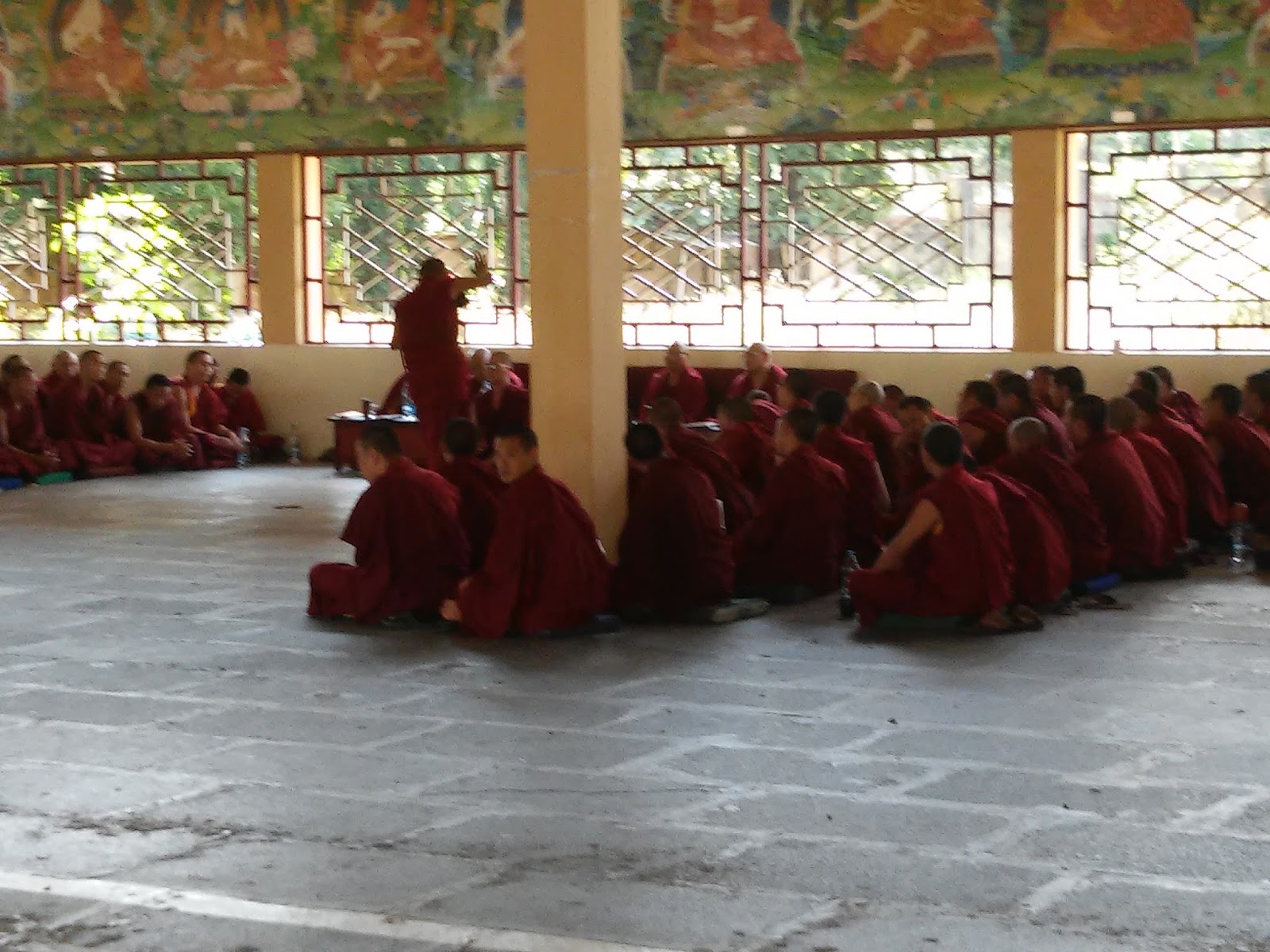
Another way to activate students practised for hundreds of years in Tibetan monasteries: requiring them to debate  in pairs while peers are looking on and with large physical gestures.
  1. Get everyone active with 1-2-4-all: students think about a question first alone, then share in pairs, then they share insights with a neighbouring pair and finally you discuss it in the big classroom. Another colleague mentioned that when students are forced to discuss in groups of 4, almost all of them will do some work (because there will always be some active students in the group), especially if you walk around to check on them.
  2. It is important to focus your lecture well, because as H. Simon said "a wealth of information creates a poverty of attention"
  3. A nice blog about peer instruction, with among others a nice series of blogs on why flipped classrooms fail. One thing that can make your flipped classroom fail is if you require students to do all kinds of work, but do not actually give feedback about this work. Another thing that can make your flipped classroom fail is when there are no consequences when students do not do the work, or when students are not clear on what their and your responsiblities are in the classroom. Useful case in point: it's helpful to spell out what you mean by "active participation" in the classroom. I will definitely try this out in my classroom.
  4. Nice platforms for creating online course content: FutureLearn and Google Classrooms. Both allow you to create very nice-looking course materials. Google classroom has the advantage it nicely integrates with googledocs for marking up assignments and things like that. Google classroom also makes it easy to grade with a rubric.
  5. A nice empirical investigation of the flipped classroom: article
  6. Tools for doing online voting: Socrative (allows you to also setup competitions in which teams try to answer as many quiz questions together as possible), mentimeter (allows you to easily vote on single questions and display the results interactively)
  7. A website with active activities: https://compass.itcilo.org as well as a book with game-like activities: Game Storming
  8. If you make quizzes for students to do before class, make sure you give useful feedback, e.g., "go back to section 11.3 of the book"
  9. Tools to make videos: for making screencasts: https://screencast-o-matic.com (e.g., to explain using some data analysis software), or to make cool animated videos/cartoons: https://www.powtoon.com/home/
  10. Another cool tool is "ticket to class"--make sure students do some activity beforehand to earn their ticket to class. One tool I like a lot is Perusall, in which students collaboratively read textbooks or articles. You could also use an exit ticket in which students can only exit the room if they hand in a piece of paper with the answer to a question such as: what is the question still remaining after this class? Name three things that can improve science? Etc (if you require students to add their name to this you immediately have a handy tool to keep attendance).
  11. A very effective tool to get students who are doing poorly back engaged is to find out who is not engaged with learning analytics (checking Blackboard for example) and then sending them a personal e-mail asking why they are not submitting assignments/not showing up etc.
  12. Nice database with exercises for physics, math etc: sowiso
  13. Tool to allow students to make collages of course-relevant information and comment on that (like a kind of instagram): padlet

Sunday, February 05, 2017

How to activate students? Ideas for juicing up your teaching

me teaching during the Artificial Intelligence teacher of the year award ceremony. Picture by Niels Taatgen.
I recently attended a workshop at my university about innovations in teaching. There were several ideas that I thought were useful, so I decided to blog about them. Firstly, I attended a workshop on MOOCs by Tom Spits. There are more and more MOOCs. You can actually use those MOOCs to complement your classroom teaching. For example, you can use them in the flipped classroom: students watch the MOOC at home and then you spend the time in the classroom doing assignments and discussing difficult points. I think this makes a lot of sense, because sometimes lectures on MOOCs are excellent, and why would you waste your own time and effort on that? For example, I found this MOOC on methods and statistics excellent. I may actually refer students to that for some components of my Research Methods class. This could be also helpful for students who need a bit more explanation or background information. The only thing you have to watch out for is MOOCs taking place asynchronously with your class, so that students are not able to sign up and watch the lectures.

MOOCs can also be a helpful source of assignments. Of course you should check this with the MOOC teacher, but reusing some of these assignments can save you a lot of time (given that creating assignments takes *a lot* of time...). Moreover, many of these assignments even give automatic feedback, which can help students to practise the material well. Another potential use of MOOCs could be to remedy deficiencies. For example, in a multidisciplinary field like Artificial Intelligence, some students are weak on programming, others on psychology or machine learning. There are plenty of MOOCs in all these areas that students can do to remedy these deficiencies. Advantage of MOOCs over regular university courses is that they can be done at your own pace, and in your own time.

A significant challenge with MOOCs is finding the right one. One place to start is a MOOC search engine: moocse. There are also websites with reviews of MOOCs, e.g., class central. And of course you can follow your favorite academics on twitter and find out when they are teaching a MOOC.

Another teaching innovation are learning communities. mentimeter in the lecture to keep students engaged. And finally, a very simple thing you can do to have students take charge of their learning is to provide lecture slides before the lecture so that students can click links and explore during the lecture (of course this is also tricky, since it may be very distracting for the students...).

In summary, I got quite a few new ideas for enhancing active learning in my classroom. I am planning to check some of these ideas out in the next few weeks, when I am starting to teach again.

Sunday, January 31, 2016

How can we get students actively engaged in learning? (report from a workshop I attended)

A few days ago I attended a symposium about promoting active learning organized by my university. Here are some of the things I learnt. There is a lot of interest currently in "flipping the classroom". We learnt that a new tool that is available to make flipping the classroom a little easier is Perusall. When you add your PDF to this system, students can annotate it collaboratively and ask questions. You will then be provided with a report, so you can adjust your teaching to the student's questions. With some magical algorithm, the system is also able to grade the quality of the students' comments, although I am a little suspicious of that, I must say.

Luckily there are also quite a few non-electronic ideas to "wake up" your students, which I picked up in a workshop by Jasmijn Bloemert. A good start of a lesson is to ask students what they hope to get out of it, and to write it down. Asking the student to think about their objective directs their attention away from the preceding events and towards the learning that will take place in the classroom. Moreover, it creates a sort of contract that they can go back to, to check whether they are getting out of the class what they want to. Writing things down is helpful because it makes the intentions more real than just holding them in your mind.

Lectures often consist of a lot of dense material. To help the student navigate that, it is often useful to give them a question that they need to find the answer to. In that way, they have a target to keep track of. You can alternatively ask them to come up with question about what they just heard, or simply to compare notes with a fellow classmate.
here I am attending a different workshop on teaching, a few years ago, at the UOGC (University of Groningen Teachers Education Centre)

Frequently students don't speak up for fear of making mistakes. To get them to speak up, you can ask them questions that do not have right or wrong answers, such as "how do you feel about this? Is it positive or negative for you? Another good trick to draw out people's interest is to show them a puzzling picture (or quote, or other type of material) and ask them to guess what it is or what it means. In a similar vein, you could show two "things" (e.g., pictures) on the screen and ask students to find the differences.I guess this will be hard for the course Research Methods that I will soon be teaching, but it may work well for courses that involve more concrete "things."

Teaching the reading of difficult material can also be made more social by asking students to underline the most important sentences of a passage, and then asking them to compare notes on what was underlined, and finally to come up with a summary of the text in one sentence. Doing this really helps you to find the essence of a text. I may try this out with research papers in one class where I read the primary literature with students. It is often difficult for them to draw out the essence of a paper, and this exercise may help them to develop this "helicopter view" of the material.

Finally, there was an interesting method used often in America called "teachers teach." At some random moment in the lecture, the lecturer claps their hands three times, and students have to immediately teach each other what they just heard. It is a very high energy method, but kind of fun, and encourages students to think on their feet (if they are willing to do it, of course). Altogether, I acquired some fun ideas in this workshop. I will definitely try out some of these in my upcoming classes.