Showing posts with label teaching. Show all posts

Tuesday, January 02, 2024

My favourite podcasts about ballet and contemplation

Now for a more practical blog: what podcasts would I recommend? I have started to listen to quite a few podcasts that inspire me a lot! Many of them are about ballet, kind of obviously ;-) But I think also the ballet ones teach me quite a bit about life in general. Let me walk through my current facvourites, sorted by topic:

Picture  by Michel Le Photography 
at Morlaix Ballet camp

Contemplation

- Mind & Life podcast (I was super-honoured to be featured on this one myself!) in which people are interviewed that work on the intersection of research and contemplative practice. I find these always such fascinating conversations!

- Open Question by Elisabeth Mattis-Namgyel, an amazing Buddhist teacher who presents a no-nonsense approach to asking deep questions in life

- The kind heartfulness podcast by Gomde Austria, an interesting series of conversations with Buddhist teachers and practitioners.


Ballet

- A dancer's mindset by Isabella McGuire, who talks about the mindset that is required to be successful at anything, but especially from the perspective of ballet. Lots of good advice, although I don't always agree with everything. I think she forgets that not everything can be controlled

- Athletistry by Shane Wuerthner, another ballet mindset podcast, which is also useful to anyone engaged in a difficult pursuit, such as academia

- Ballet Rising by Casey Herd: fascinating stories about people trying to bring ballet to the communities that not always get access to it, e.g., ballet in India and Africa

- Hard Corps podcast by Romee Adair, who talks with guests about the general dance industry and especially challenges within it. It's fascinating to learn more about how the dance industry works.

- The adult ballet studio by Elisabeth Blosfield, a series of conversations with people trying to make a space for amateur adult ballet dancers. So inspiring!

- The balanced ballerinas podcast by Georgia Dostal, a series of interviews with so many amazing people in the dance world. Again, so many interesting things to learn!

- Artists Becoming, another series of conversations with dance professionals, but this one is specifically focused on bringing out the artists, and challenges to that

- Moving Moments by Alicia Graf Mack: more conversations with dance arists. I just love hearing the person behind the dance artist!

- The turning: Room of Mirrors: a really interesting deep dive into the ballet choreographer Georges Balanchine. Very interesting although this one is a bit on the sensationalist side

- Broche banter by Julie Gill/Leung: all things adult ballet, including interviews with adult amateur ballet dancers. Lots of insightful stuff about how adults learn ballet


Academia

- Degrees of freedom by  Tassos Sarampalis and Marcello Seri: lots of philosophy and practical tips about teaching in academia.


I hope some of these are inspiring to you, and maybe you find some new ones to listen to!

Sunday, August 15, 2021

How Iceland made me lose my computer but find a way to think through movement and dance

In the past week I attended a summer school on embodied critical thinking, which is part of an Erasmus project in which I am a member. It was a remarkable experience, in which I found new ways to connect the part of myself that is a dancer with the part of myself that is an academic. Moreover, it was my first travel outside the country since Covid-19 hit. The summer school took place in the beautiful country of Iceland, a place where I had never been before. The nature and culture of Iceland were awe-inspiring, which very much complemented the power of the summer school. So what is embodied critical thinking? 


This is a method used--Thinking at the Edge--was developed by a philosopher by the name of Eugene Gendlin, who felt that thinking should not just be in the head but also make use of the wisdom of the body. This is probably something we all use to some extent--when we have a "gut feeling"--but we are never too conscious of it. In thinking at the Edge, you bring your attention to it, and you take the time and space to explore what your body has to say. By doing this, you can often find surprising things. I think the reason it's called "critical thinking" is that it does not take the meaning of concepts as a given, but instead invites you to further explore what concepts may have as hidden meanings, and to inform them with your life experiences to find new connections. An important question that is often being asked is "is there more?", and this is particularly asked when you observe a bodily reaction. As such, the practice demands a lot of tuning into the body. Thinking at the edge consists of a series of 12 steps-exercises if you will, that allow you to investigate the topic you want to think about from many different angles and in many different ways. A very important concept is the "felt sense", which is the feeling in your body of you consider the thing you are thinking about. Rather than paying attention to whether the words are intellectually "correct", one asks whether the words evoke the right feeling, or image. Because of the focus on imagery, there is a possibility to explore new meanings of the topic we are thinking about. This is further expanded on by going over your notes again and again to deepen your understanding.

In my case, I chose to focus on the topic of what embodied critical thinking is and how we can understand it from a cognitive perspective. Rather than going straight into conceptual thinking, the process allowed me to investigate the feeling dimension of this question, which was very interesting and surprising (one of the sentences I wrote, for example, is "the fabric of the spiderweb is space"). A lot of work is done with a partner, who listens to you (usually for luxurious amounts of time, such as 30-40 minutes) and helps you clarify your thinking, but also brings your attention to the bodily dimension. For example, they may say that they noticed that you really started to physically connect to and make lots of gestures when you came to a particular point. To facilitate this process, there was lots of time for silence, and an absence of judgment. The week started even with the announcement that we did not need to feel like we needed to produce something in this time. To further facilitate this, we were also encouraged to do a lot of writing on paper, journalling and carefully writing down what our partner said, and to let go of our computer (more about that in a little bit). I helped out a bit by guiding some movement exercises to help people connect their body and literally dance with their ideas. It was such a gift to be in this caring and spacious environment for a week!
watching the view at the Blue Lagoon site (the blue comes from the silica in the water). Picture by Dorothe Bach)
On top of the exercises from the twelve-step process we went through, we also had various excursions in which we connected to the magnificent nature of Iceland. During my bicycle tour on the first day, I learnt that Iceland is called the land of fire and ice, and its landscapes are largely shaped by volcanic activity. This roughness and wildness yields a very dramatic and awe-inspiring landscape, which helped me to drop the self-focus a bit and instead just be. Moreover, the rocks and volcanoes just have so much space! A further daily connection to nature was provided by the hot springs--just like the Icelandic people I went to the hot pools every day (water comes up right from the ground and is then captured in pools that are spread all across the city of Reykjavik where we stayed). I feel that as you go in the water at the various temperatures (switching between hot and cold baths) it is such a good way to connect to your body and feel what it needs.
being in awe with the volcano behind me (picture by Dorothe Bach)
Now the disconnection from my usual "heady" state in which I am on my computer all the time was further facilitated by an event on the first day, when I was guiding a movement exercise on the beach. We found a beautiful place with lots of rocks to stand on and some grassy patches, and move to the sounds of the wind and the water. I had found a lovely grassy patch to put my laptop bag on while I was guiding the exercise. At the end of the exercise I returned to my back, only to find it standing in a puddle of water, as the tide had been rising while I was--happily unaware--guiding the exercise, standing on a nearby rock. Obviously there was no way I could have any chance at using my computer, since i had to let it dry for at least two days (as I found out from a computer store where I went the next day). And I am writing this on a new computer since sadly my computer never woke up again. The whole episode was a beautiful lesson though, because it made me realize I could actually function without a computer for a little while (especially since a colleague kindly allowed me to use hers for some meetings I needed to do). I was also stunned at my own reaction, which never was one of fear or panic, but simply just ready to go with whatever was. The environment was that spacious! (especially after a few days of vacation that I took in Iceland before the summer school, and especially realizing that an injury is so mch worse).
the place on the coast where I held my movement exercise and my laptop drowned
The last, and very important, lesson from the summer school was that there is a way to bring movement more explicitly into my academic life, and that I have something to offer there. As we went through the twelve-step Thinking at the Edge process, my partner made me realize that expressing through movement and dance, and at the same time being in the academy, is a unique gift I have, which may be of benefit to enrich people's thinking but also strengthen their resilience. So while I started with a project on the cognitive effect of thinking at the edge, I ended up with important realizations about my life and ideas for how to redirect it to bring my dancing and my academic work closer together--a process I started many years ago with Edan Gorlicki in his Unblocked Project.

Tuesday, December 08, 2020

Step-by-step tips on how to transform your course for online teaching

Like the rest of the world, I am teaching online these days. While my first online teaching back in April was mostly just a repeat of the normal courses in an online format, I decided to completely restructure my course Data Analytics & Communication for the current quarter, to make it more amenable to online teaching. Thanks to a wonderful course by our Education Support and Innovation (shoutout to Tracy Poelzer!), it was actually much less intimidating than expected.


The first thing I did to transform the course to an online format was to divide it up into online folders corresponding to the course weeks, and within every week a series of steps. To make this insightful, I plotted all the steps into a jamboard. This allowed me to quickly keep track of the different components of my course. Every week starts with a short welcome video in which I explain the students what the week is about. I make these videos in loom, a very easy to use video recording program.

Sample screen shot from my course environment with the folders belonging to the weeks on the left bottom and some of the first steps in the centre.


Because this covid time is very hard for everyone, I decided to provide my students with maximal flexibility by only having a single lecture every week. All the other lecture material consists of pre-recorded mini-lectures on loom. So every week I go through my original course lectures, extract the main topics, and make a 5-10 minute video on each topic (see for example this video on reproducibility versus replicability). I can reuse most of my slides because loom allows you to present the slides while you talk. I then link all these videos to Blackboard, which hosts the course. The added benefit of this is that loom records the number of views of each video, so I get a sense of how many students are following the lectures.

I have transformed the live lecture substantially to centre around student interaction. Again, I use the topics I identified from my original lectures to come up with classroom activities. These activities can include a poll. Typically I start the class off with a fun icebreaker poll, for example asking the students to pin a needle on a map indicating where they are listening in from. Another popular activity is putting students into breakout rooms of 4 or 5 and discussing a question or having a debate. I then ask about the outcomes of this debate using a fun website called Wheel of Names, in which I insert the group numbers to randomly choose a group to report. Another popular tool is to ask students to brainstorm together on a jamboard, for example, "what is your advice for producing good graphics?", which requires the students to mobilise all their knowledge from the lectures, the course readings and their own experience. A final fun lecture activity is to invite an expert on a topic (e.g., who has written a paper the students have read) and hold a kind of talkshow in which I as a lecturer moderate the discussion (in this case a good source of questions were the comments made by the students on the social reading platform Perusall that I use in my course).

A final change I made to the online course is to make the tutorials more explicitly social. Rather than them being just an education activity, I also invite students to come to the tutorials to have a chat with each other or with the teaching assistants. Rather than having the tutorials within the Blackboard environment, we moved them to gather.town, a fun online environment that kind of looks like an old computer game. In this environment, you only see and hear individuals when you are sufficiently close to them, kind of like in the real world. This would allow students to naturally work together on assignments, and walk up to the teaching assistant if they have questions. There are even some games to play in this environment created by my awesome colleague Martijn Wieling!

Screenshot from the gather.town environment


Of course a big challenge is the final exam. When students do final exams online you have to assume that they have all information available and communicate with each other through the class WhatsApp. Consequently, I decided to make my exam, which usually involves knowledge questions about the material and interpretation of data analyses, to be about the actual analysis of real-life datasets. Different students get assigned different datasets and answer different questions about these datasets. Hopefully this will make the exam fair and also a good reflection of the students' knowledge and skills. And most importantly, prepare them well to do data analysis and interpretation in the real world. 

Tuesday, October 13, 2020

Some tips and tricks for hybrid teaching

As most people, I have been engaging in hybrid teaching in the last months. This is surely challenging, but thankfully our university has quite some support from education professionals to help us rethink our courses. Teaching online is not simply a matter of delivering your lectures through the internet, but rather requires you to rethink the way you teach. And this doesn't have to be bad, and I must say I really enjoy learning new teaching tricks. I am currently participating in a course on Teaching Online taught by Tracy Poeltzer, which is a lot of fun. In this blog I share some of the things I have learnt in the course and in webinars.
Image from the days of giving in-person talks
One of the most important things to think about in teaching online is building connections with the students, because successful learning does not only depend on transferring information successfully, but also requires a human connection. A very simple way to start building connections is before class: being present in the chat about 5-10 minutes before the class starts and welcoming students and asking how they are doing or chatting about the weather is a good start. You can then gauge how students are feeling in the class itself by asking them to respond with an emoji or respond to a question using polling software such as mentimeter or polleverywhere. Another fun icebreaker is to ask students to pin themselves on a map in one of these polling software tools. This is especially useful now students may not be following your course from the same continent as where you are. Then during the class, it's always nice to tell stories. A powerful way ti tell a story is using the word "imagine...". Also analogies can be very powerful, for example teaching during the pandemic is like building a plane while it's flying in the air. This evokes a vivid imagine in the student's mind. Another way of humanizing the course is to use video introductions to get to know each other. A perfect and easy tool for this is flipgrid, in which you can easily make videos and comment on other's videos. Also video or spoken comments can be a nice way to humanize things. Googledocs for example allows you to record comments with google voice, but you can also record video comments with screencastify and loom. These comments have the added advantage that you can share more of your thinking process with the students, which can sometimes be a hekpful learning tool. A final nice tool to humanize the course is to hold an informal coffee shop in which students can drop by to ask questions but also to simply chat or wave to each other. Teaching online also requires you to be much clearer for the students about what is expected of them, and ideally the course has many asynchronous components that students can do at a time that works for them. One model that students seem to like is to make folders for every week of the course, and in those folders to make a series of steps. In that way, students find it easy to keep track of where they are and what they need to do when (someone should build calendar plugins for those!). Then when you get to the lecture, it's good to minimize the amount of frontal talking. You can actually pre-record your lectures in short chunks (or use existing lectures from e.g., TED, coursera etc), and then use class time to discuss these in breakout groups. Breakout groups are great because students really get to know each other. One nice model for breakout groups is to ask students to discuss about questions they want to ask the lecturer in the next plenary session. In that way, students practise asking questions. A very practical tip for the lecture time is to insert a slide that reminds you to press the record button (if you're anything like me and tend to forget to record). As regards discussion, it is helpful to explicitly discuss group norms for interaction, that mention things like kindness, respect etc. The same can also be useful to put in discussion fora, which are very helpful to get students to interact on an asynchronous basis. Finally, it's really important to remember that we are all working from covid brains, so be gentle with yourself as well as with the students. How are you doing with covid teaching? Any tips or tricks?

Monday, September 17, 2018

Happier classrooms - some ideas from the Dalai Lama (and others)

Today His Holiness the Dalai Lama visited the Netherlands to give some talks and lectures. I was fortunate enough to attend one of these, a Buddhist teaching on the Eight Verses for Training the Mind, which is actually a Lojong text as well! In conjunction with this event, Mind and Life Europe also organized a workshop entitled Education of the Heart. In this blog I share some of what I learnt at these meetings.

First the Dalai Lama gave a good tip relevant to those following the #lojongchallenge: if you have a flight delay, read the Eight Verses of Training the Mind text to yourself. Presumably another Lojong text would also do, but the main thing is to use the time for something useful, instead of getting frustrated about the delayed flights. The Dalai Lama also mentioned that you can also acquire a glimpse of the understanding of how phenomena are empty by looking at present-day quantum physics. However, in quantum physics they then go on to state that there is no objective reality at all, which is not in accord with Buddhism, which does assert an objective reality--things do appear--but just not in the way we usually perceive it. He ended by mentioning that the teachings on emptiness can really help to free the mind, because they reduce the self-centredness that causes anxiety and anger and ruin our health.


So how can we train in these skills? For this we need education. Sander Tideman mentioned that in a previous Education of the Heart meeting, one important point was that compassion is not just empathy but involves critical thinking as well. Just like His Holiness the Dalai Lama, he mentioned how compassion and warm-heartedness can overcome stress and anxiety. Geshe Lobsang Tenzin Negi from Emory University talked about the Social Emotional and Ethical Learning program they have developed at Emory University tries to implement the vision of His Holiness the Dalai Lama from his books on secular ethics (e.g., Ethics for the New Millenium) into a curriculum, which so far focuses on K-12. The curriculum includes attention training, compassion and care, systems awareness (becoming aware of the larger context of which you are a part), and ethical engagement. Crucial in this is that teachers embody these skills themselves. The program includes a lot of scientific perspectives as well as reflective practices such as journaling. Early findings suggest the program results in more self-compassion, a calmer classroom and better prosocial skills.

Also in higher education there are some initiatives. Rob van Tulder described his work in bringing the heart into the business school of the Erasmus University of Rotterdam. He shared an inspiring quote of how rare it is to find people with a cool head, even rarer those with a warm heart, and the rarest of all are those who use the warmth of their heart to keep their head cool. Quite an inspiring quote! He mentioned how more of these ideas are worked out in his book Skill sheets which I have not had the chance to check out. Nevertheless, one important challenge they are facing is distraction by too much information, social media, etc. I agree that this is a challenge. I think this is where structural teaching of mindfulness practices could be useful, because they could help people to acquire a sense of meta-awareness of where their attention is.

Finally, Katherine Weare presented the new initiative of the Contemplative Education hub of Mind & Life Europe, because there are many initiatives on contemplative education, but little coordination. Such coordination could allow the different initiatives to learn from each other, but also in advocacy on a societal level, and to deal with challenges such as "how to incorporate the wisdom traditions in an authentic way, yet remain open to people of all religious and non-religious backgrounds?" She ended on a happy note, reminding us that true mindfulness is not only a path to happiness, but happiness is this moment. Maybe contemplative education can help us to build happier schools, and universities. Wouldn't that be marvellous?

Monday, December 04, 2017

More ideas for activating students, and: should we do that?

Today I had the second installment of the course Flipping the Classroom by Ine Noben of the University of Groningen. It gave me a lot more ideas for activating my students, but also stimulated some interesting thoughts about how we organize our education.
getting creative with lesson design


First, in terms of the ideas: we started with an interesting activity called "concept map", in which you draw a concept map about a topic (in this case the previous lecture), which was a good way to see what we remembered about the previous meeting. We then retrieved even more memories of the previous meeting by "crowdsourcing", in which we walked up to another person in the class, explained the maps to each other, and then exchanged them. When we received them, we scored them on a scale from one to five, and moved on to another person with the new map we got. We continued this a few times and got to see quite a few concept maps. Quite a fun activity!

Another thing we learnt was that it's important to think about how to engage *all* students. That made me realize that when I have some students give presentations, then the others typically disengage and start to play with their phones (or even enter the lecture late). I came up with the idea of asking students to draw a concept map of the presentation and hand it back to me as an 'exit ticket' at the end of class (added benefit: you get a reading of who is present in the class at the same time). Alternatively, I could ask students to write down comments, or things that are incorrect about the presentation, or I could ask them to come up with an exam question about the presentation. Lots of interesting options!

A third interesting activity is having students engage in a debate, where they are randomly assigned to diametrically opposite positions. They have to write a paper about the topic before the class (so they come prepared), and then a subset of students are chosen to debate in class. Of course you have to make sure that all students engage, so you could switch out students at random moment (I can imagine you can make this pretty fun with some weird bell to indicate it's switching time!).

Rink Hoekstra came to share his experiences with the flipped classroom, which he started with the critical note that the flipped classroom is really nothing new, just a repackaging of the older concept of "active learning." He had been experimenting with the flipped classroom (or active learning) and made the interesting observation that students tended to skip the lectures once he provided pre-recorded video lectures because they felt they already knew the information from the video lecture (so what's the point of coming to class?).

We also had some good discussions about whether these active learning forms are not too much like high school. And do they not play too much into the students' extrinsic motivation? On the other hand, how else do you get most students to engage from week 1? An interesting observation by another colleague in this respect was that students really like to see progress, so giving them some form of feedback is crucial.

Finally, we learnt about how video can be a cool tool in the classroom. I am not too excited about recording myself for video lectures, but two things can be very helpful. First, there is a tool called

Monday, November 20, 2017

Activating students: some more tools

Today I took a course about flipping the classroom. Flipping the classroom refers to the idea that students listen to video lectures before class while the teacher helps them with exercises during class (instead of the lecture being spent delivering a lecture while students have to do their homework at home). The most important idea here is that flipping the classroom allows the students to be more active and allows the teacher to help the students where they need help most: to elucidate misunderstandings. In a course by Ine Noben I got some of the following ideas:
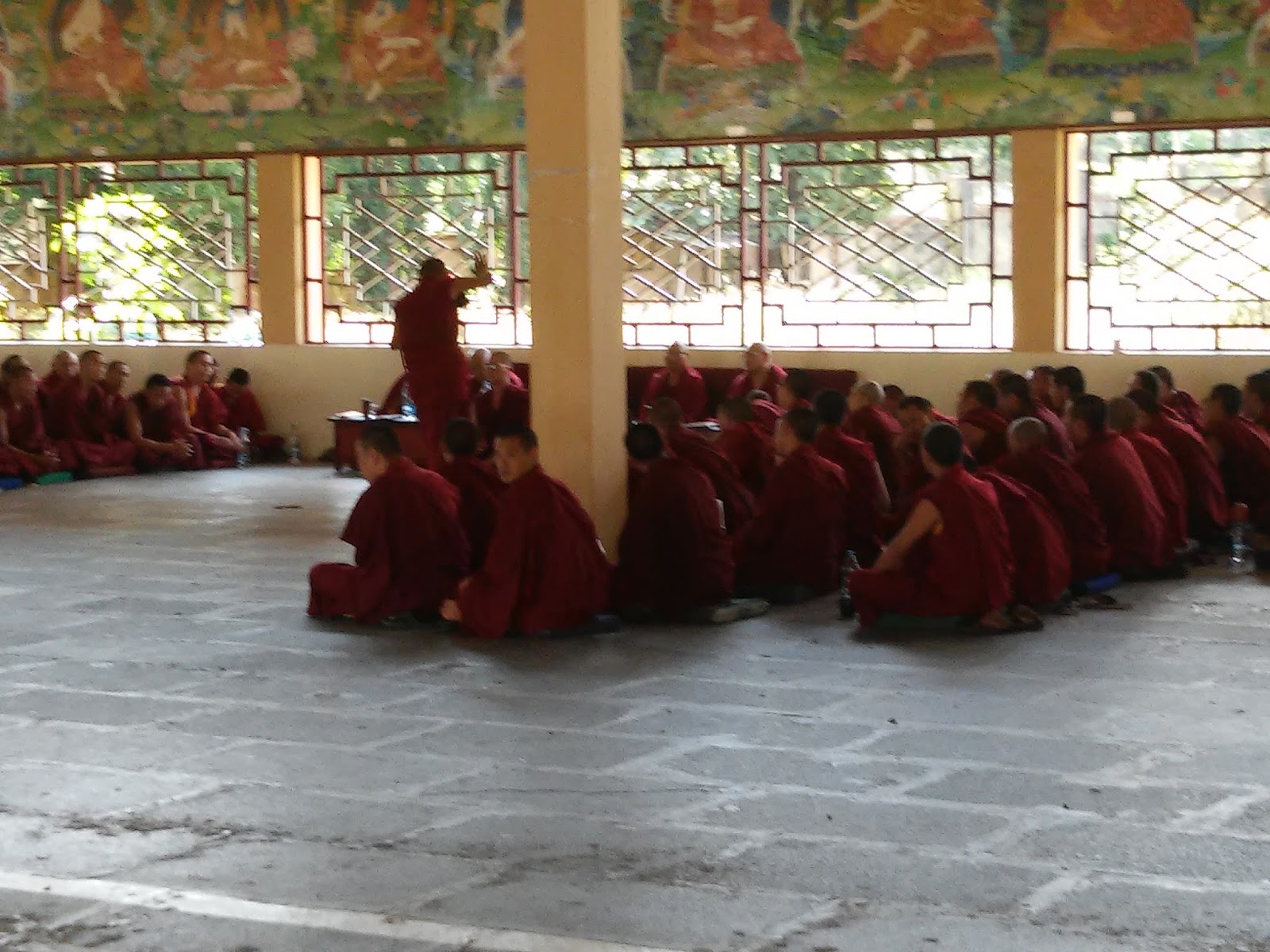
Another way to activate students practised for hundreds of years in Tibetan monasteries: requiring them to debate  in pairs while peers are looking on and with large physical gestures.
  1. Get everyone active with 1-2-4-all: students think about a question first alone, then share in pairs, then they share insights with a neighbouring pair and finally you discuss it in the big classroom. Another colleague mentioned that when students are forced to discuss in groups of 4, almost all of them will do some work (because there will always be some active students in the group), especially if you walk around to check on them.
  2. It is important to focus your lecture well, because as H. Simon said "a wealth of information creates a poverty of attention"
  3. A nice blog about peer instruction, with among others a nice series of blogs on why flipped classrooms fail. One thing that can make your flipped classroom fail is if you require students to do all kinds of work, but do not actually give feedback about this work. Another thing that can make your flipped classroom fail is when there are no consequences when students do not do the work, or when students are not clear on what their and your responsiblities are in the classroom. Useful case in point: it's helpful to spell out what you mean by "active participation" in the classroom. I will definitely try this out in my classroom.
  4. Nice platforms for creating online course content: FutureLearn and Google Classrooms. Both allow you to create very nice-looking course materials. Google classroom has the advantage it nicely integrates with googledocs for marking up assignments and things like that. Google classroom also makes it easy to grade with a rubric.
  5. A nice empirical investigation of the flipped classroom: article
  6. Tools for doing online voting: Socrative (allows you to also setup competitions in which teams try to answer as many quiz questions together as possible), mentimeter (allows you to easily vote on single questions and display the results interactively)
  7. A website with active activities: https://compass.itcilo.org as well as a book with game-like activities: Game Storming
  8. If you make quizzes for students to do before class, make sure you give useful feedback, e.g., "go back to section 11.3 of the book"
  9. Tools to make videos: for making screencasts: https://screencast-o-matic.com (e.g., to explain using some data analysis software), or to make cool animated videos/cartoons: https://www.powtoon.com/home/
  10. Another cool tool is "ticket to class"--make sure students do some activity beforehand to earn their ticket to class. One tool I like a lot is Perusall, in which students collaboratively read textbooks or articles. You could also use an exit ticket in which students can only exit the room if they hand in a piece of paper with the answer to a question such as: what is the question still remaining after this class? Name three things that can improve science? Etc (if you require students to add their name to this you immediately have a handy tool to keep attendance).
  11. A very effective tool to get students who are doing poorly back engaged is to find out who is not engaged with learning analytics (checking Blackboard for example) and then sending them a personal e-mail asking why they are not submitting assignments/not showing up etc.
  12. Nice database with exercises for physics, math etc: sowiso
  13. Tool to allow students to make collages of course-relevant information and comment on that (like a kind of instagram): padlet

Sunday, January 31, 2016

How can we get students actively engaged in learning? (report from a workshop I attended)

A few days ago I attended a symposium about promoting active learning organized by my university. Here are some of the things I learnt. There is a lot of interest currently in "flipping the classroom". We learnt that a new tool that is available to make flipping the classroom a little easier is Perusall. When you add your PDF to this system, students can annotate it collaboratively and ask questions. You will then be provided with a report, so you can adjust your teaching to the student's questions. With some magical algorithm, the system is also able to grade the quality of the students' comments, although I am a little suspicious of that, I must say.

Luckily there are also quite a few non-electronic ideas to "wake up" your students, which I picked up in a workshop by Jasmijn Bloemert. A good start of a lesson is to ask students what they hope to get out of it, and to write it down. Asking the student to think about their objective directs their attention away from the preceding events and towards the learning that will take place in the classroom. Moreover, it creates a sort of contract that they can go back to, to check whether they are getting out of the class what they want to. Writing things down is helpful because it makes the intentions more real than just holding them in your mind.

Lectures often consist of a lot of dense material. To help the student navigate that, it is often useful to give them a question that they need to find the answer to. In that way, they have a target to keep track of. You can alternatively ask them to come up with question about what they just heard, or simply to compare notes with a fellow classmate.
here I am attending a different workshop on teaching, a few years ago, at the UOGC (University of Groningen Teachers Education Centre)

Frequently students don't speak up for fear of making mistakes. To get them to speak up, you can ask them questions that do not have right or wrong answers, such as "how do you feel about this? Is it positive or negative for you? Another good trick to draw out people's interest is to show them a puzzling picture (or quote, or other type of material) and ask them to guess what it is or what it means. In a similar vein, you could show two "things" (e.g., pictures) on the screen and ask students to find the differences.I guess this will be hard for the course Research Methods that I will soon be teaching, but it may work well for courses that involve more concrete "things."

Teaching the reading of difficult material can also be made more social by asking students to underline the most important sentences of a passage, and then asking them to compare notes on what was underlined, and finally to come up with a summary of the text in one sentence. Doing this really helps you to find the essence of a text. I may try this out with research papers in one class where I read the primary literature with students. It is often difficult for them to draw out the essence of a paper, and this exercise may help them to develop this "helicopter view" of the material.

Finally, there was an interesting method used often in America called "teachers teach." At some random moment in the lecture, the lecturer claps their hands three times, and students have to immediately teach each other what they just heard. It is a very high energy method, but kind of fun, and encourages students to think on their feet (if they are willing to do it, of course). Altogether, I acquired some fun ideas in this workshop. I will definitely try out some of these in my upcoming classes.