Showing posts with label mind and life. Show all posts

Monday, January 01, 2024

What is a contemplative life?

I wrote this blog when I just attended the Mind & Life Europe Retreat and the European Summer Research Institute (ESRI), also from Mind & Life Europe. Both events took place in Pomaia, Italy. For me, these events are always very good because they make me ask what the role is of contemplation in my life, and other big questions about being human.

In fact, this time I started to ask a lot of questions about my identity. When asked who I am, I usually say something like "neuroscientist" or "computational cognitive neuroscientist". Yet, in the MLE retreat, and more frequently this past summer, my identity has become also "dancer". Of course I don't get paid to do it, but yet, there is such a strong force in me that makes me dance, and I have in recent time been able to do more and more things with professionals. Then in the MLE retreat and the European Summer Research Institute, I suddenly also became a "contemplative", when I taught the meditation and contemplative dance practices. As someone who has been trying to follow the path of a scientist-practitioner, this was a really interesting experience, which I am still feeling into.

Picture from Morlaix Ballet camp
By Michel Le Photographe
What does it mean to be a contemplative? During the retreat we talked about "continuous practice". With my busy job, I don't have the time to spend hours a day practising meditation, although I certainly practise meditation every day. But there is much more that bringing meditation into your life can mean. For example, I try to be aware of my motivation for doing things, and where possible bring this into an altruistic motivation, intending that whatever I do be for the benefit of all beings. At the end of the day, I try to dedicate my efforts also to the benefit of all beings. In addition, I try to take short moments of meditation during the "lost moments" of the day--when walking somewhere, when waiting for the traffic light, and so on.

Inspired by the MLE retreat and ESRI, one of my more recent practices is also trying to bring awareness of interdependence into my action. There is this interesting concept of "enaction", which means in my limited understanding something like that whenever you take action, you are just moving around in the sea of interdependence, you are never able to have a fully independent action.

In addition to continuous practice, another feature of a contemplative is some amount of renunciation. In the old days, contemplatives would live in monasteries. However, monasteries are not so compatible with a modern life. Nevertheless, during ESRI Martijn van Beek talked about new alternative structures such as Vaekstcenteret where he lives in Denmark. And even if you are not entering a very specific community, you can also live a monastic life at home. For example, Misha Belien talks about being a monk with a family in this very inspiring documentary. Also I myself try to live a simple life, without too many distractions. The monks of yore would say "ora et labora" (pray and work), and in some sense, that is what I try to do.

Monday, December 26, 2022

A key to resilience - learning to dance with whatever life throws at you

The next slogan in the #LojongChallenge is number 48: "Practice impartiality toward everything. Deep and comprehensive mastery overall is essential." I think this is such a good reminder. Probably for me the thing that most certainly makes me unhappy is to want things to be different from what they are. I got a lot of time to practise with this in the past 6 months in which I had the great good fortune to travel again. Traveling is especially one of these circumstances where you don't get to choose your circumstances. Sometimes things are pleasant, and sometimes they are annoying. For a Western European for example, it always takes some adaptation to go to countries where time is not so strictly adhered to, so things don't necessarily start at the assigned time. One possibility is to get annoyed about it, but a more adaptive option (albeit not always easy in practice) is to just go with the flow. When I was lucky enough to attend the Mind and Life meeting with His Holiness the Dalai Lama in Dharamsala earlier this year. This was an amazing meeting, but also required quite a bit of flexibility. I particularly remember one moment when we were in the car on the way back from an excursion to the Norbulingka institute outside Dharamsala and suddenly the car stopped for a traffic jam up the hill. After waiting for a bit, we decided to get off the car and actually walk up the hill leaving the taxi behind so we could make it somewhat in time for the next excursion. In the end, we were still late, but the schedule changed and all was good. For a person living in a stable country like the Netherlands, it is easy to forget that things are not always predictable, and they naturally change, even if we don't like that. A similar experience occurred later during my India trip when I was staying in a hotel in Allahabad, where the staff seemed to have their own mind about when things such as breakfast would happen. My first reaction was to get very frustrated, but that does not really change things, especially when you are only staying in a hotel for a few days so staff won't change their habits. After a few days my more adaptive response was just to plan around it and to dance with whatever life was throwing at me.
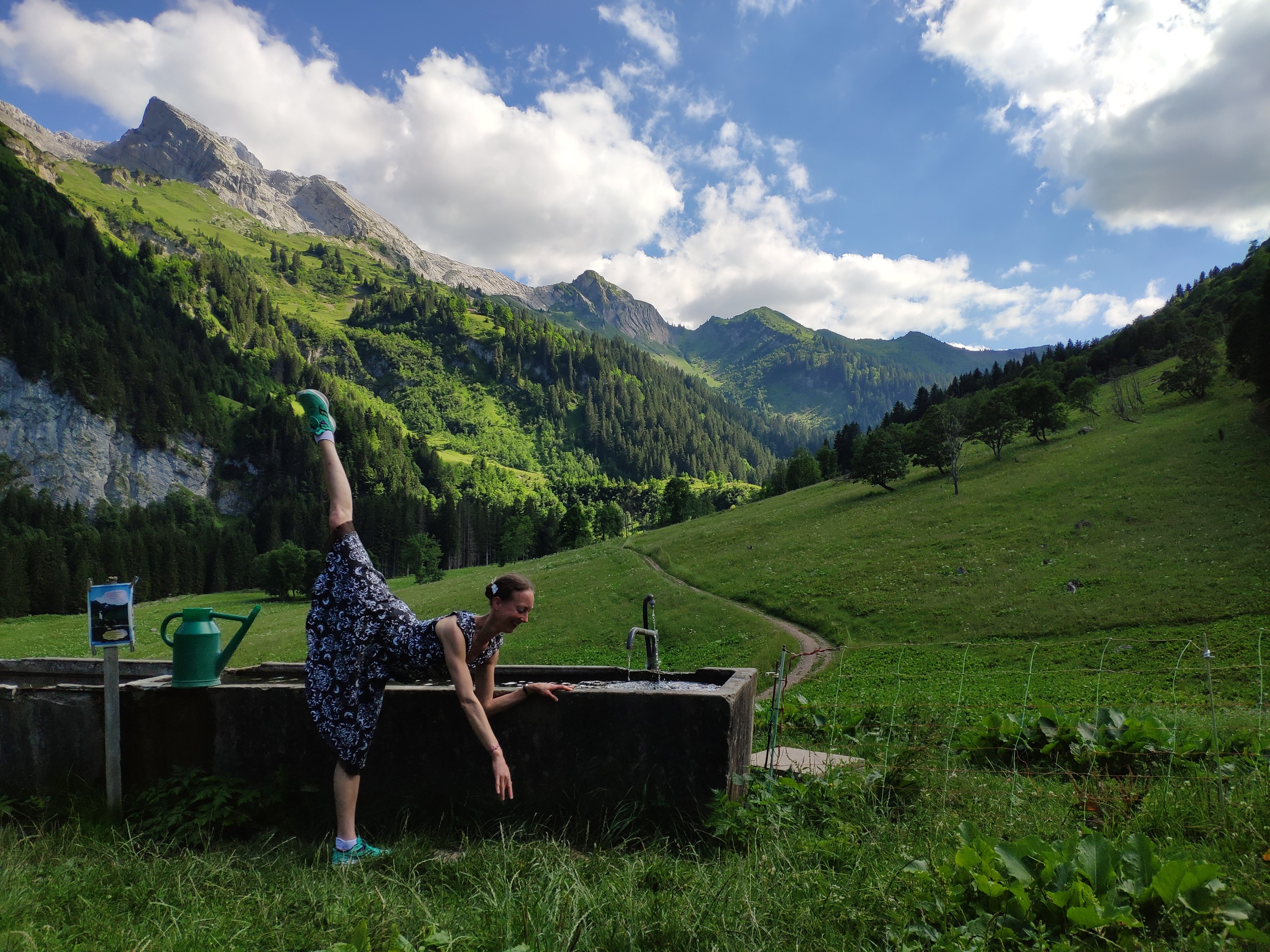
Image of dancing from Morlaix Ballet Camp by Michel Le 


I think actually impartiality is an overlooked outcome measure of contemplative practices such as mindfulness, as was already suggested in an early paper by Gaelle Desbordes. In one of the papers we wrote in my lab this past year we started to look at people's impartiality more empirically by comparing how people's thinking would change after being exposed to either a social stressor or a positive mood induction. We found that after a stressor, people were more distracted and had more negative thoughts than after a positive mood induction. In an on-going study (we are still looking for Dutch-speaking participants!) we are looking at how a mindfulness and a positive fantasizing intervention for a longer period can affect these same thought parameters. Hopefully this will eventually allow us to figure out how we can train people to dance with whatever life is throwing at them, like in the picture accompanying this blog (from the Morlaix Ballet Camp).

Sunday, August 28, 2022

Remembering the important things

I just got back from a Buddhist retreat in the south of France (the beautiful Tibetan Buddhist temple of Lerab Ling). It's such a gift to be able to spend a good week just thinking about the Buddhist teachings and the meditation. The focus of the retreat was meditation, and there was lots of space and time for practice, which for me is the most important thing. I feel like I already received so many teachings, but I don't have the time to put them into practice. 
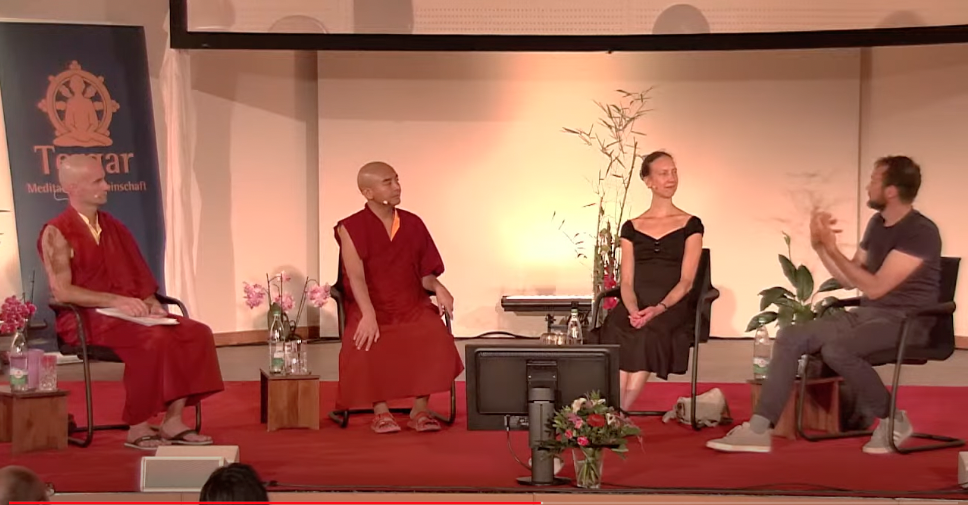
Impression from the dialogue with Mingyur Rinpoche

 Every day I started by going for a run, allowing me to move my body. The first day was kind of exciting, because it had been a good 4 years since I had last been to this retreat centre, so I didn't know whether the running path still existed, and whether I still remembered it. Thankfully my body still remembered it, and actually it was easier than I remembered: usually on the big hill somewhere at the end of the round I would need to stop halfway to catch my energy, and this time I was up before I knew it (maybe it was all the zhemfit I have been doing?). 

My favourite spot to practice on top of the hill
 What I found very interesting was that being in this space really made it so easy for me to completely disconnect: to ignore my email and my social media and the news (not that I completely forgot about the news: I did send a lot of prayers to Ukraine in the prayer sessions and also though about Salman Rushdie, who had been attacked just prior to me leaving for retreat). Having the space to simply be and enjoy the nature and the practice was just so much more rewarding than these other things (I remember this being much more challenging previously when I did my retreat at home). 

During a gorgeous day at Lerab Ling
This reminds me of the next #lojongchallenge slogan, number 46, which says "meditate on the three things that must not detoriorate". The three things the slogan refers to are the connection to the spiritual teacher, the enthusiasm for practice, and the sense for what actions are right and wrong. Now enthusiasm for practice is so much easier when you are in a space dedicated to practice, where all that is expected is doing the practice, and everything else is taken care of. What a luxury! Now the challenge will be to go back to busy everyday life, where I myself need to convince myself that practice is important, despite the millions of other things that are expected of me. Hopefully my happy memories of the profound sense of well-being and spaciousness will help me here. 

 Another thing that can help me remember my enthusiasm for practice is an experience I had in the middle of the retreat, when the centre was hit by severe thunder storms (thankfully I was staying in a wooden cabin, so unlike people staying in their own tents, I was very safe). Earlier in the day, I had been sitting on my favourite meditation spot on top of the hill, and I felt the strong winds, but despite all of that my mind felt quite settled and stable. Then I went down to the temple for teaching and practice, and we heard the news that the major had sent a warning to the retreat centre that a major storm, possibly hurricane, would hit the centre, and we needed to be prepared (people in personal tents were asked to sleep over in the temple to ensure their safety). What was interesting that now my mind completely jumped all over the place, even though at that point the weather was almost the same: now I started to worry a lot about things like whether my running shoes would fly away (they were hanging out at the door of my cabin). It's amazing how our mind dramatizes things so much, and creates a lot of suffering that way. But that's why we do the practice: to become aware of this pattern, and instead of mindlessly following it, to gentle observe it and let it go instead. 


View from my run 

Impression from Lerab Ling


 The second thing that the slogan asks us to remember is the spiritual teacher. In the Buddhist teachings, the teacher plays a crucial role, as an embodied role model for the path to enlightenment. They are so inspiring because they live in the same world as we do, and give us examples in how to deal with that more sanely. Sometimes even thinking of the teacher can put you in a more sane and wise state of mind. In fact, that is the essence of the Tibetan Buddhist practice of guru yoga. One teacher who currently really inspires me is Mingyur Rinpoche, whom I had the tremendous honour to dialogue with just prior to my retreat. In his way of being, he shows how to maintain a joyful mind no matter what happens to you (I could really use that reminder in a very rough train journey on my way to the retreat, where I arrived with 4 hours delay at 2 am in Montpellier, the city closest to the retreat centre...). If you want to know some more concrete examples, I highly recommend his book In love with the world or the movie about his wandering retreat Wandering but not lost (we also got to watch this after the dialogue: what a treat!). 

 The final thing to remember from the slogan is how to behave as a decent human being. The Buddhist teachings are actually very simple in this: rather than giving you a list of rules, the simply ask you to do not harm others, and where possible to help. Of course in reality this is not so simple, because sometimes helping in the short term can be harming in the long term--something I reflect on a lot in the context of climate change (hence my frequent train journeys and avoidance of flying where possible). It's so important to keep reflecting on your actions. I try to remember (not always successfully) to take some time at the end of my day to reflect on what I did, and whether that is in line with my values, and also at the beginning of the day to set my intention to be of benefit. When I do manage to remember these things, I certainly feel so much more fulfilled...
Impression from Nurnberg

Saturday, July 09, 2022

Inter-subjectively exploring intersubjectivity in the French Alps

 In the last week, I had the good fortune to be part of Mind & Life Europe's ENCECON meeting. In this meeting, philosophers, neuroscientists, psychologists, meditators and more get together to discuss how we can study first-person experience and bring this full experience together with objective, third-person methods. This year's theme was "inter-subjectivity", which we explored through a series of meditation exercises, interviews and discussions. The interviews were not any interviews, but ==microphenomenological interviews, which is a method to explore experience in a very detailed way, trying to focus on the experience itself, leaving out our habitual theorizing. Another important characteristic of microphenomenological interviews is that they invite us to slow down, and repeatedly relive our past experience, so we become more aware of the details of these experiences, using more of our senses than we typically report on. What i found really interesting as a scientist was to observe the so-called evocation state, in which people show signs of being disengaged from the current context, something which we in the mind-wandering literature term "perceptual decoupling". The interviewees at this point slow down their speech, may close their eyes and sometimes repeat gestures from their past experience. What is challenging about this method, is that to explore a few minutes, or even less, of experience, you typically have an interview that lasts 30-60 minutes. At the same time, this is a state of pure contemplation--engaging in a reliving without judgment. Yet, this makes it very difficult to combine with other methods of research such as neuroimaging, because for most of these experiments, we need many repetitions of the same instance of experience. So, we had a lot of discussions about this.

What amazed me during this meeting is the profundity of the experiences that could be evoked by very simple meditations. On the first day, we were asked to simply bring to mind a person whom we felt grateful to. I kind of missed this instruction because I was so tired that I fell asleep during the meditation! On the second day, we sat next to one other person, and were asked to open ourselves up to the presence of the other person. It was fascinating to see how many people reported sensations of profound connection or even merging with the other person, as if they had a single body. On the third day, we were sitting together with the full group, and first we were asked to open ourselves up to the presence of the others, and then to hold each other's hands. In this moment, many people felt completely connected to the others, and lost a bit of their sense of self.


Many of our discussions revolved around the topics of how these practices helped to melt down the boundary between self and other. This was profoundly effected by the meditation practices we did, and of course by the fact we were staying together in a beautiful place in the French Alps. What this reminded me of is how helpful these simple practices could also be for reducing our destructive emotions, something that the next Lojong slogan talks about, which says "Train in the 3 difficulties". What this refers to is first the difficulty of becoming aware of your negative emotions, then secondly the difficulty of applying antidites to these negative emotions, and thirdly the difficulty of making the first two a habit so they change the way you are. Now when you are as profoundly connected as we were during the practices, the interesting thing is that negative emotions such as anger, jealousy and craving do not have even a chance to arise--they simply dissolve in the void. How wonderful would it be to do these practices together more often!

We also reflected on the role of the body in all this, because we found that touching each other's hands during the meditation practice had a profound effect. It dramatically amplified the feeling of having a single body with each other. Interestingly, this mirrors my findings from a dance experiment that I hope to write up soon, in which we found through working with dancers that the most powerful ways we can connect through movement is not by synchronizing our movement with another, but rather by moving as if we have a single body, or by engaging in a movement dialogue. So, it may be quite interesting to study more about how moving together can affect our thinking, and how such simple instructions ask bringing to mind the presence of others can do so. I am also curious whether we can use the perceptual decoupling state to better determine when microphenomenological interview information is reliable, and when it is less reliable (because people are not actually reliving their past experience, but rather theorizing about it). Finally, I am curious whether we can apply the experience of microphenomenology in zooming in on lived experience, and staying away from our theories about what's going on, to improve our societal discourses, which are so often stranded in these theories and stories, rather than simply being present with the facts. And the stories are what we know results in so many destructive emotions...

Sunday, February 14, 2021

What are you longing for?

This was the main question that pervaded this past weekend, while I attended the Mind and Life Europe retreat, led by Martijn van Beek and Hanneli Agotsdatter. It was quite an amazing experience. The retreat was a contemplative way of reflecting on how we lead our lives as academics and practitioners. It was one of the most wonderful things I have done in a long time. There is nothing as joyful as pursuing something meaningful, even when it is hard. Let me share some aspects of the experience.


We started on Friday night with gentle meditation and yoga exercises, after which Martijn gave a short lecture on the idea of a "vita contemplativa", a contemplative life. This idea is about how we can bring a spiritual dimension into everything we do, not just a few minutes of meditation or mindfulness on the cushion. We ended the evening with a beautiful meditation practice in which we virtually connected our hearts to the middle of the earth and to each other.


The next morning, we continued with the meditation and yoga practices, but then deepened the contemplation into a question that was quite a bombshell: what am I really longing for? And in addition to that, what are my talents and on the other hand the things that I would like to cultivate. I realized that I had neglected this question about longing--being in a stable job for the last ten years. But also in my spiritual life, it is so easy to just get stuck with the practices you are doing, instead of thinking about why you are doing those. It is so easy to get caught up in the doing mode, rather than being aware of why you are doing those things and focus a bit more on the being mode. During the retreat we did quite a few journalling exercises to ponder these questions, and then we shared with each other in breakout rooms.


I was blown away by the wisdom in the group. I had many insights driven by these conversations. One of the things I was thinking about was that while I love ballet practice dearly, the physical feats achieved by this will never last. The only thing that is a meaningful product out of this pursuit is the mental work. But that in itself is not to be underestimated. Metaphorically, it allows me to connect with the wisdom in my body, and to dance with the open questions in my life.


In the afternoon of the second day, we had a good conversation about how to put these things into practice in our everyday work life. Stefano Poletti and myself got the precious opportunity to share our paths. It was amazing to reflect on what I have done over the years, and to realize the wealth of experiences I have had the chance to accumulate.


On the last day, we then brought back this richness of experience into the daily life. How can we continue this? For myself, I would like to really bring a few minutes of meditation practice in the middle of my day so I get the space to see what is going on, and tune in with any gaps that may be occurring (that is my personal biggest gap). I also hope I will be able to remind myself of loving kindness in the many meetings I have during the day, to make these contemplative values more of a continuum. Finally, I think I need to do this practice more often, and especially to do a short retreat to reflect on what projects I need to let go of, because I tend to overcommit myself. As Gabor Karsai wisely said: we tend to focus on the things we produce, but fail to notice the side effects of these productions--the effects on our health, the effects on our family that is ignored and so on. I ended with the reflection that when you are running too fast, you may miss the goal or the point of it all. Hopefully writing this down will help me to remember this a bit better.

Sunday, August 16, 2020

Exploring together-apart mind and reality in times of COVID-19

Last week I attended the European Mind and Life Summer Research Institute. I have been lucky enough to attend many such events over the course of my career, and it is safe to say they have shaped my career as a contemplative scientist. During these Summer Research Institutes, scientists and contemplatives get together to discuss about issues in the field of contemplative science, but also do a lot of contemplation themselves. Unsurprisingly, this year's edition took place online.

I was not sure how an online version of this event would work out, but I was pleasantly surprised at the amount of connection that I felt with the other attendees. This was achieved by some quite inventive meeting formats. Before the meeting itself, the faculty had recorded brief (20-30 min) lectures that you could watch and ask questions about. These questions were collected on a board that allowed for upvoting of your favorite questions. Participants who presented posters had submitted PDFs and 2-minute video presentations of their posters and all gotten a Slack channel to discuss these posters during the meeting. Every day of the meeting started with contemplative practices: a choice of meditation, and a choice between chi gong, yoga and juggling. I ended up mostly not following those but taking a ballet class instead. After that, the first session was a plenary meeting with the faculty in which they briefly recapped the essence of their talks, followed by a panel discussion, partly driven by the submitted questions. There was also a brief period in which we were put in breakout rooms to discuss possible questions to ask. I must confess that during most of these sessions I ended up instead just talking to the others about their fascinating work! In the afternoons, we then had breakout groups with the day's speakers in which we discussed a bit more deeply. Before that, we would often have a fun activity, for example answering a question with one word on mentimeter that then transformed into a word cloud. The afternoon ended by bringing everyone back together with reports from the breakout groups and more general discussion. As the week progressed, there were also more and more self-organized zoom meetings for discussions and chats. As usual, there was a much-needed silent meditation day in the middle of the week which also featured a teaching by Mingyur Rinpoche, who talked about his wandering retreat and meditation in general.

Now the contents of the meeting. We started the first day by talking about perception: how do we derive knowledge from the world? This questions was approached from neuroscientific, philosophical and contemplative directions. Michel Bitbol for example argued that our experience of the world is just the part we need, which is an optimal way to perceive the world, but we should remember that that is not reality. There were many discussions about how we continuously make up stories about the world, and then confuse them for reality. Yet even if science is just another story, Michel Bitbol argued that it is a very efficient way towards knowledge, for example in the case of a search for a COVID-19 vaccine.

The second day was dedicated to interoception and emotions. Holger Yeshe talked about how the Buddhist teachings give us tools to investigate where our suffering, and our negative emotions (which are the source of this suffering) come from. Micah Allen talked about interoception--the feeling of our body from the inside, and argued that many psychiatric disorders are accompanied by problems in interoception. There have been claims that meditation improves interoception, but the evidence for this is not unequivocal. He also argued that we need more replication in the field of meditation reserarch and called for a Many Labs experiment in this field. I fully agree, and I am working on a project to work towards that! On a more poetic note, Giovanna Colombetti argued that emotions are not a feeling of the body but a feeling through the body. A lot to think about!


Thursday was dedicated to embodying knowledge. All too often, we think that knowledge is just in our heads, but dancers will know that you can also know and investigate through the body--a perspective that was also shown by Asaf Bachrach and Hsuan-Hsiu Hung. Asaf Bachrach showed an intriguing experiment in which people were moving in virtual reality, where he found that people felt very calm, and he noticed that when people moved slowly, they felt more together than when moving quickly. Despite the wisdom there is to be found in movement, Guiseppe Pagnoni argued that by keeping body and mind still during meditation practice, you can detect changes in the body-mind complex with much greater precision, which affords you to be less enslaved in your habits.

The last day was dedicated to artificial intelligence. Luisa Damiano argued that in addition to the empirical cycle of scientific research, we need the synthetic cycle in which we simulate the world and explore the world in-silico. Father Tiso discussed how artificial intelligence allows us to appreciate the sphere of interconnected minds through the internet (as was indeed happening there and then during the summer research institute!). Venerable Aileen Barry summed up the Ai day very beautifully by arguing that behind every AI there is a human, and a motivation, and we should watch this motivation.

Altogether, the ESRI was a very rich and beautiful exploration of what it means to know, and what it means to connect as humans--through technology. My head was spinning by the end, and there was as always too little time to explore this richness in ideas, but it was definitely a beautiful experience. And now it is time to take that wonder into my own retreat.

Sunday, February 23, 2020

Contemplating sustainable happiness in Vienna

I decided to contemplate the next slogan--"always maintain only a joyful mind" during a trip to Vienna. Now you might say: that is really easy: Vienna is a gorgeous city, so it's no challenge to be happy. This is certainly true. However, it was not that trivial. I went there for work: to discuss the future of Mind and Life Europe. Mind and Life is an organization that grew out of a series of dialogues between the Dalai Lama and scientists. So how does work relate to maintaining a joyful mind?


Let's first unpack the slogan. Maintaining only a joyful mind does not mean that you always need to be smiling and ignore all the sadness and difficulty that is abound in life. It does mean that you do not completely wallow in feeling sorry for yourself. After all, as His Holiness the Dalai Lama says, when there is something to solve a problem, do it, and when there is nothing you can do, it does not help to feel sad about it either. So this attitude of maintaining a joyful mind is the mind that considers everything as workable. Usually this attitude makes even difficult things easier. I got to practise this today on my flight back from Vienna. The flight was kept on an indefinite hold because of stormy weather in Amsterdam. Thankfully enough, my mind actually was quite OK throughout it all. It's not actually that bad to hang out at the airport if you just focus on the moment (and happily plough through the infinite amount of work that is always present). And as I am writing this, I am sitting on the plane, which now has gotten a delayed departure time after all.

Nevertheless, the more important dimension of maintaining a joyful mind became clear to me over the course of the meeting. We were reflecting on what makes Mind and Life events so special. I felt that a crucial ingredient is that it connects us to a dimension of life that we find deeply meaningful. While eating a Sachertorte, which we also did during the meeting, is lovely, this pleasure is only very temporary. In contrast, when you are engaging into work that puts into practice your deepest human values (which for a Buddhist practitioner is mostly cultivating compassion for all living beings, as well as wisdom), this feels very gratifying. When my academic work aligns with these values, in which wisdom may be operationalized as simply learning more about the nature of the human mind, and compassion as doing research that matters and brings benefit to beings, or teaching that gives insight and knowledge to others, then I feel happy for a much longer time. Moreover, by breaking down the boundaries between work and spiritual practice, there is less of a feeling of stress because work becomes just another way to engage in spiritual practice, rather than a competitor for our time. In this way, I think figuring out a way to align one's work to true human values is a way to "always maintain a joyful mind", and also a recipe against burnout.

Monday, June 17, 2019

Plunging in the deep of consciousness at the European Neurophenomenology, Contemplative, and Embodied Cognition Network meeting

Last week I attended the European Neurophenomenology, Contemplative, and Embodied Cognition Network meeting at Schloss Buchenau in Germany. This year we explored similarities and differences between the practices of meditation, hypnosis, trance and psychedelics. I must confess that up to that point I had always been quite skeptical of hypnosis, trance and psychedelics, feeling that they are kind of "out there" and I did not quite want to touch them. At the meeting, we got to explore some of these methods (trance and hypnosis) ourselves, and my ideas changed quite a bit. In fact these methods are not as strange as they sometimes appear, and certain forms of meditation also share some features with these other practices. And importantly, they can really benefit people!
Picture by Ute Brandes. Some of the results of the trance

In general, in many forms of meditation you bring your attention to an object of interest, and you monitor metacognitively where your attention goes, and whether it is still on the object. In some forms of meditation, you drop the object, and instead just monitor with kind attention where your awareness is. In some other forms of meditation, the object is more dynamic, for example it is a thread of philosophical thinking. In yet other forms of meditation, you visualize an entire environment and you incorporate all sensory impressions in this visualisation. For example, you may visualize a buddha, and then whatever sounds you are hearing may be reinterpreted as a mantra. This kind of practice actually shares quite some similarities with hypnosis in which you also construct a different narrative about the environment, and reinterpret thoughts and sense stimuli in this sense. Quite a powerful example of this was a video by Marie-Elisabeth Faymonville who showed how suggestion was used to alleviate pain during an operation. A patient who received large blows on their nose as part of nose surgery was led to interpret this as the shocks involved in skiing a mountain. And amazingly, this allowed them to undergo the operation with only local aneasthetics and substantial comfort.
Picture by Ute Brandes. Me giving my presentation

Similarly, in some practices of meditation you just allow your mind to accept whatever thoughts and emotions occur. When the faculty of monitoring disappears completely, and you just pursue whatever thoughts and emotions arise, then this becomes similar to the trance state (at least in my experience). During the meeting we were led into a trance state by listening to some very powerful deep drum sounds interspersed with animal sounds and more. We were encouraged to simply follow our impulses and to drop our cognitive control. To facilitate the latter and go with the flow, we were encouraged to make whatever sounds arose in our minds. In the beginning I think all of us felt a bit timid, but as we led go more, we entered this pure flow of experience. I myself felt quite compelled to move, and while I normally am a ballet dancer, now for the first time floorwork movements just manifested from my body automatically. To ensure people weren't harming themselves or others, an experienced team was watching over the trance and guided people gently as needed. After the end of one trance state, we were also invited to turn our experience into a painting. It was quite amazing to see what pieces of art came out! I wonder what the connections are between this state of effortless awareness where monitoring is almost completely abandoned and states of meditation practices that involve a nondual flow of awareness as well.

The meeting ended with trying to formulate a vision for a joint paper outlining some of these similarities and differences between the practices we discussed and experienced. While the communities of scientists studying these practices has traditionally been quite separated, I think it could really benefit from cross-talk to learn from each other's methods, roadblocks and more. For example, meditation research has a strong tradition of using pain to study the effects of the practice, but this has not been much considered in psychedelics. Hypnosis has a strong tradition of examining how people's suggestibility affects the results, and this could potentially be informative in studies of meditation as well. I could also imagine that comparative studies between the practices could be very helpful, because they engage, as I sketched above, to some extent similar mechanisms, but to some extent also different ones.
Picture by Steven Laureys. Group picture.

Picture by Ute Brandes. One of the many discussions.

Real German houses!