Showing posts with label retreat. Show all posts

Sunday, August 28, 2022

Remembering the important things

I just got back from a Buddhist retreat in the south of France (the beautiful Tibetan Buddhist temple of Lerab Ling). It's such a gift to be able to spend a good week just thinking about the Buddhist teachings and the meditation. The focus of the retreat was meditation, and there was lots of space and time for practice, which for me is the most important thing. I feel like I already received so many teachings, but I don't have the time to put them into practice. 
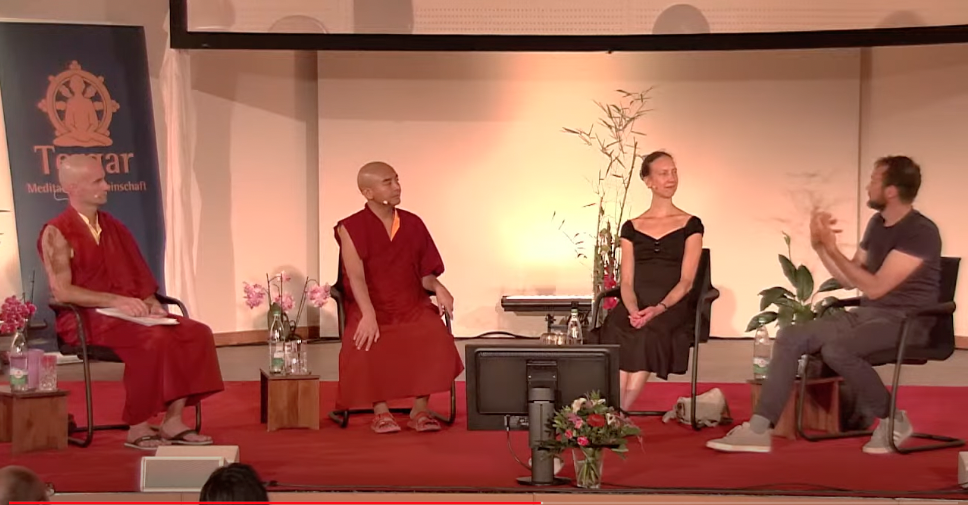
Impression from the dialogue with Mingyur Rinpoche

 Every day I started by going for a run, allowing me to move my body. The first day was kind of exciting, because it had been a good 4 years since I had last been to this retreat centre, so I didn't know whether the running path still existed, and whether I still remembered it. Thankfully my body still remembered it, and actually it was easier than I remembered: usually on the big hill somewhere at the end of the round I would need to stop halfway to catch my energy, and this time I was up before I knew it (maybe it was all the zhemfit I have been doing?). 

My favourite spot to practice on top of the hill
 What I found very interesting was that being in this space really made it so easy for me to completely disconnect: to ignore my email and my social media and the news (not that I completely forgot about the news: I did send a lot of prayers to Ukraine in the prayer sessions and also though about Salman Rushdie, who had been attacked just prior to me leaving for retreat). Having the space to simply be and enjoy the nature and the practice was just so much more rewarding than these other things (I remember this being much more challenging previously when I did my retreat at home). 

During a gorgeous day at Lerab Ling
This reminds me of the next #lojongchallenge slogan, number 46, which says "meditate on the three things that must not detoriorate". The three things the slogan refers to are the connection to the spiritual teacher, the enthusiasm for practice, and the sense for what actions are right and wrong. Now enthusiasm for practice is so much easier when you are in a space dedicated to practice, where all that is expected is doing the practice, and everything else is taken care of. What a luxury! Now the challenge will be to go back to busy everyday life, where I myself need to convince myself that practice is important, despite the millions of other things that are expected of me. Hopefully my happy memories of the profound sense of well-being and spaciousness will help me here. 

 Another thing that can help me remember my enthusiasm for practice is an experience I had in the middle of the retreat, when the centre was hit by severe thunder storms (thankfully I was staying in a wooden cabin, so unlike people staying in their own tents, I was very safe). Earlier in the day, I had been sitting on my favourite meditation spot on top of the hill, and I felt the strong winds, but despite all of that my mind felt quite settled and stable. Then I went down to the temple for teaching and practice, and we heard the news that the major had sent a warning to the retreat centre that a major storm, possibly hurricane, would hit the centre, and we needed to be prepared (people in personal tents were asked to sleep over in the temple to ensure their safety). What was interesting that now my mind completely jumped all over the place, even though at that point the weather was almost the same: now I started to worry a lot about things like whether my running shoes would fly away (they were hanging out at the door of my cabin). It's amazing how our mind dramatizes things so much, and creates a lot of suffering that way. But that's why we do the practice: to become aware of this pattern, and instead of mindlessly following it, to gentle observe it and let it go instead. 


View from my run 

Impression from Lerab Ling


 The second thing that the slogan asks us to remember is the spiritual teacher. In the Buddhist teachings, the teacher plays a crucial role, as an embodied role model for the path to enlightenment. They are so inspiring because they live in the same world as we do, and give us examples in how to deal with that more sanely. Sometimes even thinking of the teacher can put you in a more sane and wise state of mind. In fact, that is the essence of the Tibetan Buddhist practice of guru yoga. One teacher who currently really inspires me is Mingyur Rinpoche, whom I had the tremendous honour to dialogue with just prior to my retreat. In his way of being, he shows how to maintain a joyful mind no matter what happens to you (I could really use that reminder in a very rough train journey on my way to the retreat, where I arrived with 4 hours delay at 2 am in Montpellier, the city closest to the retreat centre...). If you want to know some more concrete examples, I highly recommend his book In love with the world or the movie about his wandering retreat Wandering but not lost (we also got to watch this after the dialogue: what a treat!). 

 The final thing to remember from the slogan is how to behave as a decent human being. The Buddhist teachings are actually very simple in this: rather than giving you a list of rules, the simply ask you to do not harm others, and where possible to help. Of course in reality this is not so simple, because sometimes helping in the short term can be harming in the long term--something I reflect on a lot in the context of climate change (hence my frequent train journeys and avoidance of flying where possible). It's so important to keep reflecting on your actions. I try to remember (not always successfully) to take some time at the end of my day to reflect on what I did, and whether that is in line with my values, and also at the beginning of the day to set my intention to be of benefit. When I do manage to remember these things, I certainly feel so much more fulfilled...
Impression from Nurnberg

Thursday, August 20, 2020

Dropping the self from the meditation

We're moving along quite nicely in the #LojongChallenge! Today I want to discuss slogan 29: "give up poisoned food." Of course it is never good to eat food with poison, but obviously here this is meant more metaphorically. The idea here is that when you practice, you do it not so that other people think you are an amazing person, but rather, for the benefit of others. This is not surprising, since the whole Lojong is pretty much about that. Nevertheless, it is important to keep examining your motivation in whatever you do.

Here I would like to focus a little more on the case of meditation, since I am currently doing a meditation retreat. In meditation too, it is attractive to want it to be a kind of quiet and peaceful state in which we feel good and feel like we are a great meditator. But of course, meditation isn't always like that! Often meditation is just like a big mess of turbulent thoughts that go all over the place. And many of these thoughts--in fact--are self-related. We know this from neuroscientific research: whenever people are left to their own devices, a brain network known as the default mode network turns on, which consists of a set of mostly midline areas such as the medial prefrontal cortex and posterior cingulate cortex that are thought to be strongly involved in self-referential processes. And in my lab I have demonstrated that the moment people are prompted to think about themselves, they get distracted and do worse on cognitive tasks such as a memory task.

So what to do? One strategy I am playing around with right now is to focus on the process rather than the result. Just the fact that you sit down to practise is awesome. Sometimes the practice will feel good, sometimes it won't, but slowly you will make progress anyway. It is also said that it is better to leave your analysis and judgment of how the meditation went until afterwards, and to during the practice mostly focus on being relaxed and spacious. One quote of Sogyal Rinpoche that illustrates this well is "meditation is becoming naturally assimilated in it." It says that instead of working hard to do something, it is more about un-doing, and trusting that you will land in your buddha nature. What a beautiful and soothing idea in this stressful world!

Saturday, August 15, 2020

What does it mean to do retreat in times of COVID-19?

As I am writing this, I am entering into a retreat. A retreat not at the Buddhist centre of  Lerab Ling where I usually go to, but at my own home. In one of the first sessions, it was mentioned that the moment you leave your home, the retreat is half accomplished. Of course that makes a lot of sense, because you have already physically retreated from ordinary life. This made me reflect on the question of what is means to retreat, when you do not leave your home. 

For me, retreat is about taking the space and time to reflect on the Buddhist teachings--something I nornally only have little time to do. When you are in a Buddhist retreat centre, the whole environment is conducive to thinking about this, and the place is usually so beautiful that meditation almost arises naturally. The aim of this is of course to transform our minds so that it works a little bit differently, with a little more sanity, in everyday life. So how can I create that in my own home?

The meaning of retreat is "boundary", so the first thing to do of course is to reflect on every single thing I do: is this necessary for my retreat, or can I drop it? Of course work has to go, for sure. Social media, also pretty clear. News? I noticed I am quite addicted to news since COVID-19, so ideally this should go as well. At the same time, it is important to know when something changes in the world situation that may affect the way I live my life. So I decided to have a short "news" moment every morning. I will still keep up my ballet practice because it is important for me to have a flexible and strong body, but I will do so with youtube teachings, rather than interacting with other individuals. The wonderful thing of a retreat is to momentarily drop social interactions (not so difficult when you live alone like me) so you can devote yourself with less distractions to the study and reflection.

I must confess that doing retreat at home is challenging because I can feel the pull of the habits that like to fill my mind and provide entertainment. So this is a time to work with this attachment--after all, retreat is about reducing attachment and aversion, according to the Richö teaching. At the same time it is also wonderful to have the space and time to do something as meaningful as study and practice. And here it is important to not go into overdrive either but make sure that while you adhere to a retreat schedule, you also take enough time to relax. This is particularly important because this is not only my retreat but also my vacation. As it says in the Richö: "Generally, refrain from any noise and busy-ness, whether outside or within the mind, and simply remain perfectly at ease, effortlessly. This is the true, essential solitude or hermitage."

In the end, while I miss the beautiful surroundings of the Buddhist centre, I think it is also lovely to create new habits that may more easily transpire to life after the retreat. I am planning to keep writing blogs, so I will keep you posted on how it goes.

Wednesday, January 02, 2019

Dancing into the new year

As in several previous years, I spent the new year's eve at a moving meditation retreat, this time somehow as one of its facilitators. The latter fact also filled me with quite a bit of trepidation because I definitely did not feel ready to do this. But of course that is a great thing to dance with as well, because the idea of moving meditation is to dance with your habits. So what is moving meditation? Why move during your meditation? Let me give a try explaining a little.
image from Aarhus--on the way to the retreat venue

Moving meditation is a form of meditation in which you don't sit still while meditating, but instead you a moving. Moving can take place individually, but also in a dyad, or in a larger group. Just like sitting meditation can move through phases from being focused on an object, to simply being aware of everything, to letting go of even the idea of meditation, so can moving meditation. If you pay attention to it, you will find that there is always movement in your body, and instead of remaining silent you can just let this flow and move the body where it decides to go. And just like you have habits of thought that keep coming back, you also have habits of movement that you keep rolling back into when there is music on. When you become aware of these habits, you suddenly have the choice to not follow these habits and to instead take a different path. Then there is suddenly a lot more freedom! During the retreat I gave the participants a brief introduction to ballet movements as a way to expand their movement vocabulary. During the music, the meditators could then use these movements as well to follow the natural flow of the body.


What is interesting is that movements can be a different way to listen into our mind and our ideas and the external world. When we go into auto-pilot, we can become quite bored during moving meditation, but if instead we just flow what is, there is always inspiration, and there is always something happening. It is quite a wonderful exercise in just letting the movement and meditation arise out of itself. I found that I did not need to be scared about leading the retreat, because when I was simply there to listen, the retreat magically emerged out of itself.

In addition to the general process of moving meditation, we also went through a special new year's process, in which we first thought about what habit we wanted to dance a lovingly goodbye to, and what we wanted to welcome in the new year. We then entered into silence for a day or so (until new year's eve). During the silent period, we enacted the process of being born: from the appearance of matter out of space, to simple single-cell animals such as amoeba, to more complex animals that can crawl, all the way to elegant swans and birds, and finally to humans. While it may sound silly, this whole process of giving birth metaphorically is a wonderful way to reach a state of wonderment about life, and to give space to new ideas and new habits to arise for the new year. I mostly worked with the idea that I would like to simplify my life (I am also starting to work with the Simple Living calendar, the Simpel leven agenda in Dutch). Over time, the insight emerged that maybe I should plan more time to simply sit quietly with my project and listen to what project can dissolve to give more space to other projects.

A final remarkable thing about moving meditation is that it is a very beautiful way to be with other people, because we all practise being together in a very non-judgmental way. It was so moving to see everyone dancing together on New Year's eve: everyone with their own unique moves, no-one being ignored, everyone sharing joy and wonder with one another. These qualities are also cultivated in the moving meditation practices, for example a practice in which we listen into each other's being and use that to move together. As we listen into each other, we become more and more open to the unique texture of every individual, and their unique beauty. I hope that I will be able to keep some of that non-judgmentalness and wonder in the new year!

Sunday, August 27, 2017

Pondering work and meditation

Some reflections from my stay at Ngari Institute of Buddhist Dialectics in Saboo, Ladakh.
Morning story: I woke up to run with the kids at 5:30. Since I wasn't sure where to go, I ran up to what I later found out to be the monk's quarters. Two of the institute dogs came with me. When there was nowhere to go, they guided me back below to where the kids were running. I joined some of them. Together we struggled up the hilll, panting for breath, looking at the beautiful views together, meeting yaks and people on our way. What a beautiful fresh way to start the day!\\
Contemplation:
From Andrew Harvey--''A journey in Ladakh'': ``Those who reject the materialism of the West, who despise it and separate themselves from it, are in danger of refusing to look at it, they are in danger of not being responsible to the facts of life as it is lived, and must be lived, now. We must find a way to work within the world, within science, within industry, even within politics; we cannot simply pretend a superiority to those things, for they are the forces that largely shape mankind. To work within the world we will have to be strong, and in the world our inner strengths will be greatly tested. But that is good. That will dissolve any pride we may have, any sense of virtuous invulnerability. It will take away from us any sense that we are "special'', that we deserve "special treatment'', that we are "unique.''
My continuous struggle is to figure out how to be living a "vita contemplativa.'' What does it mean to be a scientist and yet to also live a spiritual life such that the life and the science are not wasted, but are in fact of benefit to both myself and others. It seems from this writing that what is truly crucial is humility: to just work without expecting anything in return, without any recognition. And also, to drop any thought of being special but just focus on being of help. It is difficult to really live this, because in the West and especially in a career in a competitive profession we are conditioned to continually try to prove we have the best and we deserve recognition. So how can we resist that? Maybe one way would be to contemplate again and again on how we are interdependent with everything. Everything we do cannot be done without the kind help of many others (if only for the food we eat, the electricity we use, and so many more things).
Another helpful quote from the same book: "Be quietly detached from what you do and dedicate it to the good of all created beings, and you will be safe from disillusion or vanity.'' Every time when I go on retreat I realise how important it is to dedicate time in silence. Even just being here, I can see my automatic tendency to ditch meditation in favor of "something useful''--typically processing some information like reading a paper. It is hard sometimes to see the true value of meditation, yet this is the only way we can remain detached from what we do and put it into perspective. And only when we do that can we remain joyful in the face of difficulties, because we see there is so much else that is involved in all of our successes and failures.

Saturday, August 19, 2017

Science at the monastery gets real


I just returned from another study visit to Sera Jey Monastery in Bylakuppe, India. We are studying the effects of monastic debate and analytical meditation on emotion and cognition. Since this was already the fourth visit of the project, it was time to get real and get down on scientific rigour. In our EEG study, instead of just exploring different types of debate, we now developed a procedure in which each pair of debaters debated the same topic (a text on bodhicitta), got some chance to refresh their memory before the debate by studying the text for 15 minutes, and we used a standard classification for the triggers that the observing monks were using to score the debate. We even asked our observers to give the debates a grade, so we can in the future see whether the quality of the debate is related to some patterns of brain activity. In addition, the most interesting new feature of our EEG studies was more related to the frequent power outages: we bought a big car battery to run our EEG system off of!
We also took major strides in standardizing the behavioral tasks that we have been running by filming one of the monks explaining it while demonstrating on a tablet, and then showing this same video to all of our participants. The video demonstrations nicely combine standardization of explanation with a hands-on demonstration.
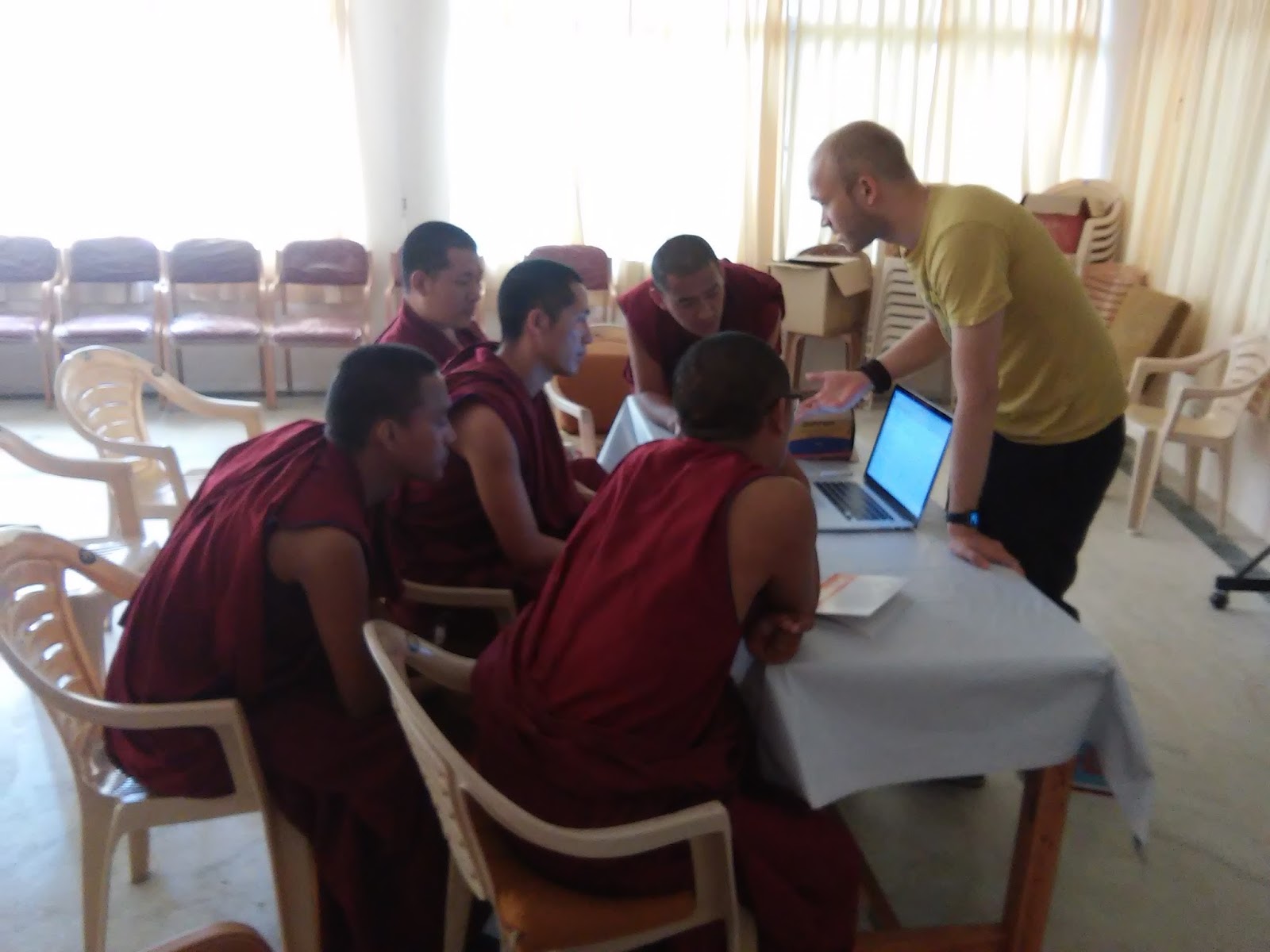
Monks pouring over a computer running JASP in stats class


In addition to spending time on standardizing experiments, we also spent quite a bit of time making predictions with the monks. This was a significant challenge, because obviously monks do not have the same space of possibilities in their heads that we Western scientists do (e.g., things either differ in their magnitude or there is a linear or non-linear relation between them). The monks found it a challenge to make predictions--maybe because guessing is not really encouraged in monastic debate you are drilled to be absolutely certain of what you are talking about (and in predictions you can never be). Nevertheless, we managed to get some predictions, and at least some of the EEG predictions were actually borne out! This is always a major happy moment for a scientist.

monks getting ready for EEG
Of course predictions are not always borne out, and we are also still sorting through a lot of confusing data that we still have to make sense of. Actually, the hard part of doing psychological science is that when you present a person with a task, quite often do they behave in quite a different way than we expected. This is mostly because the tasks we use to learn about the mind are really mostly geared towards Western college students (see this paper for a great discussion of that issue). As we slowly see all these interpretations of the tasks happen, we develop more appropriate instructions, and hopefully in the future also new tasks that are made more for our target population. As a first step in preparing for this, we held a methods and statistics class, which was actually met with tremendous enthusiasm: almost the whole monastic core team showed up voluntarily for this class on their free day! We had a lot of fun talking about t-tests, anovas and different kinds of variables, and we even played around with Bayes Factors in JASP!

This trip also was one of lots and lots of discussions. Actually one of the things that became obvious to me this time around is that the most insightful discussions actually happen when you are working one-on-one, not when having a large group discussion. For example, I spent a good amount of time sitting with my monk-colleagues to translate the debates (well, they translated, I wrote down the translations). In the course of this process I learnt a lot of tricks that happen while debating, such as interpreting a question differently when you do not know the answer to this question.
behavioural testing in action

This time we also met for the first time some Western monks studying at Sera Jey. Both with them, and with some members of our monastic collaborator team who studied in the West, I had some really interesting conversations about how monastic university training differs from Western university training. One thing that differs is the extent to which it actually informs how one practises and lives one's life. In addition, the debate training is a tool that is very confrontational: if you do not know something in great detail then there is no place to hide. This has as a result that you learn to really understand things in depth, but probably also that you build up quite an emotional resilience to being continually challenged. In short, it was a very illuminating visit, and such a precious chance to get to hang out in the peaceful monastery environment and the amazing group of monastic collaborators!
Last but not least: our study was featured in the Times of India!

Saturday, June 03, 2017

Running around a retreat with cell phone in hand--an opportunity to find spaciousness in busyness

I attended a retreat with my teacher Sogyal Rinpoche over Ascension day weekend. As I am writing this, after four intense days, I cannot help but feel tremendously spacious and relaxed. That is actually pretty odd given that I went there with a healthy dose of aversion, feeling tired and somewhat sick, and then spending the full four days of the retreat running around with phone in hand from 7:15 am to 9:00 pm. How could this be?
Sogyal Rinpoche teaching in Amsterdam (picture from Facebook Rigpa Nederland)

People attending the teaching; the dots dress on the far left is me (picture from Facebook Rigpa Nederland)

Going on retreat with Sogyal Rinpoche you know one thing, and that is that everything is going to change all the time. The only thing that is certain is the time at which the first session starts, and from that moment, everything is in a constant flow. The reason I was running around with the phone in my hand this time around was that I was the so-called "teaching services coordinator", who has to make sure that changes in the program are communicated to all the relevant teams, that every team is doing its work properly and that everyone has the materials they need and know what to do. In other words, this roles requires you to constantly be in touch with everything that is happening in all the different places, and to constantly be "in the change." It felt a bit like the retreat was an organism, and I as a teaching services coordinator had to feel what it was doing.

One of the big themes of the retreat was the "twit-twit mode"--a mode of being very busy and not being aware of what is actually happening. This mode of being sounded very familiar to me, and therefore the retreat was a fantastic way to work with it. The idea is that if you are connected to the awareness that is always present in your mind, then you will be able to hold your ground, instead of being swept away by busyness. I noticed that I was able to get a flavour of this at the retreat, because I was able to listen to the teachings on meditation in the nature of mind, and then immediately go back to working to hold the retreat. In that way it was quite easy to experiment with that awareness. Another beautiful idea that Sogyal Rinpoche used to describe this state of mind was that our ordinary mind would be consumed by the awareness of our nature of mind, instead of our ordinary being consumed by confusion. And when we are confused, we are easily burnt out because we cannot prioritize.

An important part of being aware is also being able to listen. Sometimes working together is benefits from less focus on results, and more focus on just getting together and listening. In fact, when you are with people, it's not what you say, but how you are. What is incredibly helpful is just to be open, loving, and compassionate, and then things may resolve themselves. This is both the case for situations between people and for our own mind: when we leave our mind in its pure awareness, then we can also find our true home. This is a true friend that is always there, whereas all other friends will some day disappear.

A further theme was the "throwaway culture" in which we live nowadays, in which we always want quick fixes yesterday, instead of going for more durable solutions. In particular, we are not willing to spend time and effort on a spiritual path that does not give very quick improvements. Moreover, we always want new things, and quickly get bored. I found that this analysis of present-day society rang true to my own experience, especially our consumerist society.

In addition, we often look for happiness outside ourselves. But actually, the source of happiness is inside ourselves: in a sense of joy and appreciation for what is always there. This ability to transform everything that happens into something good is the essence of Vajrayana buddhism. It reminds me of a Dutch poem: "if you look carefully, then you see that everything is colorful." Everything is in fact a display of clarity, joy, and wisdom, but it's so easy to forget that in the nitty-gritty of our everyday experience. Similarly, we can find joy in our work--even when we are very busy--when we are inspired by bodhicitta and caring for others. But if we just do the work to get ahead and to gain recognition then we will quickly burn out.

In summary, I felt the retreat was very much about bringing together the absolute teachings about the nature of awareness with the nitty-gritty of everyday life. I was able to get a taste of what happens when you get let go of the "twit-twit mode" and instead expand your awareness to everything that happens in the retreat, being in touch and not so much worried about little things. An inspiring way to find space in my own mind!

Tuesday, September 13, 2016

Minding and finding the gap

I recently went on a retreat in Lerab Ling, a Tibetan style Retreat Center with an authentic Buddhist temple in the south of France. A retreat is a period that you step away from your ordinary life and focus intensely on spiritual practice, instead of the mundane concerns of ordinary life. For me one of the most important themes of this particular retreat was "the gap." While the gap has a very specific connotation in the teachings, metaphorically it is a very important concept.
First of all, a retreat in itself is a gap--a gap between our ordinary ways of thinking, completely reactive and preoccupied with whatever is at hand. Because a retreat is a place where you are in a completely different context, it allows you to take a step away from your ordinary thinking patterns and take a more bird's eye perspective. Sometimes you need a full retreat to remind you that there is actually the possibility of a gap, but of course the gap is always there. There is always a space to take a step away from your ordinary thinking. Just take a breath, and drop all your concepts and preoccupations, and there is a gap. It is so easy to forget that! In fact, I think it takes a lot of courage to break through our ordinary thinking and take the space to just be for a moment. And even if you try, sometimes you may feel as if it just doesn't work to drop your preoccupation. That is fine too. You can even let go of the concept of letting go. This may seem paradoxical, but sometimes when trying it out, this can just work. Why is engaging with a gap so important? Very often we keep ourselves busy from early morning to late at night (at least I do!), and there is no space to think about why and what we are doing. We are just following our mental habits. Making a little gap allows you to step outside these habits for a moment, which may provide you with a new perspective. Moreover, I find that I feel less stressed when I make a moment to stop and observe the gap. Another thing a "gap" can do is to consolidate our knowledge and understanding. A traditional Buddhist method for contemplation is to alternate periods of analytical thinking about a philosophical issue with periods of just resting. The idea is that when you rest, the knowledge becomes more embodied. Wouldn't it be an interesting experiment to try that out with things that we are analyzing and thinking about in our work? It may lead to interesting new insights, or maybe to a stronger memory of the material you are thinking about. I am definitely going to try this. So: it may be worth it to not forget the gaps, but to try to cultivate them. This blog is also posted on http://radicallyhappy.org/blogpage