Showing posts with label monastic debate. Show all posts

Monday, October 22, 2018

Viewing monastic debate through the lens of Western psychology and neuroscience: what can we learn?

I recently submitted a paper co-authored with probably more Tibetan monks than any paper in history (you can read a preprint here). The main point of the paper is to explain that while meditation research in the West has mostly focused on a narrow range of meditation practices such as mindfulness, there are many more practices out there, one of which is analytical meditation and debate. Why are analytical meditation and debate so interesting? As the Dalai Lama pointed out a few weeks ago in his talk in the Netherlands, reasoning and study, of which analytical meditation is the method, may be the best way for Westerners to engage with the Buddhist teachings. Even for a secular ethics that would be available for people from all religions, such analytical meditation could be useful.

So what is analytical meditation and what is debate? Analytical meditation is a practice of studying a text and contemplating it, asking questions such as "do I really understand what it means? How does that relate to other things I know? What follows from this statement? What is it consistent with? What is it inconsistent with?". In debate, you ask these questions to another person. In the tradition, such debates have a very distinct physical manifestation. You can find some videos and pictures from monastic debates a the website of the project.

In our paper, we describe what cognitive mechanisms we think are involved in the practice of debating. First you need to keep track of all the things that have been discussed so far, and this requires working memory. As the debate goes on, cognitive load increases. This may reflect in increasing engagement of a neural network called the fronto-parietal attention network, and this may also be associated with increasing inwardly-turned attention. In EEG measurements, such inwardly-turned attention is likely to be reflected in increasing brain waves in mid-frontal areas. Debating may also increase your speed of processing information, because if debaters do not respond quickly enough, then they are made fun of by their opponents. Furthermore, debate may promote mental flexibility, since winning a debate requires you to look at things from many different angles, and try to find an angle that your opponent has not yet found. Experienced debaters also say this is the most satisfying aspect of debating: it is a kind of research that may give you more insight into the topic when you consider the implications of looking at it in a particular way. This suggests to me as a neuroscientist that debate may require strong engagement of areas such as the anterior cingulate cortex and prefrontal cortex. Debating also is a strong motivator for memory training, since you can not go back to your textbook in the debate courtyard. Indeed we found that during a type of debate called "counting debate", in which the debaters review the texts and definitions, it happened more often that one of the debaters had "difficulty remembering" than during the logic debates, but even there difficulty-remembering could occur. Since debate uses logical reasoning as a foundation, it may also train this cognitive skill. We are now measuring that with reasoning tasks (stay tuned for results!). But debating is not just a cognitive practice: it also requires resilience to strong emotions such as anger, anxiety and more. Once you lose your cool, you are likely to lose the debate. Especially during logic debates, the debaters face many self-reported difficulties. Nevertheless, in some preliminary data from a questionnaire, we found that more experienced monks reported fewer difficulties in regulating their emotions (also stay tuned for this). Finally, debate is a highly social form of meditation, and in another paper we report how inter-brain synchrony, thought to reflect mentally tuning into each other, changes over the different phases of the debate.

So why is all of this interesting? Maybe some of the techniques that the debaters use can also be helpful in our education system. For example, the movement aspect could be used to make the students more physically active. The technique of continually questioning everything that is being put forward and carefully examining its logical consequences could help to cultivate critical thinking. However, a significant challenge in this is that our education system in the West relies on covering a large amount of material cursorily and learning skills for managing information rather than really knowing a detailed area by heart. This makes it much more difficult to apply the techniques learnt in debate. But I continue to think about this idea. If you have any suggestions, let me know!

Sunday, July 08, 2018

Lesson I learnt from Tibetan monks: make sure you don't take yourself to seriously and play

The next #lojongchallenge slogan is "in daily life, be a child of illusion." The idea is that during meditation, you become more familiar with the idea that all phenomena are impermanent, interdependent and consisting of multiple things. However, only realizing this in meditation is not enough: you need to also embody it in your daily life. As I detailed in my previous posts, even just getting a taste of this already creates so much space in your mind, and so much humor.
monks playing around during a classroom activity demonstrating a signalling cascade with a movie-cut board


Some monks really love to play badminton, basketball or soccer!
The challenge is of course to remember to be a child of illusion--looking upon the world with the innocence and playfulness of a child--in the midst of the craziness of life. Probably my most powerful reminder of how this could work were my experiences teaching the monks at the Emory-Tibet Science initiative. Although most of these guys were in their thirties and beyond, they were so tremendously playful, while also being dedicated at the same time. They were always up for little game-like activities in class. One day we studied visual adaptation by asking some volunteers to wear "pirate patches" (in reality those were sleep masks covering only one eye) and then having them go through an obstacle course in a dark room that had been created by their fellow students. They had so much fun taking pictures of themselves wearing their patch, then stumbling through the obstacle course (even the non-patch wearers wanted to try it afterwards). In the West, probably my students would have complained about having to do such silly things, but here everyone just played whole-heartedly in a game. But the monks were not just playing around--they were also studying until 1 am for their buddhist philosophy exams. I hope that i can learn some of the monk's playfulness. We need to have more in our world, that is often way too serious. I am convinced that having more playfulness will help to reduce stress and thereby improve mental health, and probably enhance success as well. It would be so much fun if during our scientific debates at conferences, we would pepper them with jokes and humor, instead of being worried about being serious and prestigious scientists.

In short, what I probably learnt most from the Tibetan monks is: don't forget to play. The added benefit is that it implements part of this Lojong slogan on being a child of illusion as well!

Tuesday, April 17, 2018

(Some) monks enjoy statistics and other lessons from a recent India trip

Kalden presenting our research in Allahabad
I recently went to India again to continue my collaboration with the monks of Sera Jey monastic university, who are learning to become scientists. This time, we started the visit with the International Conference on Meditation Research, at the University of Allahabad. For the first time, three of the monastic collaborators presented our joint EEG research on Tibetan monastic debate. It was amazing to see them present in a real scientific forum, which was even covered by the Times of India. As one of the monks reminisced, it was also quite historic that the presentation was held in a location quite close to the ancient Buddhist university of Nalanda. The conference also hosted many Indian and international scientists who talked about topics ranging from computational models of meditation (myself) to Hindu philosophy of meditation and its clinical use.


Video scoring in action

Getting our project overview ready


After this exciting meeting I flew to Bangalore, where I gave a few talks, followed by the most important part of the trip: a visit to Sera Jey monastic university. This time, the main goals of our journey were to start a questionnaire study and to improve the rating system of our EEG videos. When we record EEG during a monastic debate, we ask one of the monks to press buttons to indicate events such as agreement, disagreement, distraction, and more. But of course, a problem with this approach is that we do not know how reliable such ratings are. In scientific studies, it is then important to compute inter-rater reliability. We talked about this concept, and then proceeded to re-rate the videos of the EEG sessions we collected, such that it is possible to look at the agreement between raters. This turned out to be quite an interesting experience that led to a lot more discussion between the monks about how to decide when to press a certain button.

Talking about statistics
During this visit, we also had another important realization: that we actually never talked very much about project management. To accomplish a complex team project of the type we are working on, it is crucial to actually divide tasks between individuals, and to have a shared vision on what needs to be accomplished and when. Once we realized this, we put together a big scheme that is now decorating the walls of the Sera Jey science centre, which indicates what the questions are that we are trying to answer, and who is responsible for what part of the work. Such discussions are probably even more necessary when you are working with a multicultural team of Tibetan monks and Western scientists compared to when you are working in a small collaboration with a PhD student at a Western university, because there are just so many more hidden assumptions. Moreover, work cultures are very different, where the West tends to have fixed schedules and predictability, in the Tibetan monastery things happen when they happen, and it is hard to plan ahead (especially given things like power outages).

Despite all this, what was the most surprising thing I learnt this trip? Maybe it's that Tibetan monks like statistics (at least the ones we have been working with). They did not only seem to enjoy geeky conversations during the conference in Allahabad, but also were excited about statistics lessons we ran at the Science Centre.

Saturday, August 19, 2017

Science at the monastery gets real


I just returned from another study visit to Sera Jey Monastery in Bylakuppe, India. We are studying the effects of monastic debate and analytical meditation on emotion and cognition. Since this was already the fourth visit of the project, it was time to get real and get down on scientific rigour. In our EEG study, instead of just exploring different types of debate, we now developed a procedure in which each pair of debaters debated the same topic (a text on bodhicitta), got some chance to refresh their memory before the debate by studying the text for 15 minutes, and we used a standard classification for the triggers that the observing monks were using to score the debate. We even asked our observers to give the debates a grade, so we can in the future see whether the quality of the debate is related to some patterns of brain activity. In addition, the most interesting new feature of our EEG studies was more related to the frequent power outages: we bought a big car battery to run our EEG system off of!
We also took major strides in standardizing the behavioral tasks that we have been running by filming one of the monks explaining it while demonstrating on a tablet, and then showing this same video to all of our participants. The video demonstrations nicely combine standardization of explanation with a hands-on demonstration.
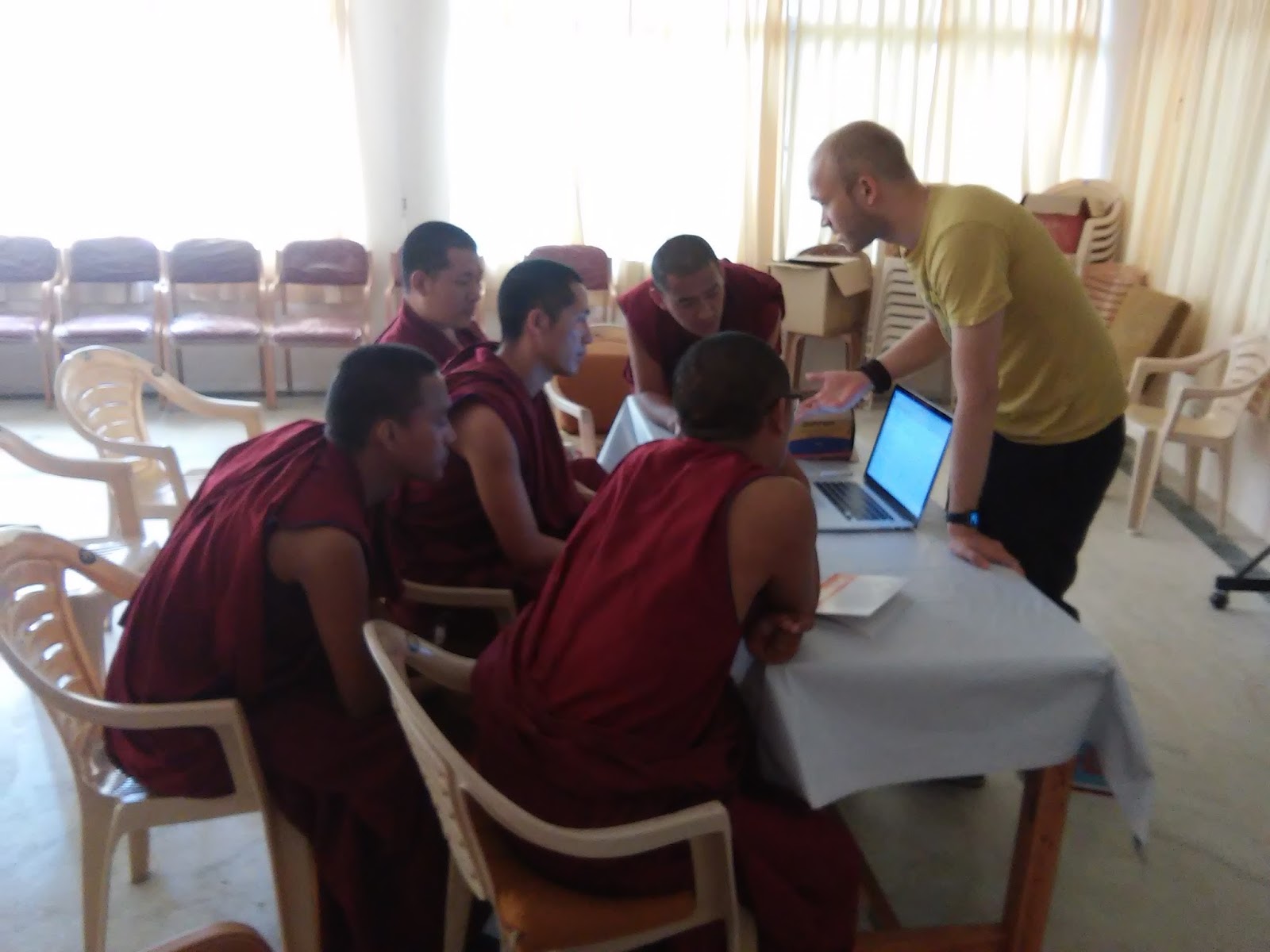
Monks pouring over a computer running JASP in stats class


In addition to spending time on standardizing experiments, we also spent quite a bit of time making predictions with the monks. This was a significant challenge, because obviously monks do not have the same space of possibilities in their heads that we Western scientists do (e.g., things either differ in their magnitude or there is a linear or non-linear relation between them). The monks found it a challenge to make predictions--maybe because guessing is not really encouraged in monastic debate you are drilled to be absolutely certain of what you are talking about (and in predictions you can never be). Nevertheless, we managed to get some predictions, and at least some of the EEG predictions were actually borne out! This is always a major happy moment for a scientist.

monks getting ready for EEG
Of course predictions are not always borne out, and we are also still sorting through a lot of confusing data that we still have to make sense of. Actually, the hard part of doing psychological science is that when you present a person with a task, quite often do they behave in quite a different way than we expected. This is mostly because the tasks we use to learn about the mind are really mostly geared towards Western college students (see this paper for a great discussion of that issue). As we slowly see all these interpretations of the tasks happen, we develop more appropriate instructions, and hopefully in the future also new tasks that are made more for our target population. As a first step in preparing for this, we held a methods and statistics class, which was actually met with tremendous enthusiasm: almost the whole monastic core team showed up voluntarily for this class on their free day! We had a lot of fun talking about t-tests, anovas and different kinds of variables, and we even played around with Bayes Factors in JASP!

This trip also was one of lots and lots of discussions. Actually one of the things that became obvious to me this time around is that the most insightful discussions actually happen when you are working one-on-one, not when having a large group discussion. For example, I spent a good amount of time sitting with my monk-colleagues to translate the debates (well, they translated, I wrote down the translations). In the course of this process I learnt a lot of tricks that happen while debating, such as interpreting a question differently when you do not know the answer to this question.
behavioural testing in action

This time we also met for the first time some Western monks studying at Sera Jey. Both with them, and with some members of our monastic collaborator team who studied in the West, I had some really interesting conversations about how monastic university training differs from Western university training. One thing that differs is the extent to which it actually informs how one practises and lives one's life. In addition, the debate training is a tool that is very confrontational: if you do not know something in great detail then there is no place to hide. This has as a result that you learn to really understand things in depth, but probably also that you build up quite an emotional resilience to being continually challenged. In short, it was a very illuminating visit, and such a precious chance to get to hang out in the peaceful monastery environment and the amazing group of monastic collaborators!
Last but not least: our study was featured in the Times of India!

Tuesday, November 29, 2016

One trick for slowing down: study Tibetan monks in India

I previously blogged about my study of monastic debate in Tibetan monks in India. Last July I returned for another research visit. It was very exciting to get to go back to these wonderful, cheery individuals. While the purpose of our first visit was just to try things out and come up with a model of what the monastic debate that these monks do might be, this time it was a matter of getting down to business and actually collecting data.


I spent the first few days of this trip in Bangalore, networking with scientific colleagues. One of the places I visited was NIMHANS, a premier mental health institution and research facility. What was very notable was that unlike in institutions in the West, here the care was not just taking into account the patient, but also his/her family. This meant that the complex had big parks and gardens where whole families could just hang out with the patient. Moreover, conventional scientific approaches to mental health were sisterly placed next to ayurvedic approaches. Similar to in the West, there was substantial interest in meditation interventions, and scientists with labs studying the basic science of, for example, decision making, often also have a research program on meditation. It was really interesting to see how things that we in the West tend to think of as separate are here were much more integrated.

Once my American colleagues arrived, we drove to Bylakuppe, the Tibetan settlement where Sera Jey monastery is. We stayed in the very quiet guest house, which has a lovely garden with tea stall. Unlike our previous visit, nothing was going on at this time, and the place looked deserted. The only thing that was busy was...us! I had made an ambitious schedule for running behavioral studies, EEG studies, and discussions. Due to some poor preparation, I was still finishing programming tasks on a tablet (it's really cool that OpenSesame allows you to program tasks that just run on a tablet!). Consequently, I was totally absorbed in my laptop, instead of hanging out with the monks. And actually, for doing research in India... this is the most crucial thing! Research in India does not primarily proceed by making a tight schedule and squeezing in as much as possible, but rather by hanging out and being in touch with what happens. Only then can you see what is really happening, and can the monks feel comfortable to approach you and share their wisdom and ideas. So, once we realized this, we actually consciously slowed down.

In the West, we are used to just showing an undergrad into a cubicle with a testing computer, letting them do the task, pay them, and get them out again. With the monks, we actually first leisurely introduced ourselves, explained why we thought their method of debating was interesting, then started with an experiment, showing how the experiment worked slowly, and afterwards had a nice chat about science, monk life, consciousness, world peace, and more. We learnt a lot, and I think the monks did so too. One important lesson was that what we find simple in using a computer may not be as simple for a monk who rarely uses one. Tasks that we administered on a tablet seemed much easier than tasks administered on a laptop. And the younger monks seemed to find the computer tasks much easier than the older monks. Something to think about in our next studies...

On the last day we were once again reminded of slowing down. While we were walking to a place to have lunch, one of the dogs that was following us around got hit by a car, ran off howling to the side of the road and died. One of those moments that brings the reality of life and death quite up close. Somehow it really touched our hearts very deeply as we watched but could not do anything. A precious reminder that life is much too short to squander it being busy doing lots of things without being present to what is.
(also posted on http://radicallyhappy.org/blog/2016/11/28/one-trick-for-slowing-down-study-tibetan-monks-in-india)