Wednesday, October 05, 2022

Opening the mind through travels

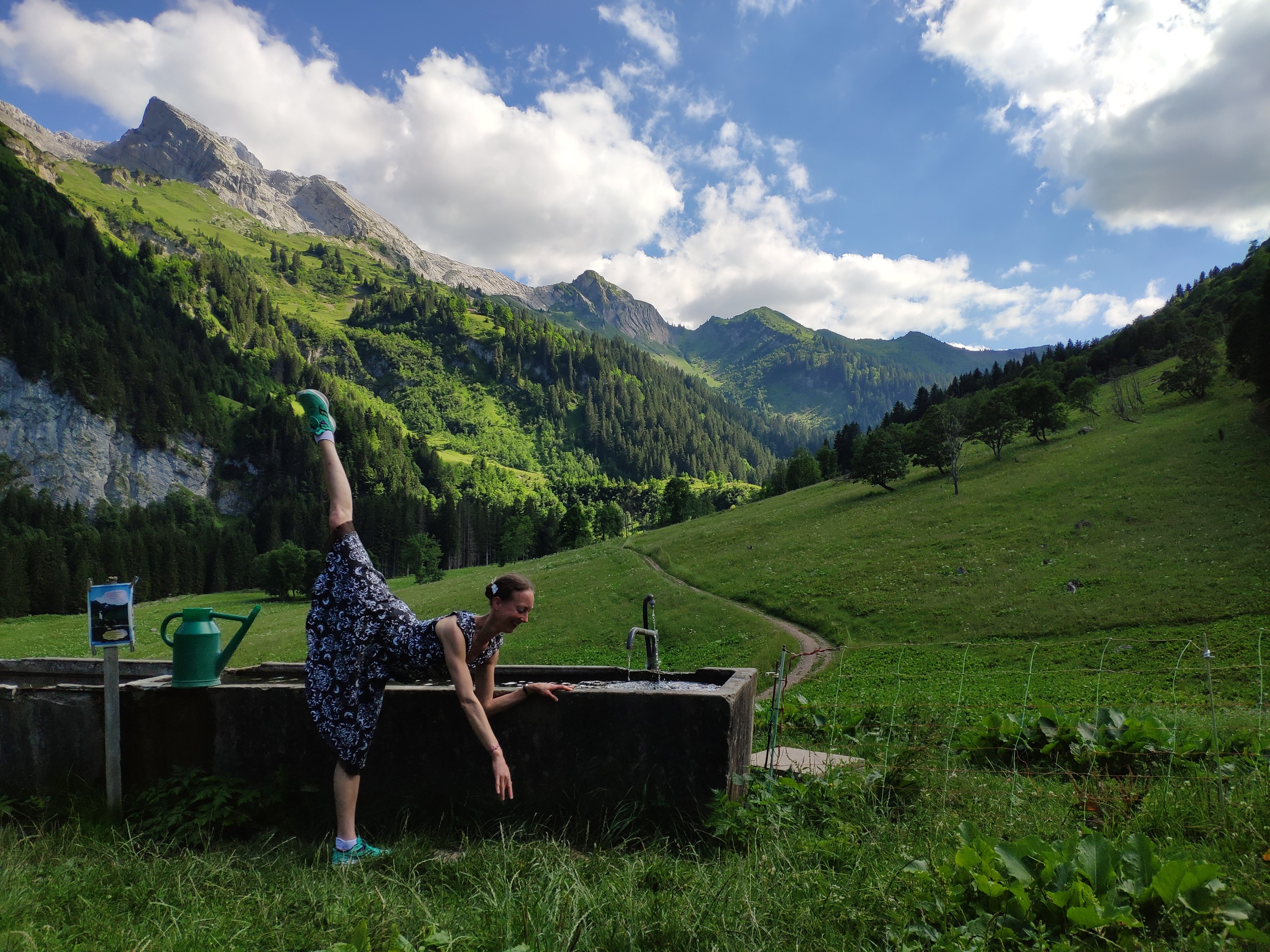
As I am finally able to travel again, I reflect on how amazing travel is. Even though I did not feel unhappy during the pandemic, I don’t think I realized how much I missed travelling. I am sitting here, writing this essay during my first trip to India in more than two years. The world has changed significantly, with not only a pandemic but also a stronger and stronger realization that climate change is real and a war raging in Europe. This makes me sometimes wonder whether it is still a good idea to travel. Is there even a reasonable argument to be made to spend so much kerosine for flying to other continents? I think there is, but at the same time I think it is critical to engage in sustainable travel. For instance, I have put myself on a flight diet, meaning that I will not fly to India more than once a year, and I will not fly to the Americas more than once a year. To allow for this, I try to make each trip longer and pack in everything I can think of, rather than flying back and forth. Yet, the reason that I think it’s still justified to travel is that it also provides a potential solution to many of our societal problems. Specifically, I think it can make significant strides in reducing the divisiveness in society that is currently magnified by the filter bubbles created by (social) media, and secondly it can help us become more naturally eco-friendly. Let me discuss each of these two in turn.

Visiting the Taj Mahal with Delhi By Cycle

Visiting the Taj Mahal with Delhi By Cycle

Travel can give us more understanding about other cultures and other viewpoints, by exposing us deeply to other people. An example of this was my trip with Delhi By Cycle to Taj Mahal, cycling through the small villages of India while learning about the life of Krishna, and the history that created Taj Mahal. In today’s filter bubble it’s so helpful to create deep experiences of unfamiliar cultures. For me as a rich Westerner, it makes me also acutely aware of the tremendous privilege I have: that water is coming from the tap, that electricity and internet are always there… Travelling in India, I experience, even as a tourist, what it is like that those things are not always there. And this has a profound effect on the mind as well, because it gives you a visceral experience of impermanence—that life is not always controllable or predictable. And realizing impermanence then allows you to appreciate what you have much more, and also helps you prioritize the most important things, since you don’t know how long it will last.

Near the Ganges in Rishikesh

The second reason travel is valuable is that it can make us more aware of environmental issues, when it allows us to experience nature in such a deep way that we feel in our body the need to protect it. I felt this very clearly last year when I saw an erupting volcano in Iceland last year, and also this year when I got to bathe my feet in mother Ganga in Rishikesh. These two experiences made me feel so tremendously connected to mother nature—almost as if you are touching mother Earth directly. As a result, paying attention to climate change comes much more naturally—not because I think I have to behave that way, but because it feels like it is the right thing to do.

In short, although in the short term, travel may be associated with some pollution, when engaging in sustainable tourism, such as taking tours by cycle and by walk, travel can do a lot to transform our minds and make our behaviour naturally sustainable.

 

Sunday, August 28, 2022

Remembering the important things

I just got back from a Buddhist retreat in the south of France (the beautiful Tibetan Buddhist temple of Lerab Ling). It's such a gift to be able to spend a good week just thinking about the Buddhist teachings and the meditation. The focus of the retreat was meditation, and there was lots of space and time for practice, which for me is the most important thing. I feel like I already received so many teachings, but I don't have the time to put them into practice. 
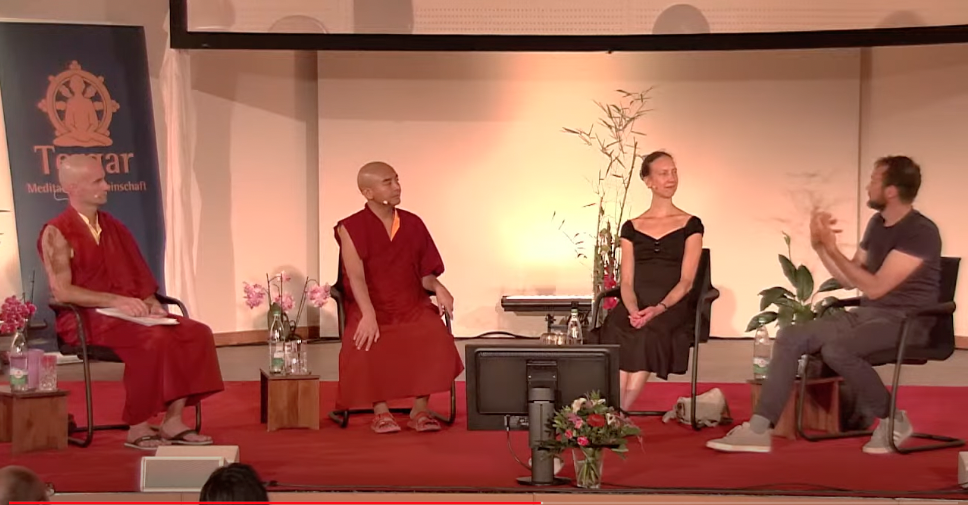
Impression from the dialogue with Mingyur Rinpoche

 Every day I started by going for a run, allowing me to move my body. The first day was kind of exciting, because it had been a good 4 years since I had last been to this retreat centre, so I didn't know whether the running path still existed, and whether I still remembered it. Thankfully my body still remembered it, and actually it was easier than I remembered: usually on the big hill somewhere at the end of the round I would need to stop halfway to catch my energy, and this time I was up before I knew it (maybe it was all the zhemfit I have been doing?). 

My favourite spot to practice on top of the hill
 What I found very interesting was that being in this space really made it so easy for me to completely disconnect: to ignore my email and my social media and the news (not that I completely forgot about the news: I did send a lot of prayers to Ukraine in the prayer sessions and also though about Salman Rushdie, who had been attacked just prior to me leaving for retreat). Having the space to simply be and enjoy the nature and the practice was just so much more rewarding than these other things (I remember this being much more challenging previously when I did my retreat at home). 

During a gorgeous day at Lerab Ling
This reminds me of the next #lojongchallenge slogan, number 46, which says "meditate on the three things that must not detoriorate". The three things the slogan refers to are the connection to the spiritual teacher, the enthusiasm for practice, and the sense for what actions are right and wrong. Now enthusiasm for practice is so much easier when you are in a space dedicated to practice, where all that is expected is doing the practice, and everything else is taken care of. What a luxury! Now the challenge will be to go back to busy everyday life, where I myself need to convince myself that practice is important, despite the millions of other things that are expected of me. Hopefully my happy memories of the profound sense of well-being and spaciousness will help me here. 

 Another thing that can help me remember my enthusiasm for practice is an experience I had in the middle of the retreat, when the centre was hit by severe thunder storms (thankfully I was staying in a wooden cabin, so unlike people staying in their own tents, I was very safe). Earlier in the day, I had been sitting on my favourite meditation spot on top of the hill, and I felt the strong winds, but despite all of that my mind felt quite settled and stable. Then I went down to the temple for teaching and practice, and we heard the news that the major had sent a warning to the retreat centre that a major storm, possibly hurricane, would hit the centre, and we needed to be prepared (people in personal tents were asked to sleep over in the temple to ensure their safety). What was interesting that now my mind completely jumped all over the place, even though at that point the weather was almost the same: now I started to worry a lot about things like whether my running shoes would fly away (they were hanging out at the door of my cabin). It's amazing how our mind dramatizes things so much, and creates a lot of suffering that way. But that's why we do the practice: to become aware of this pattern, and instead of mindlessly following it, to gentle observe it and let it go instead. 


View from my run 

Impression from Lerab Ling


 The second thing that the slogan asks us to remember is the spiritual teacher. In the Buddhist teachings, the teacher plays a crucial role, as an embodied role model for the path to enlightenment. They are so inspiring because they live in the same world as we do, and give us examples in how to deal with that more sanely. Sometimes even thinking of the teacher can put you in a more sane and wise state of mind. In fact, that is the essence of the Tibetan Buddhist practice of guru yoga. One teacher who currently really inspires me is Mingyur Rinpoche, whom I had the tremendous honour to dialogue with just prior to my retreat. In his way of being, he shows how to maintain a joyful mind no matter what happens to you (I could really use that reminder in a very rough train journey on my way to the retreat, where I arrived with 4 hours delay at 2 am in Montpellier, the city closest to the retreat centre...). If you want to know some more concrete examples, I highly recommend his book In love with the world or the movie about his wandering retreat Wandering but not lost (we also got to watch this after the dialogue: what a treat!). 

 The final thing to remember from the slogan is how to behave as a decent human being. The Buddhist teachings are actually very simple in this: rather than giving you a list of rules, the simply ask you to do not harm others, and where possible to help. Of course in reality this is not so simple, because sometimes helping in the short term can be harming in the long term--something I reflect on a lot in the context of climate change (hence my frequent train journeys and avoidance of flying where possible). It's so important to keep reflecting on your actions. I try to remember (not always successfully) to take some time at the end of my day to reflect on what I did, and whether that is in line with my values, and also at the beginning of the day to set my intention to be of benefit. When I do manage to remember these things, I certainly feel so much more fulfilled...
Impression from Nurnberg

Wednesday, July 20, 2022

An amazing ballet adventure with some unexpected connections to Buddhist philosophy

 I am writing this on the way back from ballet camp: nine days of dancing with amateur adult ballet dancers from across the globe. It was such an amazing experience that I want to try to capture some of it by writing it down in a blog. The adventure started with a quite disastrous train journey from the French Alps (see my previous blog) to Morlaix, in Bretagne (France), since my train from Geneva to Paris had more than one hour delay, which caused me to miss my connection in Paris, and hence I was two hours delayed and missed the welcome party of the ballet camp. Thankfully the people in Morlaix are very nice, and my bed & breakfast host was willing to welcome me more than an hour after the check-in time ended, and the ballet camp people came to pick me up by car from the train station. It was such a warm bath after such an exhausting journey. Nevertheless, it was already very exciting to meet people from across the globe who all had been making their way to ballet camp. 

a view of beautiful Morlaix

The next day, after enjoying the delicious breakfast made by my B&B host Nicholas (which included crepes and all kinds of cakes), we were called to go to different studios in the city of Morlaix, where we did our first class, and then different people started to learn their first pieces of the ballet. This part was a bit disorienting as some people seemed to already know variations, and it was a lot of sitting around. Nevertheless, this was also a great moment to chat with the fellow dancers and get to know them. And before I knew it, I had learnt my first pieces, so in the time that others were learning I could work on practising my own variations or chat with the others. It was so interesting to hear everyone's stories! It was also beautiful to see how everyone was helping one another. In this ballet camp, we were also accompanied by two professional dancers who were dancing the lead roles, and they were so incredibly nice and welcoming. They were curious to talk to us, were clearly helping with rehearsing and dancing alongside us, as well as spending time with us. It was so heart-warming to feel this spirit of everyone being welcome, no matter their level of ballet experience.

The place where we were practising was a fascinating place: an old tobacco factory that had been turned into an arts space with lots of performances and other happenings (and a ballet school). The only challenge at this time was the floor, which was very slippery, at both of the studios where we were practising (more on this later). At the end of the first day I was so nice to come all together for a class with the organizer, Julie Dupas, who led us in a sequence of ball rolling exercises to massage our muscles, and then it was time for dinner. I mostly walked everywhere during the week, which was a great warming up at the beginning of the day, and cooling down at the end.


As the week progressed, learning got more intense, and in the 2nd and 3rd day, it became quite stressful, as I felt like I was not remembering anything. Thankfully the teachers, Alex Negron and Laura Poikolainen, were very patient with us, despite us messing up for the hundredth time. But slowly, slowly the ballet became more and more familiar. Having said that, the days were pretty intense, starting at 9:15 in the morning on most days with a ballet class, then launching straight into rehearsals, which lasted until lunch around 1 pm, after which rehearsals continued until the muscle relaxation class at 17:00. Sometimes we had a break in the middle when we had to change studios with a short walk through the lovely city of Morlaix. We avoided doing pointe work since the floors were so incredibly slippery. After a few days, we started to rehearse in the actual theatre where the show would take place, and this had an actual marley floor, which made us so happy since it was slippery. However, after only about one day, disaster started to strike as also the marley floor became slippery! It became scary to dance, so rehearsals and classes were very nerve-wrecking... (even more than they already were anyway because it was such a challenge to memorize all the steps...). Amazingly enough, I did not have major muscle ache--maybe the tough zhemfit classes I had been doing were paying off!


Then came the day of the dress rehearsal. Everyone was freaking out, but the teachers went to their last resort: spraying the stage with 7up. And yes: that worked! We had a squaky and sticky stage (of course squaky was not intended, but at least it allowed us to dance without being afraid to break our legs). It was quite nerve-wrecking to do a full performance after having rehearsed it only for a week, but somehow magically I made it through without major mistakes. At times I had to pinch myself that I was there: for the first time of my life learning an actual ballet from the classical repertoire, surrounded by dancers, wearing a tutu and pointe shoes! And then the next day, we had the actual show! I was quite nervous, but also so excited to dance this happy ballet with my new ballet friends. Although this vacation was clearly not stressfree, it feels so good having done it and created this beautiful piece of work together! (see my instagram for some pictures).

For the regular readers of my blog, you know that I am working through the Lojong challege. Lojong is a set of slogans for training the mind from the Tibetan Buddhist tradition. In the Lojong challenge, I go through each of these slogans and see how they apply to my life. We are now at slogan 45: Take on the three principal causes. This means that we are encouraged to take on the three principal causes for enlightenment, which are working with a good teacher, cultivating a pliable mind, and creating life circumstances conducive to training our mind. I think that when applied to ballet, this post shows how in the past week, I definitely experienced all three conditions. However, I think the learning process of the past week was to some extent also a mind training in the sense of Lojong, because the kindness of people encouraged me to also practise kindness, and the performance process itself was a great invitation to let go of all judgment and simply be in the moment, like for my last performance. Moreover, ballet performances are also a moment where it is important to let go of your own bubble and to open up yourself to the full interdependent circumstances that create the performance together. If you are in your own bubble, it does not work, because you will then easily end up being in the way of others, or failing to react to what is going on on stage, including unplan

the whole group

ned things. So the Buddhist views of interdependence and selflessness are very helpful here. Sometimes ballet training and Buddhist mind training have quite some overlaps!


Saturday, July 09, 2022

Inter-subjectively exploring intersubjectivity in the French Alps

 In the last week, I had the good fortune to be part of Mind & Life Europe's ENCECON meeting. In this meeting, philosophers, neuroscientists, psychologists, meditators and more get together to discuss how we can study first-person experience and bring this full experience together with objective, third-person methods. This year's theme was "inter-subjectivity", which we explored through a series of meditation exercises, interviews and discussions. The interviews were not any interviews, but ==microphenomenological interviews, which is a method to explore experience in a very detailed way, trying to focus on the experience itself, leaving out our habitual theorizing. Another important characteristic of microphenomenological interviews is that they invite us to slow down, and repeatedly relive our past experience, so we become more aware of the details of these experiences, using more of our senses than we typically report on. What i found really interesting as a scientist was to observe the so-called evocation state, in which people show signs of being disengaged from the current context, something which we in the mind-wandering literature term "perceptual decoupling". The interviewees at this point slow down their speech, may close their eyes and sometimes repeat gestures from their past experience. What is challenging about this method, is that to explore a few minutes, or even less, of experience, you typically have an interview that lasts 30-60 minutes. At the same time, this is a state of pure contemplation--engaging in a reliving without judgment. Yet, this makes it very difficult to combine with other methods of research such as neuroimaging, because for most of these experiments, we need many repetitions of the same instance of experience. So, we had a lot of discussions about this.

What amazed me during this meeting is the profundity of the experiences that could be evoked by very simple meditations. On the first day, we were asked to simply bring to mind a person whom we felt grateful to. I kind of missed this instruction because I was so tired that I fell asleep during the meditation! On the second day, we sat next to one other person, and were asked to open ourselves up to the presence of the other person. It was fascinating to see how many people reported sensations of profound connection or even merging with the other person, as if they had a single body. On the third day, we were sitting together with the full group, and first we were asked to open ourselves up to the presence of the others, and then to hold each other's hands. In this moment, many people felt completely connected to the others, and lost a bit of their sense of self.


Many of our discussions revolved around the topics of how these practices helped to melt down the boundary between self and other. This was profoundly effected by the meditation practices we did, and of course by the fact we were staying together in a beautiful place in the French Alps. What this reminded me of is how helpful these simple practices could also be for reducing our destructive emotions, something that the next Lojong slogan talks about, which says "Train in the 3 difficulties". What this refers to is first the difficulty of becoming aware of your negative emotions, then secondly the difficulty of applying antidites to these negative emotions, and thirdly the difficulty of making the first two a habit so they change the way you are. Now when you are as profoundly connected as we were during the practices, the interesting thing is that negative emotions such as anger, jealousy and craving do not have even a chance to arise--they simply dissolve in the void. How wonderful would it be to do these practices together more often!

We also reflected on the role of the body in all this, because we found that touching each other's hands during the meditation practice had a profound effect. It dramatically amplified the feeling of having a single body with each other. Interestingly, this mirrors my findings from a dance experiment that I hope to write up soon, in which we found through working with dancers that the most powerful ways we can connect through movement is not by synchronizing our movement with another, but rather by moving as if we have a single body, or by engaging in a movement dialogue. So, it may be quite interesting to study more about how moving together can affect our thinking, and how such simple instructions ask bringing to mind the presence of others can do so. I am also curious whether we can use the perceptual decoupling state to better determine when microphenomenological interview information is reliable, and when it is less reliable (because people are not actually reliving their past experience, but rather theorizing about it). Finally, I am curious whether we can apply the experience of microphenomenology in zooming in on lived experience, and staying away from our theories about what's going on, to improve our societal discourses, which are so often stranded in these theories and stories, rather than simply being present with the facts. And the stories are what we know results in so many destructive emotions...

Sunday, June 19, 2022

Explorations of mind-wandering in Ljubljana

 Last week, I taught at the TECT (Training Embodied Critical Thinking) summer school, which this year took place in Ljubljana (Slovenia). Just like last year's summer school in Iceland, it was a treat to be there. What is cool about this summer school is that it is a very interdisciplinary place where students with backgrounds ranging from architecture and design to philosophy to neuroscience to artificial intelligence get together to investigate the mind and experience. This investigation is very much grounded in the body and uses techniques such as microphenomenology, thinking at the edge, and exploring the mind through meditation.

During the summer school, I was co-teaching the track on meditation with colleagues Urban Kordes and Toma Strle, and we alternated periods of meditation with a sharing of experience during this meditation to reach a better understanding of mind-wandering. During this track, we started by practising meditation, before everyone introduced themselves, with the reasoning that by practising meditation together, you get to know each other much better than by just sharing your biography. This was proven to be indeed the case, because at the end of the week, the group naturally started to feel very connected to each other during the meditation practices, wanting to hold hands in their imagination.
Probably quite critical in this process was a mid-week excursion to explore some of the beautiful nature of Slovenia, where we wandered around in a park with beautiful caves, springs and forest. We practiced among other things a "depth walk", in which we walked around in the environment with a companion, and traced a path driven by paying attention to subtle internal cues, while at the same time we verbalized what we noticed. It is amazing how much more you notice when you walk like this! Suddenly becoming aware of angular shapes in the natural environment, the springy nature of the ground, or the play of the light. It was also very interesting to notice how this natural environment shifted our thinking patterns.


Now back to our meditation course, exploring mind-wandering in the environment of the city, we ended up with very deep discussions about what is mind-wandering, with probably the most fascinating moment being a "mind-wandering meditation", where we asked people to mind-wander, instead of meditating, and suddenly all the thoughts were gone! We also deeply went into questions of why we mind-wander, whether there is agency in mind-wandering, and how mind-wandering compares to daydreaming and other mental processes. One interesting insight that came was of the parallels between wandering the city, and wandering in our own mind in meditation, and how good that feels when we can simply wander in a non-sticky way, which is the true definition of mind-wandering according to Kalina Christoff and Zach Irving. Yet, it is not so easy to get there, but I think the practices we did during the summer school helped us to tune into that.

This brings me to the point of other practices we did during the summer school: apart from my teaching about mind-wandering and meditation, I also taught movement practices, in which we explored the body through different kinds of dance movement, to tune better into our bodies. Not only was that a great way to start a long day of discussions and thinking, but it also was so cool to bring my dance experience into work at an academic context.


In a way, the summer school was like a retreat, where I got to connect back to my embodied experience, ask big questions about my research and life in general. This is quite in line with the next #lojongchallenge slogan, number 43, which says "observe the two, even at the risk of your life". Basically the two refer here to commitments of the Buddhist teachings in general and the Lojong teachings in particular. In this case, for me the most important lesson is to not forget about the importance of and the power of meditation and tuning into experience, rather than being occupied with things that are visible from the outside, but do not lead to transformation. I myself find it particularly difficult to spend more time on meditation when I have an endless todo list (so this makes it great to have a summer school where you meditate for your job!). And yet, when I practise, I notice just how much sanity it yields, and what better way to study mind-wandering than to observe your own mind... 

Monday, June 13, 2022

Using Buddhist slogans to inspire a conducive mindset for a ballet performance

Picture by SBS foto marketing.
 In the last few days, I had the good fortune to participate in ballet performances. Finally the pandemic is allowing us to experience those again! As it turns out, the mental side of it was a pretty experiencing journey, which is also relevant to the next #lojongchallenge slogan (slogan 42) which is: whichever of the two arises, be patient. The idea of this slogan is that we constantly tend to want certain things and avoid certain other things--trying to get things we want and avoid things we do not want. I can tell you that definitely happens during a ballet performance, where there is the fear of making mistakes, or even worse, falling and injuring yourself, and the hope of shining and having a good time. Thankfully in the ballet school where I dance in Groningen, we have three shows, so when on Friday I felt quite engrossed in these thoughts about being afraid of failure and not so much able to enjoy the moment, I could play around with my mindset for the next two shows.


I realized that for me it was important to return back to my body, because our body is an anchor to experience, rather than the thinking-about-experience. What really helped me was to take time before the performance to really connect to my body by putting on my noise-cancelling headphones and doing an online class by Broche ballet. The teacher has a very calming and non-judgmental quality, really inviting dancers to inquire into their sensations and movements, rather than focusing on a correct or incorrect end-product. I also found that the beautiful music of the barre helped me to get into my happy space as well. 

View from the dressing room where I was warming up in my happy space (picture by Kelly Jennefer)

Then during the performance, I consciously practised appreciation. Rather than thinking about who was good or not good, I focused on the beauty of everyone at their own level, and consciously opening up myself to the connection with everyone who was putting together the show--in Buddhist terms: the interdependent circumstances that come together to create the performance, where everyone has their role to play (see also this quote for a beautiful description of that idea). It was amazing how much this changed my mind, because suddenly I shifted from a focus on myself to a focus on the system as a whole.

And when I was no longer overly focused on myself, I also was not drawn so much into judgments and thoughts. Because those judgments were exactly what was causing my frustration, because I started to make mistakes that I wouldn't make in class. Then the most interesting experience happened at the beginning of the last show, during a very happy tarantella dance. Somehow I sumbled over something and fell, right in the middle of the dance. Thankfully it was not a bad fall and I got up immediately and continued dancing straight away. But because now I had literally gotten back on earth, my body took over without too much jugdments and thoughts, and I enjoyed it like never before, I guess it also cannot really go down much from there! The show ended up the best one I did, simply because my mind was no longer seeking out any particular experience and rejecting others, but simply tuning in with whatever was there. In the end, I think my mindset work was almost the most fascinating part of the whole experience! 


Picture by SBS fotomarketing

In the dance where I fell flat on my face


Friday, December 31, 2021

Some highlights and low-lights of 2021

With the busy life I have, I often forget to think abo

Picture by Anna van der Meijden
ut what happened in the past year. So this time I thought it would be good to spend a bit of time reflecting. For me, the year was a year in which I spent many more days at home, like most people in the world, but also in my case this meant I spent a good deal of time dancing in my living room "dance studio". I must say that this dancing in my living room has been one of the pillars of my life that kept me happy and healthy when everything around my was uncertain and changing--a ballet class always has the same structure that never changes. More profoundly, in a way I am living the dream of my 11-year-old self, who wanted to become a ballerina. Evidently I am not a ballerina, but yet at the same time I am dancing almost every day, performing every now and then, I own a tutu and many pretty dresses, and I have the good fortune to know many dancers from across the world. Life's ways are mysterious...

Screenshot from the PhD defense of Oscar Portoles
Apart from this continuous undercurrent of the year, some more specific highlights are:

  • two of my PhD students--Christina Jin and Oscar Portoles--got their PhD! This was very exciting, both for me and for the students. It's been so great to see their hard work come to fruition! There is something magical about seeing people develop from being students to being independent academics who can confidently (even if very nervous) defend their work, and move on to new projects. And I have another PhD defense lined up for January!
  • since I could not travel to India due to the pandemic, I had bi-weekly calls with my Tibetan monk collaborators. I was so excited the moment we got to the point where they started to do their own statistical analyses on the data we collected together. It's been quite amazing to see them grow this much!
  • I did my first foreign travel again since the beginning of the pandemic. I made a trip to Iceland to teach at the summer school on Embodied Critical Thinking. Not only was Iceland an amazing place to discover, but it was also very gratifying to share my dance in an academic context. 
  • I subsequently made a few more work trips before Europe locked down again: to Paris, to Berlin, and to Lisbon, followed by Aix-en-Provence. There is something so profound in being together with colleagues (even if you have to wear masks), and to explore new places. This is certainly the part of pre-pandemic life I miss most! 
  • Watching a volcano in Iceland (picture by Dorothe Bach)
    During the conference in Aix-en-Province, I had the chance to bring my dancing life and my professional life together once again by doing an improvisational ballet performance while a cellist (who was also a neuroscientist) was also improvising, and we were both wearing EEG headsets (which did not work...). It was an incredibly exciting performance!
  • I chaired the European Mind & Life Summer Research Institute, which was a wonderful event, despite the fact that it was held online. I also got elected to the Mind & Life Europe Board. Mind and Life Europe is a beautiful organization that connects all the different parts of me: academic, spiritually and artistically.
  • I got to meet some of my colleagues in real life again and was back in the office for a bit, until the Netherlands locked down again in December.
  • throughout all the lockdowns I kept dancing in my living room and going on weekly runs with my running buddy. I also connected with many amazing fellow dancers through the internet, which is one of the main gifts of this pandemic. Thanks so much for my wonderful support group! We also had an online ballet intensive in June, which was such a gift: being taught by international ballet teachers was so much fun (even though I could only partly participate because of my ankle injury...). And in the last few months I have been able to really gain some confidence and skill in pointe dancing due to some focused practice with the online ballet studio Broche Ballet.
  • With the Young Academy of Groningen, I helped to give birth to a report on harassment and bullying at our university. A very sad report, but important stuff nevertheless. I hope it forms the basis for change towards a more socially safe university. The whole process in itself was very time-consuming but also taught me a lot about university politics.
  • In my faculty, the Young Science and Engineering Network that I helped to found acquired a more established position, and is now being incorporated in the decision making processes, which I think is a wonderful thing!
  • Iceland!
    I lived through an ankle injury which took about 5 months to recover. I was quite challenging to not be able to dance properly, and not jump, run and do all those things I love. Yet, also this taught me a lot about how my body works (and the importance of rest, which will surely be an aspiration for the next year!). One of the things that kept me engaged during that time was the 21-day ZhemFit abs challenge. I highly recommend it for anyone, with an injury or without.

So, with this year under my belt, let me dedicate to the well-being of all sentient beings, in the spirit of Lojong slogan 41, which says "Two activities: one at the beginning, one at the end." The idea is that we start the day by reviewing our intention and motivation. Of course this is an even better idea to do right now at the end of the year. You can focus on specific goals you would like to accomplish, but also on mental qualities you would like to cultivate, such as maintaining a more altruistic motivation. The advantage is that a motivation depends only on you, not on other circumstances, unlike many other kinds of goals. And then at the end of the day (or of the year in this case), you can review how it went,. what you accomplished and how you would like to improve. You can then take this with you in the next day, and in the next year. My aspiration is taking more time to review on a weekly basis in the coming year. 


Example of a meeting with colleagues in real life, where we went for a walk together


I am curious what the next year will bring. Thank you so much for being in my life, and happy new year!

Wednesday, December 29, 2021

Finding meaning in the dark days after Christmas with wonderful Lojong resources

The next slogan is number 40: counter all adversity with a single remedy. Whenever when life sucks, which may happen to many of us during this pandemic, we routinely blame others. However, this usually does not help very much, and in fact renders us quite powerless, because we cannot do much about what others do. If instead we ourselves take responsibility, we can at least do something about our role in the adverse situation. For example, when there is another lockdown, we can spend all our energy complaining, but that does not really help very much. We could also use that energy to think about who is suffering, and what we can do about it. Something like the famous prayer that says: give me the strength to change the things I can change, the patience to accept the things I cannot change, and the courage to know the difference between them.
For cultivating this wisdom, I came across two excellent resources recently: 
  • a set of teachings on Lojong by John Dunne and Roshi Joan Halifax. https://www.upaya.org/resources/exploring-the-power-of-lojong-2021-resource-page/ This includes a nuanced discussion of how we can work with our own role in adverse situations, how we can stay with a kind heart and self-compassion, but also take action to remedy damaging circumstances and avoid moral harm. 
  • One particularly powerful example in these teachings is the story of a sailor who gets hit by another boat. He starts yelling at the other boat, but no-one responds. When he finally gets closer, he sees it's just an empty boat. How often are we not yelling at an empty boat? I find it very helpful to think of the empty boat when I am in challenging (or simply annoying) circumstances. That takes so much of the edge off...
  • the Everybodhi podcast by Dungse Jampal Norbu, which goes through the Lojong slogans from a modern perspective. https://everybodhipodcast.libsyn.com
Enjoy!

Saturday, September 11, 2021

The beginning of the academic year: thoughts on how to become more intentional

 This past week, the academic year started again. It's very interesting to suddenly see so many students from all over the world again in Groningen, which is usually very quiet in Summer. I even taught my first in-person lecture since the Fall of last year! It was so wonderful to see how motivated the students were to be at an in-person lecture again, and in contrast to last year, this year they automatically engaged in social distancing even when it was not formally required (last year it was formally required and yet students had a lot of trouble with the distancing).

Directing my life by being more intentional. Picture by Anna van der Meijden (https://www.instagram.com/annamaypinephotography/)

At the beginning of the year, I was reflecting a lot on my intention, prompted in part by the #Lojongchallenge slogan 39 "Do everything with a single intention," but also prompted by several podcasts. First the Lojong slogan: this refers to constantly checking your intention for whether it is altruistic, or whether on the other hand you are doing or saying something to strengthen your ego. According to the Buddhist teachings, you should try to emphasize the benefit of others over strengthening your own ego, because only focus on others will make you sustainably happy. There is also some scientific evidence for that. For example, I found that when you think about whether a personality word describes you, this distracts you much more from remembering things than when you are thinking about something more neutral such as objects. I think the reason for this is that such thoughts about yourself tap into your hopes and fears, and may even lead to quite "sticky" rumination processes. For this reason I find it very helpful to check my intention regularly, especially at the beginning and end of the working day. Rather than focusing on worrying about my own success, I set my intention to be of benefit for others, and just do my best, and this gives me a lot of peace. 

Now back to the podcasts! In one podcast, Houston Ballet's Harper Watters talked about the importance of not just taking a ballet class "mechanically", following the teacher's instructions, but rather, to take charge by setting a focus on what you want to work on. Then take the teacher's corrections that are helpful and leave the other ones. Kathryn Morgan had another useful video in which she suggested actively reviewing corrections and then deciding on the most important ones, and making a schedule for when to focus on fixing what issue. Finally, Julie Gill has a fascinating podcast in which she decomposes ballet into different skills and suggests that it is very difficult to learn all these skills in a general ballet class. To progress, you have to decide to focus on specific subtopics, and where necessary seek specific training for that. This inspired me to seek out specific pointe classes at Julie's online studio Broche ballet to focus on those specific skills as an add-on to the regular ballet classes, where we understandably don't have the time to engage in focused practice of specific parts of pointe technique.

Reflecting on my intentions. Picture by Anna van der Meijden (https://www.instagram.com/annamaypinephotography/)

The final step is to bring this back to my working life. The Spring semester was ridiculously busy, and not fun. So at the beginning of this academic year, I am trying to figure out a way to be more intentional with how I spend my time. One part of this is that I schedule half an hour once a week to reflect on what my priorities are, and to review my time logs, and whether those are in line with my priorities. Another part of this is that to ensure that I spend enough time on what is important, I already block off time to work on these important tasks so they cannot be taken over by meetings (with an apology to all the people who want to meet with me, which now has become more difficult...). It is hard work to maintain your intention so that your work and life can be of actual benefit, but I think also so important...


Sunday, August 15, 2021

How Iceland made me lose my computer but find a way to think through movement and dance

In the past week I attended a summer school on embodied critical thinking, which is part of an Erasmus project in which I am a member. It was a remarkable experience, in which I found new ways to connect the part of myself that is a dancer with the part of myself that is an academic. Moreover, it was my first travel outside the country since Covid-19 hit. The summer school took place in the beautiful country of Iceland, a place where I had never been before. The nature and culture of Iceland were awe-inspiring, which very much complemented the power of the summer school. So what is embodied critical thinking? 


This is a method used--Thinking at the Edge--was developed by a philosopher by the name of Eugene Gendlin, who felt that thinking should not just be in the head but also make use of the wisdom of the body. This is probably something we all use to some extent--when we have a "gut feeling"--but we are never too conscious of it. In thinking at the Edge, you bring your attention to it, and you take the time and space to explore what your body has to say. By doing this, you can often find surprising things. I think the reason it's called "critical thinking" is that it does not take the meaning of concepts as a given, but instead invites you to further explore what concepts may have as hidden meanings, and to inform them with your life experiences to find new connections. An important question that is often being asked is "is there more?", and this is particularly asked when you observe a bodily reaction. As such, the practice demands a lot of tuning into the body. Thinking at the edge consists of a series of 12 steps-exercises if you will, that allow you to investigate the topic you want to think about from many different angles and in many different ways. A very important concept is the "felt sense", which is the feeling in your body of you consider the thing you are thinking about. Rather than paying attention to whether the words are intellectually "correct", one asks whether the words evoke the right feeling, or image. Because of the focus on imagery, there is a possibility to explore new meanings of the topic we are thinking about. This is further expanded on by going over your notes again and again to deepen your understanding.

In my case, I chose to focus on the topic of what embodied critical thinking is and how we can understand it from a cognitive perspective. Rather than going straight into conceptual thinking, the process allowed me to investigate the feeling dimension of this question, which was very interesting and surprising (one of the sentences I wrote, for example, is "the fabric of the spiderweb is space"). A lot of work is done with a partner, who listens to you (usually for luxurious amounts of time, such as 30-40 minutes) and helps you clarify your thinking, but also brings your attention to the bodily dimension. For example, they may say that they noticed that you really started to physically connect to and make lots of gestures when you came to a particular point. To facilitate this process, there was lots of time for silence, and an absence of judgment. The week started even with the announcement that we did not need to feel like we needed to produce something in this time. To further facilitate this, we were also encouraged to do a lot of writing on paper, journalling and carefully writing down what our partner said, and to let go of our computer (more about that in a little bit). I helped out a bit by guiding some movement exercises to help people connect their body and literally dance with their ideas. It was such a gift to be in this caring and spacious environment for a week!
watching the view at the Blue Lagoon site (the blue comes from the silica in the water). Picture by Dorothe Bach)
On top of the exercises from the twelve-step process we went through, we also had various excursions in which we connected to the magnificent nature of Iceland. During my bicycle tour on the first day, I learnt that Iceland is called the land of fire and ice, and its landscapes are largely shaped by volcanic activity. This roughness and wildness yields a very dramatic and awe-inspiring landscape, which helped me to drop the self-focus a bit and instead just be. Moreover, the rocks and volcanoes just have so much space! A further daily connection to nature was provided by the hot springs--just like the Icelandic people I went to the hot pools every day (water comes up right from the ground and is then captured in pools that are spread all across the city of Reykjavik where we stayed). I feel that as you go in the water at the various temperatures (switching between hot and cold baths) it is such a good way to connect to your body and feel what it needs.
being in awe with the volcano behind me (picture by Dorothe Bach)
Now the disconnection from my usual "heady" state in which I am on my computer all the time was further facilitated by an event on the first day, when I was guiding a movement exercise on the beach. We found a beautiful place with lots of rocks to stand on and some grassy patches, and move to the sounds of the wind and the water. I had found a lovely grassy patch to put my laptop bag on while I was guiding the exercise. At the end of the exercise I returned to my back, only to find it standing in a puddle of water, as the tide had been rising while I was--happily unaware--guiding the exercise, standing on a nearby rock. Obviously there was no way I could have any chance at using my computer, since i had to let it dry for at least two days (as I found out from a computer store where I went the next day). And I am writing this on a new computer since sadly my computer never woke up again. The whole episode was a beautiful lesson though, because it made me realize I could actually function without a computer for a little while (especially since a colleague kindly allowed me to use hers for some meetings I needed to do). I was also stunned at my own reaction, which never was one of fear or panic, but simply just ready to go with whatever was. The environment was that spacious! (especially after a few days of vacation that I took in Iceland before the summer school, and especially realizing that an injury is so mch worse).
the place on the coast where I held my movement exercise and my laptop drowned
The last, and very important, lesson from the summer school was that there is a way to bring movement more explicitly into my academic life, and that I have something to offer there. As we went through the twelve-step Thinking at the Edge process, my partner made me realize that expressing through movement and dance, and at the same time being in the academy, is a unique gift I have, which may be of benefit to enrich people's thinking but also strengthen their resilience. So while I started with a project on the cognitive effect of thinking at the edge, I ended up with important realizations about my life and ideas for how to redirect it to bring my dancing and my academic work closer together--a process I started many years ago with Edan Gorlicki in his Unblocked Project.

Sunday, July 18, 2021

One step forward, one step back: lessons from an injured ankle

It's been quite a while since I last posted. I have been extremely busy with teaching and supervising students in the last few months. On top of that, I have been struggling with an injury in my ankle that made it difficult for me to do ballet. Since ballet is one of my main outlets at this time, that has been quite a challenge. Ballet is not just exercise for me, but a way to express myself and my emotions.

I am not quite sure how the injury came about. It's probably some inflammation that resulted from overuse. Every time I came down from standing on my toes (which you do a lot in ballet...) I would feel a tremendous sharp pain. I had been feeling it for a while, but then it got really acute in March while I was running. As a result, I took it a bit easier for a few days, but then I had an online performance, which I still did because it was so special. Ever since, I have been trying to figure out a way to do something like ballet while still allowing my ankle to recover. Now it's July and I have not yet fully recovered. But finally this week I started to feel substantially better. I have taken off another week from doing any ballet, and this helped a lot (in the intermediate months I would just avoid the movements that caused pain, but clearly that was not good enough). This blog lays out some strategies i used to deal with this challenging situation and lessons I learned.

floorbarre


The first thing I learnt was that I had to accept that I had an injury rather than trying to work through the pain, as I usually do. What consoled me a lot was the first noble truth proclaimed by the Buddha: that life is suffering. Sometimes suffering comes your way, and that is a natural part of life, it's not like you are doing something wrong. And it's OK to feel frustrated and sad about that for a while. This situation also made me realize that while I am incredibly active, I am also getting older, and maybe my body cannot always keep up with my desires.

zhemfit abs challenge
Secondly, I needed to focus on what I could do, rather than what I could not do. When I paid too much attention to the things I could not do, I got very frustrated. When I managed to instead refocus on other things, I felt more fulfilled. I made use of the time to work on learning how to better turn my legs out, to get to know my core muscles better, and to figure out how to use my calves rather than my feet to point my toes. It is invaluable to do floorbarre classes in which you do ballet exercises on the floor rather than standing up--a great suggestion by my wonderful ballet teacher Wanda Kuiper. My favourites are a DVD by Stephane Dalle, and youtube videos by Hikaru Kobayashi and Joy Womack. I was also very grateful for the #21dayszhemfitabschallenge, a series of classes to get to train your abs (the other zhemfit classes are also pretty great and useful for dancers and non-dancers alike). I had never figured out this whole "core thing", and now I feel like I can finally feel how to use my ab muscles, and moreover, these classes result in visible changes to your body, which is very rewarding. As I was dabbling with various youtube fitness classes, I also realized how annoyed I get when I see all these fitness influencers not stretching their legs and pointing their toes, so I became quite a fan of Maria Khoreva's workouts (Maria Khoreva is a first soloist with the Maryinski theatre). Another thing I discovered about doing these workouts is that I could use them as mind-training as well: as much as possible, I try to do them with an attitude of loving kindness for myself and others, especially when they are a bit painful: just sending kindness into the world with each repetition.

The third lesson is one that has been my mantra throughout this pandemic: just to focus on one day at a time, rather than speculating about this future that is exceedingly uncertain. This has been particularly true with my ankle: while it is now substantially better, it may also get worse again and I don't know how long it will take to finally heal. And in this process I have to balance giving my body time to heal with my mental need for dancing. A few days ago I went back to a ballet barre after not dancing for a week to finally let me ankle heal, and it was just so joyful! (see videos below) So we keep going, one day at a time...


Sunday, April 04, 2021

Using a kind heart to overcome your competitive mind

Lojong slogan 38 says "Don't seek other's pain as the limbs of your own happiness." This refers in simple words to schadenfreude: being happy when someone else is not doing well. Or maybe even making a nasty remark when they don't look so good. I think we often do that when we don't feel good in ourselves. When we put others down, this makes us feel superior. But does it really do so on the long-term? I think that the more we develop such thoughts, the more we also start to feel unwell in ourselves because we create this need in ourselves to constantly be better than others.

Picture by Anna van der Meijden (
https://www.instagram.com/annamaypinephotography/)


I found it very helpful to combat these feelings with increasing my own compassion and kindness towards myself. Because if I feel good in myself, then there is no need to depend on comparison to others to feel better. Even more, I find that there is sufficient kindness to share with others as well. Indeed, scientific research shows that self-compassion reduces rumination, depression and anxiety https://link.springer.com/article/10.1007/s12671-019-01134-6 


So how do you do this? For me a very simple way to practise kindness and compassion for myself is to repeat the phrases "may I be well, may I be safe, may I live with ease" to myself, in a very spacious way. Really, you deserve to be happy. Doing this in formal meditation is really powerful, but even if you can do it at random moments in everyday life already helps. I then often find that I naturally extend this to others as well.


These practices can also be connected to the body while exercising. This is an interesting challenge because often I have more of a feeling of pushing my body during ballet class or running, and instead considering my body with an attitude of kindness completely changes how I relate to my body. This feeling of kindness towards myself then also makes my body much more pliable and cooperative. I also enjoy simply wishing well to people while I am running. Also that really changes my perception and feeling completely.