Monday, September 17, 2018

Happier classrooms - some ideas from the Dalai Lama (and others)

Today His Holiness the Dalai Lama visited the Netherlands to give some talks and lectures. I was fortunate enough to attend one of these, a Buddhist teaching on the Eight Verses for Training the Mind, which is actually a Lojong text as well! In conjunction with this event, Mind and Life Europe also organized a workshop entitled Education of the Heart. In this blog I share some of what I learnt at these meetings.

First the Dalai Lama gave a good tip relevant to those following the #lojongchallenge: if you have a flight delay, read the Eight Verses of Training the Mind text to yourself. Presumably another Lojong text would also do, but the main thing is to use the time for something useful, instead of getting frustrated about the delayed flights. The Dalai Lama also mentioned that you can also acquire a glimpse of the understanding of how phenomena are empty by looking at present-day quantum physics. However, in quantum physics they then go on to state that there is no objective reality at all, which is not in accord with Buddhism, which does assert an objective reality--things do appear--but just not in the way we usually perceive it. He ended by mentioning that the teachings on emptiness can really help to free the mind, because they reduce the self-centredness that causes anxiety and anger and ruin our health.


So how can we train in these skills? For this we need education. Sander Tideman mentioned that in a previous Education of the Heart meeting, one important point was that compassion is not just empathy but involves critical thinking as well. Just like His Holiness the Dalai Lama, he mentioned how compassion and warm-heartedness can overcome stress and anxiety. Geshe Lobsang Tenzin Negi from Emory University talked about the Social Emotional and Ethical Learning program they have developed at Emory University tries to implement the vision of His Holiness the Dalai Lama from his books on secular ethics (e.g., Ethics for the New Millenium) into a curriculum, which so far focuses on K-12. The curriculum includes attention training, compassion and care, systems awareness (becoming aware of the larger context of which you are a part), and ethical engagement. Crucial in this is that teachers embody these skills themselves. The program includes a lot of scientific perspectives as well as reflective practices such as journaling. Early findings suggest the program results in more self-compassion, a calmer classroom and better prosocial skills.

Also in higher education there are some initiatives. Rob van Tulder described his work in bringing the heart into the business school of the Erasmus University of Rotterdam. He shared an inspiring quote of how rare it is to find people with a cool head, even rarer those with a warm heart, and the rarest of all are those who use the warmth of their heart to keep their head cool. Quite an inspiring quote! He mentioned how more of these ideas are worked out in his book Skill sheets which I have not had the chance to check out. Nevertheless, one important challenge they are facing is distraction by too much information, social media, etc. I agree that this is a challenge. I think this is where structural teaching of mindfulness practices could be useful, because they could help people to acquire a sense of meta-awareness of where their attention is.

Finally, Katherine Weare presented the new initiative of the Contemplative Education hub of Mind & Life Europe, because there are many initiatives on contemplative education, but little coordination. Such coordination could allow the different initiatives to learn from each other, but also in advocacy on a societal level, and to deal with challenges such as "how to incorporate the wisdom traditions in an authentic way, yet remain open to people of all religious and non-religious backgrounds?" She ended on a happy note, reminding us that true mindfulness is not only a path to happiness, but happiness is this moment. Maybe contemplative education can help us to build happier schools, and universities. Wouldn't that be marvellous?

Wednesday, September 12, 2018

Remembering to remember this trick to make your mind bigger

Next installment in the #lojongchallenge. The next slogan is more general: "in all activities, train with the slogans." I think this refers to how in general, it is important to not just think about the slogans in your meditation, but try to remember to apply them in your daily life. Of course that is nothing new for us on this blog, because that is what the blog is all about. The general idea of Lojong is to train an attitude in which we give all gain to others, and take all loss upon ourselves, as the sage Geshe Chekawa said. This is about the most counterintuitive that you can think of, so it is crucial to try to remember again and again. Writing this blog is one way in which I remind myself. Other people have cards with the different slogans in a visible place, or they put some of the slogans on their fridge.


So how have I been working with these slogans? Currently I am on retreat in the beautiful dharma centre of Lerab Ling in southern France, which obviously makes it easier to remember these slogans. In the previous blog I write about how I used the Lojong teachings to generate compassion for the pain of others while running. Another example is that when some judgment about people arises, you can immediately use that as a source of compassion. Instead of judging them, you can see people's suffering, and you can pray or aspire that it may be relieved.

I also had some spectacular failure of applying these teachings. Today right after finishing my retreat rota of cleaning toilets and showers, I was sitting at lunch and noticed I had lost my water bottle. That really sucks when on retreat! So I set out to look for it, first in the temple, and then back at the place where I clean the washrooms. Now it turns out that the person who had locked the cleaningroom after we were done had misplaced the key, so I could not look for my water bottle there. I spent my whole lunch break looking for this person frantically, and not a single moment did any thought of compassion for others arise. In fact, my mind was dramatically narrowed to just looking for this one self-related thing. It was not a very pleasant feeling. Thankfully, I found the person at the end of the lunch break, and he had in fact misplaced the key and I found my water bottle back. What a different space did I feel in my mind. Next time I should remember the Lojong teachings. It would have probably made my lunch break quite a bit more enjoyable.

Finally, to further inspire serious engagement with Lojong, I recently read an article that hypothesized that the Tibetans' resilience in the face of the torture, being forced to flee their country, poverty, and so on, comes from an ingrained mentality of Lojong. They themselves called it "broad thinking" in which you take off the focus from yourself and expand it to all the others that are suffering. Definitely worth a read, and worth doing more research into!

Sunday, September 02, 2018

Everything is workable -- turning failure into compassion

The next slogan in the #lojongchallenge is "three objects, three poisons, three sources of virtue." This sounds quite cryptical, but it's actually a really powerful idea. The three poisons according to Buddhism are the three principal negative emotions of attachment, aversion and ignorance or greed, hatred and delusion. These emotions are thought to be negative because they lead to suffering for both the person and those around him or her. But the good news is that each of these can be turned into a source of virtue. So this means everything is workable!

The secret is taht whenever we experience a negative emotion, we can realize that we are not the only ones experiencing these emotions, and we can develop a sense of compassion to those others: may our experience of this negative emotion be enough. This immediately creates a sense of space, and a sense that the suffering of the negative emotion is not useless. For example, I am currently on a Buddhist retreat, and every morning I go for a run. Now it is quite hilly here, which means every run involves some painful ascent. This time, instead of being intimidated by the climb, I tried to use it to take upon me all the pain and exhaustion of all the countless runners. A that time, the climb became much less painful. What a relief!
cows I met during my daily run

up the hill (not during my running route but still up the hill)


Since I am curently on retreat, I am not working. However, I think it would also work really well in dealing with failure. For example, when your paper gets rejected, you may mentally feel: "may I take upon myself all the other paper rejections of all my colleagues as well." The paper rejection still sucks, but you are no longer alone. You then focus less on feelings of worthlessness that may also come up, but on the universality of the suffering (welcome to the world of academia!). I will definitely try this next time, if I manage to think of it ;-)

Saturday, August 18, 2018

Seeing the other: daily life benefits of changing perspectives

I have been slacking on the #lojongchallenge in the last weeks, but it is never too late to get back on the bandwagon. I guess one excuse is that I submitted a few papers: one paper described the effects of Tibetan monastic debate on the participants' brain waves. Another article reviews the very small literature on computational modeling in the context of meditation research, where of course I argue that more people should take this approach. A final paper in which we compare analytical meditation and debate to other contemplative practices will be submitted tomorrow before I head into retreat. I hope to write another couple of blogposts during the retreat, since I think blogging is a wonderful way to reflect.

Picture by Floris van Vugt. Seeing a very small other! (little frog)
Now onto the topic of this blog: the next Lojong slogan, which is: "Sending and taking should be practised alternately. These two should ride the breath." This slogan refers to a Buddhist practice called Tonglen--the exchanging of self and other. The idea in this meditation is that you do exactly the opposite of what you normally do: normally you try to acquire good things for yourself and avoid bad things. In this practice, you instead take other people's suffering, and give away all the good things you have. Now of course that is a bit challenging since it goes so directly against our natural tendencies--even though sometimes it can be quite liberating as well. Nevertheless, you can also start by putting yourself in the other's shoes: realizing that they are another human being that also wants to be happy. This seems to be logical, but if you think about it, you realize that in fact we rarely act that way. More often, we consider others as just some kind of animated things. I have this problem sometimes with my students and other employees: I tend to think about their work from the perspective of my knowledge and skills, instead of thinking about their skill level. As a consequence I then get frustrated because they may not be able to perform the work I ask them to do efficiently. When instead I look for the talents of that individual and try to help them from their perspective, the work proceeds more smoothly and more efficiently--for all of us.

This trick of exchanging yourself with others also works when another person is acting quite annoyingly from your perspective. Usually we then focus on our own annoyance, which gets worse and worse. If instead we focus on the needs of the other person, and think about why they may be acting that way, maybe even feeling some compassion for them, the annoyance decreases quite quickly. So next time this person cuts right in front of you, you can try to imagine how they may be very stressed about an upcoming deadline, instead of focusing on your own anger and frustration. Worth an experiment! (probably more than one...)

Sunday, July 08, 2018

Lesson I learnt from Tibetan monks: make sure you don't take yourself to seriously and play

The next #lojongchallenge slogan is "in daily life, be a child of illusion." The idea is that during meditation, you become more familiar with the idea that all phenomena are impermanent, interdependent and consisting of multiple things. However, only realizing this in meditation is not enough: you need to also embody it in your daily life. As I detailed in my previous posts, even just getting a taste of this already creates so much space in your mind, and so much humor.
monks playing around during a classroom activity demonstrating a signalling cascade with a movie-cut board


Some monks really love to play badminton, basketball or soccer!
The challenge is of course to remember to be a child of illusion--looking upon the world with the innocence and playfulness of a child--in the midst of the craziness of life. Probably my most powerful reminder of how this could work were my experiences teaching the monks at the Emory-Tibet Science initiative. Although most of these guys were in their thirties and beyond, they were so tremendously playful, while also being dedicated at the same time. They were always up for little game-like activities in class. One day we studied visual adaptation by asking some volunteers to wear "pirate patches" (in reality those were sleep masks covering only one eye) and then having them go through an obstacle course in a dark room that had been created by their fellow students. They had so much fun taking pictures of themselves wearing their patch, then stumbling through the obstacle course (even the non-patch wearers wanted to try it afterwards). In the West, probably my students would have complained about having to do such silly things, but here everyone just played whole-heartedly in a game. But the monks were not just playing around--they were also studying until 1 am for their buddhist philosophy exams. I hope that i can learn some of the monk's playfulness. We need to have more in our world, that is often way too serious. I am convinced that having more playfulness will help to reduce stress and thereby improve mental health, and probably enhance success as well. It would be so much fun if during our scientific debates at conferences, we would pepper them with jokes and humor, instead of being worried about being serious and prestigious scientists.

In short, what I probably learnt most from the Tibetan monks is: don't forget to play. The added benefit is that it implements part of this Lojong slogan on being a child of illusion as well!

Wednesday, June 27, 2018

Learning to rest and resting to learn

It took me a while to write this next blog in the #lojongchallenge because I have been running around at Drepung Loseling monastery in India to teach the monks there about neuroscience in the context of the Emory-Tibet Science initiative. It has been an amazing experience! About every other morning I go for a run, and during this morning's run and the subsequent resting meditation I finally had an idea for this blog. The next Lojong slogan is "rest in the nature of alaya."
Monks resting during a class experiment with heart rate monitors

In the classroom at Drepung Loseling


According to my limited understanding, the idea of this slogan is that after all of the investigation, you can rest in meditation and simply observe the thoughts and emotions. Actually, this led me to think a bit more about a very interesting meditation method common for analytical meditation: first you contemplate and reason about some concept (such as the emptiness of phenomena and self that we talked about before), and then when you get tired, you simply drop the meditation and rest. This method of resting is unique to the practice of analytical meditation, and is what makes it different from conventional study in school. The resting may help to consolidate the insights into your experience, and create a deeper and more embodied understanding.

How would resting enhance your understanding? One possible neural mechanism is that of replay. It has been found in animals that when they sit quietly, then their brain activity replays recent experiences. This replay is mostly visible in hippocampal cells that are sensitive to specific locations in space, which repeat the recent trajectory of the animal, and to some extent predict its upcoming choices. It is thought that such approximate repetition reflects the animal's simulation of recent experiences and allows it to generalize and produce adaptive choices on the basis of that (see this paper for an example of replay and its consequences for decision making in humans). In other words, we continually replay recent experiences when we have a moment of rest, and these allow us to recombine these experiences, encode them in our memory, and generalize them to new situations.

Despite this potential benefit of rest, it is sometimes hard to do. I have written before that I find it difficult to rest, but when I manage to do so, it creates a lot of spaciousness and satisfaction. One powerful moment to rest is when you--as I did this morning--have gone for a run and then afterwards you come home and feel completely exhausted. That is a moment it is very easy to simply drop your mind and rest in the essence of the mind, without any further desires (of course the endorphins created by the running help too!). So, note to self: remember to rest!

Friday, June 15, 2018

"I have no time." But how much should you believe your mind?

A bit delayed, but this blog is about the slogan "Examine the nature of unborn awareness". Where the previous slogan was about investigating the nature of reality, this slogan is about investigating the mind that perceives that reality. From my perspective as a neuroscientist I can of course say an infinity of things about this. Our mind feels so real when we think about it every moment. However, an interesting exercise is: how would you draw the mind? As a neuroscientist, I would draw the mind probably as a nice brain picture with colorful blobs. But also as a neuroscientist I know better than anyone that these blob-pictures are highly-processed statistical pictures, that actually say very little about the lived experience of our mind. They only say something about how large numbers of trials in one condition differ slightly from a large number of trials in another condition. So when you come to think of it, our mind does not really have a form.
busy in India (where I am now)

Even worse, we think we can control our minds, but actually, most of the time we are not even aware of what it is doing. In a very interesting article, Thomas Metzinger analyzes how little time we actually have agency over our minds. So much of our thinking is just driven by all kinds of habits, which we repeat over and over again without questioning. My personal favorite habit is "I don't have time", which I have been practising quite a few times in the past weeks (hence no blog). The more I practise it, the more my mind feels tight and my life feels like a heavy blanket. Sometimes, when I can see this is all just a construction of my mind, I can actually develop some agency. And even if not, at the very least, considering for a moment that my mind is a construction that seems much more real than it really is, creates a tremendous sense of space. At least for one moment I can take "I have no time" less seriously--because time too is a construction of my mind...

Wednesday, May 30, 2018

Facing an angry colleague by turning him into a dreamlike angry colleague

This week's Seven Points of Mind Training is "regard all dharmas as dreams". Dharmas here refers to phenomena. This topic links to the Buddhist teachings on emptiness, which is a huge topic. However, very simply one aspect of it is that we take our experiences less seriously. Actually, I recently watched a very interesting TED talk by neuroscientist Anil Seth that made me think of this topic. He demonstrated how none of our perceptions are pure perceptions of reality: all perceptions are in part constructed by our predictions about the world. From a Buddhist perspective, the most important predictions we make are that things are permanent--they are not going to disappear or change, that they are singular--do not consist of multiple parts, and independent--they do not depend on other things. If we think about this, all of this makes a lot of sense, but emotionally we tend to react often as if things are permanent, independent and singular. Conversely, when we consider things are like the stuff that dreams are made of, then we can often see them with a lot more humor and we get less overwhelmed by them.

This week I had a good challenge with which I could practice this: a colleague of mine got very angry with me about some communication issues and misunderstandings. When people get angry at me, my habit is to duck away and try to avoid it. However, this of course does not solve things. So, I had to face it and go talk to the angry colleague. Here the "dreamlike" concept was really helpful. Before I walked to his room, I reminded myself of the dreamlike nature of everything. And in dreams, nothing can really go wrong--when you remember it is a dream you can change everything, and if all else fails, you just wake up. The reminder of dreams immediately gave me some space outside my thoughts, and I worried less about being hurt. And actually the meeting with the colleague turned out not to be so bad after all. If only I could remember this more often!
Ballet also allows me to enter some kind of a different reality or "dream world"

Sunday, May 20, 2018

Undermining the imposter syndrome with reflecting on hopes and fears

The first slogan of the Seven Points of Mind Training is "First, train in the preliminaries". Preliminaries are in fact a whole topic in themselves. A large part of these preliminaries includes reflecting on what is called the Four Thoughts which are reflections on (1) the preciousness of our human birth, (2) the truth of impermanence, (3) the infallibility of cause and effect, and (4) the suffering nature of samsara--the cycle of birth and death. Although the last reflection on suffering sounds quite negative, this is the one I decided to focus on this week.
So much of what I do is hoping for success (picture from Young Academy Groningen)

Where does the suffering come from? One of the most clear explanations of this is given in terms of the Eight Worldly Dharmas: hope for fame, fear of infamy; hope for gain, fear of loss; hope for happiness, fear of suffering; and hope for gain, fear of loss. I notice myself getting caught up in these hopes and fears a lot, especially in relation to my job. One of the most insidious aspects of my job is the imposter syndrome, which many academics suffer from (of course many people in other professions as well). It is the feeling that you only got to your job because of a fluke, and any time they are going to find out that you are really not capable. I often get this feeling when a grant is rejected (as happened this past week), and sometimes I get it in my ballet class as well (when I am put in the back row on stage for a show).

The interesting thing about the Eight Worldly Dharmas is that they completely undermine this imposter syndrome thinking. Imposter syndrome and the feeling that you are not good enough can only exist if there is a need to succeed, to be better than other people, to not suffer. The moment I realize that actually all these hopes and fears are only leading to suffering, and kind of short-sighted, I can feel a lot of space open up. The whole question of not being good enough becomes irrelevant when you are not hoping for fame and being afraid of infamy; instead you just focus on doing your best and trying to benefit others. Of course understanding this intellectually is not fixing it straight away, and you need to go through this reasoning many times, but it is worth the effort.

Tuesday, May 15, 2018

Introducing the #lojongchallenge

Last weekend I was at a retreat organized by Rigpa Netherlands about the topic of Lojong. Lojong means literally training the habitual mind. The Lojong text we focused on was the Seven points of mind training. What is amazing about these teachings is that they are very practical ways to bring kindness and compassion in your life, and at the same time to give you some tools to work with your emotions. Note that these blogs are not intended to be teaching tools, so if you want to know more about these teachings, I suggest you read some of the excellent books that are around, such as Training the Mind, The Intelligent Heart or for a more contemporary application to the workplace: Awake at Work. Or you can of course take a course at your local Tibetan Buddhist centre if they offer it.
Picture taken in my hotel room in Amsterdam at the retreat

The retreat was an interesting one for me, because Rigpa has been in a lot of turmoil because the main teacher Sogyal Rinpoche has been accused of sexual abuse, physical abuse and financial mis-management, and consequently he stepped down as the director of Rigpa.* This was the first retreat without him, quite a searching process for the sangha that is very divided on what they think of the matter. In the midst of all the rampant emotions and the general happenings in the world, it was magnificent to study and practise Lojong.

While I think these teachings are amazing, my main problem is that I always forget to actually put them into practice. For this reason, I came up with the #lojongchallenge, where I challenge myself (and whoever would like to join) to write a blog/tweet/facebook/instagram post on a Lojong topic every week. In these blogs I plan to not regurgitate the teaching, but rather write a short story on how I worked with the teachings in my life as a practitioner and as an academic (or even as a dancer). I will probably start by going through the 59 Lojong slogans in order, because that gives a nice structure, but I may deviate from that as time continues.

Note also that these stories are not intended as a showcase of my realization (which I clearly don't have), nor a teaching tool, but only as a motivation to take the Lojong teachings seriously, and maybe to inspire others as in the process...

An example of a story could be like what happened to me during this retreat. In the first day I felt pretty much everything went wrong: folding bicycle that was supposed to transport me every day from hotel to venue broke down (its chain kept falling off and cannot be repaired), my watch stopped working, the balloon that is inside my meditation cushion broke, and I lost my coat (meanwhile found). As all this happened, I felt my familiar tendency to catastrophize, to feel that "everything is going wrong" started to emerge. Then the slogan "all dharmas are dreamlike" came to the rescue. When you realize that all of these things are natural properties of the world (things will disintegrate, disappear, break...--that is called impermanence), it is no longer such a surprise, and I felt suddenly a lot more relaxed.
a dreamlike image...

So, this was my first contribution to #lojongchallenge. If anyone else wants to join me, please do so, and add the hashtag #lojongchallenge.

* Please note that I will not be discussing matters related to the Sogyal Rinpoche controversy here on this blog. This is not because I want to ignore it or think it is not important. Rather, I think this blog is not the correct forum for that. I am very much working with it in more personal ways in the organization and beyond.

Tuesday, April 17, 2018

(Some) monks enjoy statistics and other lessons from a recent India trip

Kalden presenting our research in Allahabad
I recently went to India again to continue my collaboration with the monks of Sera Jey monastic university, who are learning to become scientists. This time, we started the visit with the International Conference on Meditation Research, at the University of Allahabad. For the first time, three of the monastic collaborators presented our joint EEG research on Tibetan monastic debate. It was amazing to see them present in a real scientific forum, which was even covered by the Times of India. As one of the monks reminisced, it was also quite historic that the presentation was held in a location quite close to the ancient Buddhist university of Nalanda. The conference also hosted many Indian and international scientists who talked about topics ranging from computational models of meditation (myself) to Hindu philosophy of meditation and its clinical use.


Video scoring in action

Getting our project overview ready


After this exciting meeting I flew to Bangalore, where I gave a few talks, followed by the most important part of the trip: a visit to Sera Jey monastic university. This time, the main goals of our journey were to start a questionnaire study and to improve the rating system of our EEG videos. When we record EEG during a monastic debate, we ask one of the monks to press buttons to indicate events such as agreement, disagreement, distraction, and more. But of course, a problem with this approach is that we do not know how reliable such ratings are. In scientific studies, it is then important to compute inter-rater reliability. We talked about this concept, and then proceeded to re-rate the videos of the EEG sessions we collected, such that it is possible to look at the agreement between raters. This turned out to be quite an interesting experience that led to a lot more discussion between the monks about how to decide when to press a certain button.

Talking about statistics
During this visit, we also had another important realization: that we actually never talked very much about project management. To accomplish a complex team project of the type we are working on, it is crucial to actually divide tasks between individuals, and to have a shared vision on what needs to be accomplished and when. Once we realized this, we put together a big scheme that is now decorating the walls of the Sera Jey science centre, which indicates what the questions are that we are trying to answer, and who is responsible for what part of the work. Such discussions are probably even more necessary when you are working with a multicultural team of Tibetan monks and Western scientists compared to when you are working in a small collaboration with a PhD student at a Western university, because there are just so many more hidden assumptions. Moreover, work cultures are very different, where the West tends to have fixed schedules and predictability, in the Tibetan monastery things happen when they happen, and it is hard to plan ahead (especially given things like power outages).

Despite all this, what was the most surprising thing I learnt this trip? Maybe it's that Tibetan monks like statistics (at least the ones we have been working with). They did not only seem to enjoy geeky conversations during the conference in Allahabad, but also were excited about statistics lessons we ran at the Science Centre.

Friday, March 30, 2018

Open science: do we need that? And if so: how can we get started?

Recently, I organized with the Young Academy of Groningen a workshop on Open Science and Reproducibility. What is open science? Isn't science supposed to be open anyway? Keynote speaker Simine Vazire showed us how this is not always the case. She took us back to the fundamental ideals of science, sharing Merton's norms, which distinguish science from other forms of knowing. Science has a sense of universalism, in which the validity of a scientific claim does not depend on who is making it--there are no arguments from authority. Another ideal is "communality"--the scientific findings belong to everyone and everyone can check them. Science should also be disinterested--all results should be reported without bias. Science should not withold findings that are unfavorable to the scientist. Finally, nothing is sacred in science, and all claims should be tested. But is this really how science proceeds in practice? How many scientific findings can really be checked by everyone? How many scientists are really unbiased? Studies show that even scientists think that most science does not adhere to these ideas. So, we need a change in science to become more open such that it becomes easier for everyone to check scientific claims.
keynote by Simine Vazire

A major problem in science is the emphasis on significant results as a precondition for publication. Unfortunately it is quite easy to obtain significant results with enough p-hacking (trying out many different tests on different subsets of your data) and HARKING (hypothesizing after results are known--presenting the obtained significant results as the original hypothesis). Probably as a result of the commonality of these practices, many studies do not replicate, which was most clearly shown in large-scale attempts at replications (e.g., the Reproducibility Project).
Here I open the workshop

So how can we improve? A good step would be to share all materials and data so others can check it. A good resource recommended was the Open Science Framework. Candice Morey for example has all her materials and data from various projects there. However, during the data management panel the Research Data Management Office mentiond that this does not adhere to the new European regulations on privacy. Better options would be to work with for example Dataverse.nl. Moreover, it is important to really think carefully about you deidentify your data, because with the current machine learning algorithms it is surprisingly easy to identify someone's data by combining a few different sources. Another challenge in opening up your data is that you may not remember the connection between all your graphs and the raw data, or you may feel your data analysis scripts are too messy. Laura Bringmann shared some knowledge about Rmarkdown, which allows you to seamlessly integrate data analysis with code, avoiding the need to have code and graphs and data live in different places. This also makes it really easy to do revisions, because you can easily reproduce the original analyses that lead to specific numbers and plots. Of course even if you decide to open your data, many others may not do so. One practical step individuals can take to enhance openness in science is to participate in the Peer Reviewers Openness Initiative, in which you pledge to only review articles which make their data open (or provide a good excuse why they cannot do so). Of course another way in which openness can be improved is if universities consider the extent to which an individual makes their data and materials open in hiring and promotion decisions.
Candice Morey talking about pre-registration

In addition, what helps to promote open science is to formalize your hypotheses and deposit them somewhere before you collect the data. This procedure is called pre-registration, a topic also discussed in a keynote by Candice Morey. Preregistration can be done quite easily on the Open Science Framework. Another interesting method is to write up your hypotheses in a Registered Report format (offered by more and more journals), in which reviewers decide on acceptance based on your introduction and methods before you collect the data, and then you are guaranteed (in principle) acceptance, independent of how your results turn out. Of course academic incentives should also change to promote this: rewarding these research practices instead of rewarding high-impact publications.

A further step in improving would be to stop overselling our results and better understanding statistics. Rink Hoekstra talked about common misunderstandings about statistics. Most notably, almost everyone's intuitions about p-values are wrong. P-values cannot ever tell you that your statistical hypothesis is true, but it only provides some evidence against a null hypothesis, and it always carries a certain level of uncertainty. It is therefore never possible to make very definite claims about your data, unlike what journals, and even more the media, wants. A very insightful visualization of how little p-values really mean is the Dance of the P-values. Instead of blindly relying on p-values it is critical to instead focus more on visualizing your data, for which Gert Stulp provided some useful resources.
The data management panel

In short, there is still a long way to go to open up your science, but more and more resources are available. The full slides and materials of the meeting can be found here. You can also check out the hashtag #RUGopenScience.


Thursday, February 15, 2018

Working with (against?) work pressure in academia

Today I followed a workshop given by Jeanine de Bruin and Brigitte Hertz on work pressure in academia. This workshop followed at the end of a monthlong writing challenge for academics, in which the goal was to write for two hours every day. I really enjoyed the challenge of consciously shifiting priorities towards generating content and away from responding to things, because even if producing is harder, in the end it is more rewarding (see also my earlier blog post here.

The first insight from the workshop was that the main tool for dealing with work pressure is trying to make the right decisions. It is very easy to get swept away by the onslaught of things to do, and the implicit attitude of "I am busy, so I am working hard and doing it right" instead of thinking about WHAT you are doing.

In managing your work you can think about three levels. The first level is working on a day level. You can start the day with the things that are important to you (e.g., writing this grant application). Moreover, do not have the illusion that you can multitask, because you can really not, and not only the quality of your work suffers, but you also feel much more stressed (at least I do). In addition, I find it very helpful to focus the energy in my day by looking at the goals I defined by means of emacs orgmode; a plain text system in which I stick on my projects with todo items and due dates. This system ensures that no projects are forgotten. I also really like to use it to keep track of each student I am supervising (each student has their own file in which I write a few notes after every meeting with what they have done and what they will do for the next meeting). You can also think about time management at the project level, in which you want to make sure you pick the right projects, and are not afraid to drop projects if they are not leading to something fruitful. Two things I learnt there are first, to take regular space for reflection on how it is going with a project and what is next and so on. This is difficult because the busy woodpecker in me would like to continue doing something "productive", but reflection can really save a lot of time and increase quality in the end. One particular thing to think about are potential roadblocks or plans B: what could go wrong, and what should we do then. I think too little about this, and maybe this wastes a lot of time. On the really long-term level time management is also thinking about what is important for the long-term. What is my passion, where do I want to be 5-10 years from now. I usually only think about this when writing my tenure dossier or a job application, but it is important in deciding what projects to pursue and even what to do in a single day as well. One skilful way of forcing yourself to reflect on this is chatting about it with a mentor over lunch. I highly recommend that. It also made me realize I should review my toggl time log a few times a year to check what my time is being used for, and whether that is what I want. Right now I only review my toggl logs every week when the system mails me the hours tracked.

We then talked about the famous Eisenhower quadrants with urgent-not urgent and import-not important. I have thought about this a lot, and I think that most stuff I do is in the "important" section of the matrix. One thing that I never grasped until this workshop was the distinction between "being important for me" and "being important to do". For example, helping a colleague is a good thing to do, but won't generally help my career ahead. So maybe in the matrix it falls in the category of "not important" in that sense. I realized that I spend too much time following news (partly news, partly news related to science and academic how-to). I made the resolution to limit my news intake to 15 minutes a day, so I won't waste too much time on it. In the end, that won't really get myself too much ahead, apart from staying up to date with the world and getting ideas for lectures, student assignments and grants. Another skilful means for reducing the "not important stuff that needs to be done" is to wonder whether not someone else can do it. I put this into action by requesting a student assistant for the next course I am teaching. While initially this is more work in instructing the person and making all procedures more explicit (grading sheets!), in the end it will save me time. And of course, it is always helpful to remember that saying yes to something means saying no to something else (also described in the book Busy by Tony Crabbe). A final insight from the Eisenhower quadrants was that focusing on the things that are important and not yet urgent will help to increase quality (because you can let the projects rest and then realize you have made some mistakes), and improve your health.

We also discussed what our university can do to reduce work pressure. One important thing I think is that I waste a lot of time searching for information on how to do things, reinventing the wheel, not being aware of procedures. Sharing knowledge more efficiently would really help. We also need to work on more delegation and most importantly better delegation: the insight here was that delegation is not just dropping the task onto someone but also training them how to do it. On the short term training takes time, but on the longer term it reduces errors and therefore headache. It would also be cool if promotion weren't so focused on grant acquisition, because grant acquisition is such a highly risky process that is a lot of work with very uncertain outcomes. I learnt that Utrecht University also has a career path focused on teaching, which sounds really cool. Finally, it would be nice to build more of a collaboration culture at university, rather than the current competition culture.

The last part of the meeting focused on recognizing stress in your work. I think I am blessed in this department because while I feel sometimes exhausted, I never have trouble sleeping and I feel generally happy. I credit the ballet dancing that is a fixture in my schedule, together with the meditation practice that I do every morning and every evening. I think it is really important to stick to those things as priorities in addition to work priorities, because otherwise you waste a whole life working and being unhappy.

In the end, reducing work pressure relies on the confluence of both individual action (trying to work on what is important and inspiring and taking good care of yourself) with institutional action; the universities will have to change because in the long run the current work culture in which many academics put in way too many hours compared to their contracts, and especially in which evaluation is biased towards metrics of grant acquisition that you have little control over is not sustainable. It is helpful to reflect on this both at the individual level and to think together with colleagues and decision makers on how to improve the work culture.

Monday, December 04, 2017

More ideas for activating students, and: should we do that?

Today I had the second installment of the course Flipping the Classroom by Ine Noben of the University of Groningen. It gave me a lot more ideas for activating my students, but also stimulated some interesting thoughts about how we organize our education.
getting creative with lesson design


First, in terms of the ideas: we started with an interesting activity called "concept map", in which you draw a concept map about a topic (in this case the previous lecture), which was a good way to see what we remembered about the previous meeting. We then retrieved even more memories of the previous meeting by "crowdsourcing", in which we walked up to another person in the class, explained the maps to each other, and then exchanged them. When we received them, we scored them on a scale from one to five, and moved on to another person with the new map we got. We continued this a few times and got to see quite a few concept maps. Quite a fun activity!

Another thing we learnt was that it's important to think about how to engage *all* students. That made me realize that when I have some students give presentations, then the others typically disengage and start to play with their phones (or even enter the lecture late). I came up with the idea of asking students to draw a concept map of the presentation and hand it back to me as an 'exit ticket' at the end of class (added benefit: you get a reading of who is present in the class at the same time). Alternatively, I could ask students to write down comments, or things that are incorrect about the presentation, or I could ask them to come up with an exam question about the presentation. Lots of interesting options!

A third interesting activity is having students engage in a debate, where they are randomly assigned to diametrically opposite positions. They have to write a paper about the topic before the class (so they come prepared), and then a subset of students are chosen to debate in class. Of course you have to make sure that all students engage, so you could switch out students at random moment (I can imagine you can make this pretty fun with some weird bell to indicate it's switching time!).

Rink Hoekstra came to share his experiences with the flipped classroom, which he started with the critical note that the flipped classroom is really nothing new, just a repackaging of the older concept of "active learning." He had been experimenting with the flipped classroom (or active learning) and made the interesting observation that students tended to skip the lectures once he provided pre-recorded video lectures because they felt they already knew the information from the video lecture (so what's the point of coming to class?).

We also had some good discussions about whether these active learning forms are not too much like high school. And do they not play too much into the students' extrinsic motivation? On the other hand, how else do you get most students to engage from week 1? An interesting observation by another colleague in this respect was that students really like to see progress, so giving them some form of feedback is crucial.

Finally, we learnt about how video can be a cool tool in the classroom. I am not too excited about recording myself for video lectures, but two things can be very helpful. First, there is a tool called

Monday, November 27, 2017

Invisible scientists and the messiness of science: a dicsussion about open science

Today we hosted a visit of Rosanne Hertzberger with the Young Academy of Groningen. The theme of the afternoon was "open science", and I heard some soundbites that were too good not to share. Rosanne is a very passionate and courageous person who decided to pioneer being a freelance scientist. She started by saying that we as scientists at the university are unaware of how invisible we are. Why? Because we write lots of stuff, that gets put in journals behind a paywall, we talk about our science at conferences that only scientists go to, and we tend to not talk to the public (because we're too busy writing our papers). Good point. Sometimes I feel like the university considers me to be a little hamster running faster and faster in the paper-producing wheel.

She also talked about how science is the only profession where it is not possible to do it as an amateur--you have to be the equivalent of an olympic athlete, or not at all. But why do you have to fully dedicate yourself to science, why is it frowned upon if you have a significant other interest (in her case: writing articles, books and columns). I sometimes feel like that too: why do people think it is so crazy to be a serious amateur ballet dancer as well as a scientist? (see the inspiring quantum physicist Merritt Moore, or my own attempts at dancing and sciencing here). We had a discussion about the extent to which "everyone" can do science (cf. the citizen science movement), but Rosanne retorted that there are so many people who get a PhD and do not get the opportunity to continue in science because there are so few jobs. And another person said: are we even that special as scientists...

Probably one of the most important discussions revolved around the issue of invisibility. Rosanne said "it's very disappointing to see how little openness social media has brought to science. Why is live-tweeting a conference talk still a thing?" In other words, why do scientists not share their talks on youtube? (see for one example to the contrary Richard Morey's periscope broadcasts or the Lab Scribbles open lab notebook). Why don't scientists share their intermediate results on twitter? (while we do see pictures of their kids or cats). We discussed about the benefits of peer review, of which Rosanne posited that it holds us back, because there is too little communication between scientists in the heat of the process about things that work and things that don't. This means that progress is very slow, which is particularly problematic in the case of diseases and epidemics.


I think one other very important point was that in the communication to the public, and in our textbooks, science all looks very clean and shiny, while it is quite messy in the midst of it. Why don't we share our mess online? Rosanne: "it should be standard procedure to overshare. There is no such thing as TMI in science". There was some debate about how this may result in us all drowning in information, but Rosanne argued that a mechanism like reddit would easily allow us to manage this.

A final remark that I really liked was "aren't we reproducing each other's work all the time? It's called scooping." Good point. We ended also discussed quite a bit about incentives in science. Sharing results and materials takes quite a lot of time, for little reward. But this is what will make science progress much more. There is probably also a lot of things we can learn by talking to people from other fields, because in our discussion we learnt that for example in informatics producing reproducible code was standard practice, while sharing event questionnaires is not standard in psychology.

In short: a lot of work needs to be done, and sharing more of our science messiness, materials, intermediate data and so on would probably be a good idea. To be continued!

Monday, November 20, 2017

Activating students: some more tools

Today I took a course about flipping the classroom. Flipping the classroom refers to the idea that students listen to video lectures before class while the teacher helps them with exercises during class (instead of the lecture being spent delivering a lecture while students have to do their homework at home). The most important idea here is that flipping the classroom allows the students to be more active and allows the teacher to help the students where they need help most: to elucidate misunderstandings. In a course by Ine Noben I got some of the following ideas:
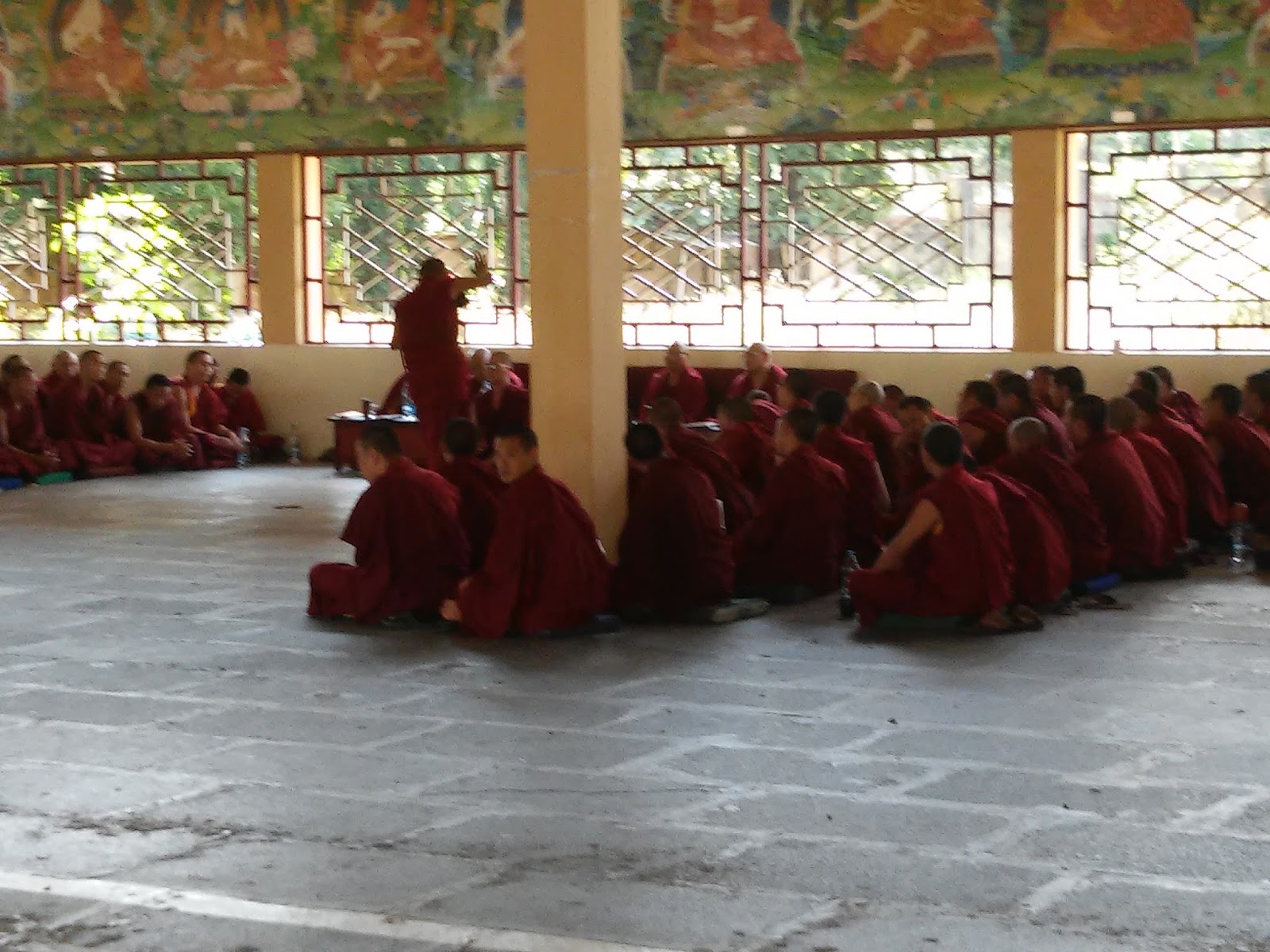
Another way to activate students practised for hundreds of years in Tibetan monasteries: requiring them to debate  in pairs while peers are looking on and with large physical gestures.
  1. Get everyone active with 1-2-4-all: students think about a question first alone, then share in pairs, then they share insights with a neighbouring pair and finally you discuss it in the big classroom. Another colleague mentioned that when students are forced to discuss in groups of 4, almost all of them will do some work (because there will always be some active students in the group), especially if you walk around to check on them.
  2. It is important to focus your lecture well, because as H. Simon said "a wealth of information creates a poverty of attention"
  3. A nice blog about peer instruction, with among others a nice series of blogs on why flipped classrooms fail. One thing that can make your flipped classroom fail is if you require students to do all kinds of work, but do not actually give feedback about this work. Another thing that can make your flipped classroom fail is when there are no consequences when students do not do the work, or when students are not clear on what their and your responsiblities are in the classroom. Useful case in point: it's helpful to spell out what you mean by "active participation" in the classroom. I will definitely try this out in my classroom.
  4. Nice platforms for creating online course content: FutureLearn and Google Classrooms. Both allow you to create very nice-looking course materials. Google classroom has the advantage it nicely integrates with googledocs for marking up assignments and things like that. Google classroom also makes it easy to grade with a rubric.
  5. A nice empirical investigation of the flipped classroom: article
  6. Tools for doing online voting: Socrative (allows you to also setup competitions in which teams try to answer as many quiz questions together as possible), mentimeter (allows you to easily vote on single questions and display the results interactively)
  7. A website with active activities: https://compass.itcilo.org as well as a book with game-like activities: Game Storming
  8. If you make quizzes for students to do before class, make sure you give useful feedback, e.g., "go back to section 11.3 of the book"
  9. Tools to make videos: for making screencasts: https://screencast-o-matic.com (e.g., to explain using some data analysis software), or to make cool animated videos/cartoons: https://www.powtoon.com/home/
  10. Another cool tool is "ticket to class"--make sure students do some activity beforehand to earn their ticket to class. One tool I like a lot is Perusall, in which students collaboratively read textbooks or articles. You could also use an exit ticket in which students can only exit the room if they hand in a piece of paper with the answer to a question such as: what is the question still remaining after this class? Name three things that can improve science? Etc (if you require students to add their name to this you immediately have a handy tool to keep attendance).
  11. A very effective tool to get students who are doing poorly back engaged is to find out who is not engaged with learning analytics (checking Blackboard for example) and then sending them a personal e-mail asking why they are not submitting assignments/not showing up etc.
  12. Nice database with exercises for physics, math etc: sowiso
  13. Tool to allow students to make collages of course-relevant information and comment on that (like a kind of instagram): padlet

Sunday, August 27, 2017

Pondering work and meditation

Some reflections from my stay at Ngari Institute of Buddhist Dialectics in Saboo, Ladakh.
Morning story: I woke up to run with the kids at 5:30. Since I wasn't sure where to go, I ran up to what I later found out to be the monk's quarters. Two of the institute dogs came with me. When there was nowhere to go, they guided me back below to where the kids were running. I joined some of them. Together we struggled up the hilll, panting for breath, looking at the beautiful views together, meeting yaks and people on our way. What a beautiful fresh way to start the day!\\
Contemplation:
From Andrew Harvey--''A journey in Ladakh'': ``Those who reject the materialism of the West, who despise it and separate themselves from it, are in danger of refusing to look at it, they are in danger of not being responsible to the facts of life as it is lived, and must be lived, now. We must find a way to work within the world, within science, within industry, even within politics; we cannot simply pretend a superiority to those things, for they are the forces that largely shape mankind. To work within the world we will have to be strong, and in the world our inner strengths will be greatly tested. But that is good. That will dissolve any pride we may have, any sense of virtuous invulnerability. It will take away from us any sense that we are "special'', that we deserve "special treatment'', that we are "unique.''
My continuous struggle is to figure out how to be living a "vita contemplativa.'' What does it mean to be a scientist and yet to also live a spiritual life such that the life and the science are not wasted, but are in fact of benefit to both myself and others. It seems from this writing that what is truly crucial is humility: to just work without expecting anything in return, without any recognition. And also, to drop any thought of being special but just focus on being of help. It is difficult to really live this, because in the West and especially in a career in a competitive profession we are conditioned to continually try to prove we have the best and we deserve recognition. So how can we resist that? Maybe one way would be to contemplate again and again on how we are interdependent with everything. Everything we do cannot be done without the kind help of many others (if only for the food we eat, the electricity we use, and so many more things).
Another helpful quote from the same book: "Be quietly detached from what you do and dedicate it to the good of all created beings, and you will be safe from disillusion or vanity.'' Every time when I go on retreat I realise how important it is to dedicate time in silence. Even just being here, I can see my automatic tendency to ditch meditation in favor of "something useful''--typically processing some information like reading a paper. It is hard sometimes to see the true value of meditation, yet this is the only way we can remain detached from what we do and put it into perspective. And only when we do that can we remain joyful in the face of difficulties, because we see there is so much else that is involved in all of our successes and failures.

Saturday, August 19, 2017

Science at the monastery gets real


I just returned from another study visit to Sera Jey Monastery in Bylakuppe, India. We are studying the effects of monastic debate and analytical meditation on emotion and cognition. Since this was already the fourth visit of the project, it was time to get real and get down on scientific rigour. In our EEG study, instead of just exploring different types of debate, we now developed a procedure in which each pair of debaters debated the same topic (a text on bodhicitta), got some chance to refresh their memory before the debate by studying the text for 15 minutes, and we used a standard classification for the triggers that the observing monks were using to score the debate. We even asked our observers to give the debates a grade, so we can in the future see whether the quality of the debate is related to some patterns of brain activity. In addition, the most interesting new feature of our EEG studies was more related to the frequent power outages: we bought a big car battery to run our EEG system off of!
We also took major strides in standardizing the behavioral tasks that we have been running by filming one of the monks explaining it while demonstrating on a tablet, and then showing this same video to all of our participants. The video demonstrations nicely combine standardization of explanation with a hands-on demonstration.
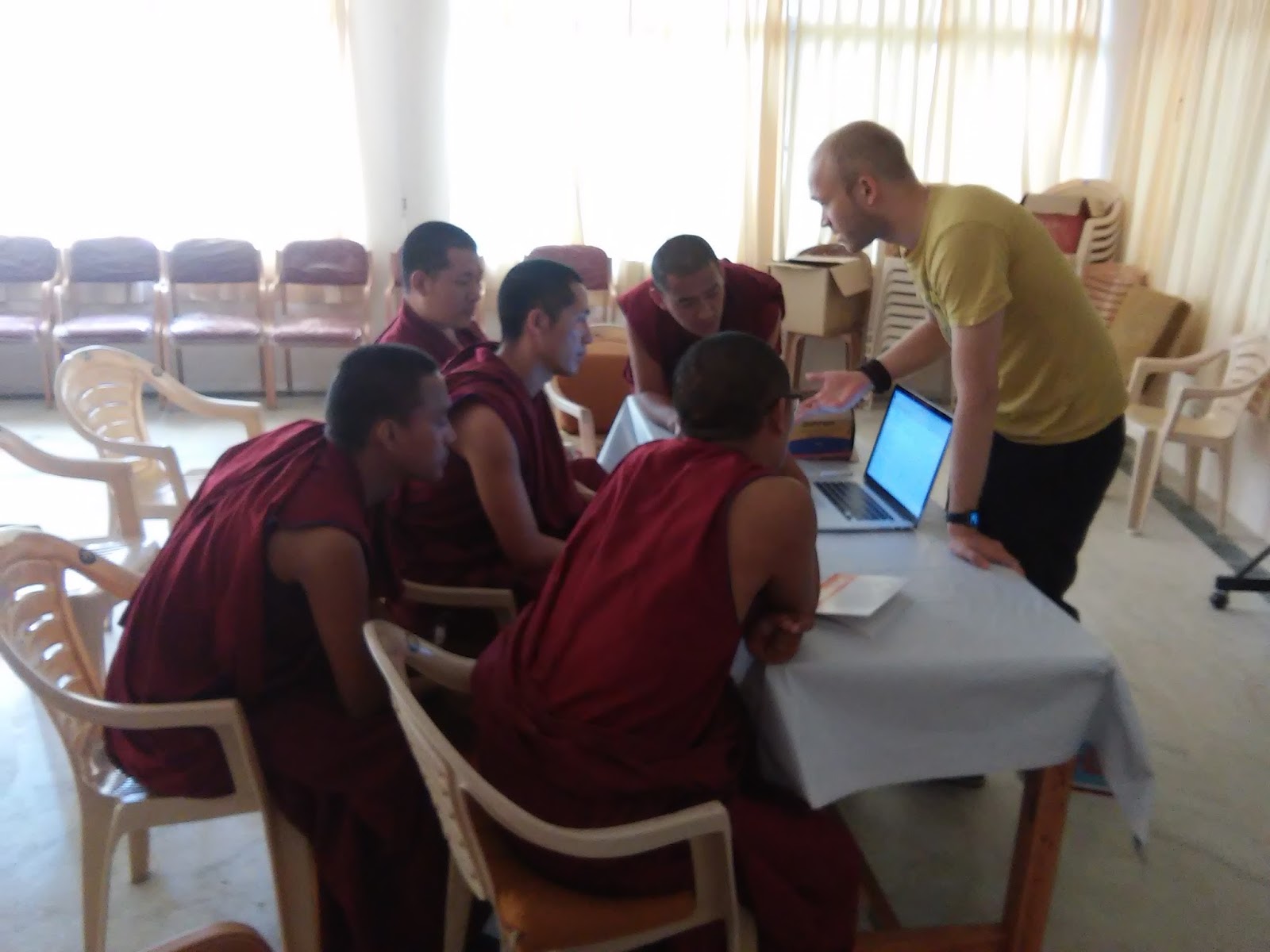
Monks pouring over a computer running JASP in stats class


In addition to spending time on standardizing experiments, we also spent quite a bit of time making predictions with the monks. This was a significant challenge, because obviously monks do not have the same space of possibilities in their heads that we Western scientists do (e.g., things either differ in their magnitude or there is a linear or non-linear relation between them). The monks found it a challenge to make predictions--maybe because guessing is not really encouraged in monastic debate you are drilled to be absolutely certain of what you are talking about (and in predictions you can never be). Nevertheless, we managed to get some predictions, and at least some of the EEG predictions were actually borne out! This is always a major happy moment for a scientist.

monks getting ready for EEG
Of course predictions are not always borne out, and we are also still sorting through a lot of confusing data that we still have to make sense of. Actually, the hard part of doing psychological science is that when you present a person with a task, quite often do they behave in quite a different way than we expected. This is mostly because the tasks we use to learn about the mind are really mostly geared towards Western college students (see this paper for a great discussion of that issue). As we slowly see all these interpretations of the tasks happen, we develop more appropriate instructions, and hopefully in the future also new tasks that are made more for our target population. As a first step in preparing for this, we held a methods and statistics class, which was actually met with tremendous enthusiasm: almost the whole monastic core team showed up voluntarily for this class on their free day! We had a lot of fun talking about t-tests, anovas and different kinds of variables, and we even played around with Bayes Factors in JASP!

This trip also was one of lots and lots of discussions. Actually one of the things that became obvious to me this time around is that the most insightful discussions actually happen when you are working one-on-one, not when having a large group discussion. For example, I spent a good amount of time sitting with my monk-colleagues to translate the debates (well, they translated, I wrote down the translations). In the course of this process I learnt a lot of tricks that happen while debating, such as interpreting a question differently when you do not know the answer to this question.
behavioural testing in action

This time we also met for the first time some Western monks studying at Sera Jey. Both with them, and with some members of our monastic collaborator team who studied in the West, I had some really interesting conversations about how monastic university training differs from Western university training. One thing that differs is the extent to which it actually informs how one practises and lives one's life. In addition, the debate training is a tool that is very confrontational: if you do not know something in great detail then there is no place to hide. This has as a result that you learn to really understand things in depth, but probably also that you build up quite an emotional resilience to being continually challenged. In short, it was a very illuminating visit, and such a precious chance to get to hang out in the peaceful monastery environment and the amazing group of monastic collaborators!
Last but not least: our study was featured in the Times of India!