Living in America can be quite stressful, especially being the type-A
personality that I am. I feel being driven is a very good thing, it
allows one to accomplish a lot. And yet, there are always chances to
get burned out and over-exhausted. So what is it that makes the
difference? Tsoknyi Rinpoche
has given some amazing teachings that address these issues. The core
of it (from my perspective) is that what makes ambition pathological is
when it is driven by ego, and by a constant need for recognition. One can
also be ambitious by ones motivation to help beings, but not be so
dependent on whether one is recognized or not. When functioning from
that perspective, you are much more closely connected to yourself, and
there is a lot more peace. Frustration cannot get a handle on you
because there is this deep courage. The courage to keep working for
the benefit of beings, in whatever way one happens to do it, no matter
what happens. Whenever you feel this sense of rushing, this impatience
that is the sign of ego, come, you can remind yourself that it is not
about 'me', and take a few deep, slow breaths, and a sense of quiet
will arise. It is quite remarkable, really.
Of course this will be quite a learning process, but even just to
recognize that there is a way out of our learned competitiveness and
judgmentalness, while still retaining our drive and dedication is
quite an insight. It is a tool on the way to becoming more of a
modern-day bodhisattva, as Dzigar Kongtrul Rinpoche likes to call it.

Tuesday, May 26, 2009

Wednesday, May 20, 2009
the circle is round
Yesterday I went to see Nacho Duato's Compagnie Nacional de Danca (CND). The ballets were very beautiful and so sensual! The dancers were completely embodying the music. What was even more interesting was that about 2 years ago, I went to a ballet workshop by CND, and this is where I broke my ankle. So I never got to see the performance, but now two years ago, the circle is round. When I went to the bathroom during the first intermission, coincidentally (?) I ran into the person who gave that workshop two years ago, and he recognized me and asked me how I was doing. I told him I was back to dancing, and even back on pointe, but that it had taken a long time. He said that he thought of me as they were in Philadelphia a few days ago. I am so happy we met and now it is as if this issue has finally found its peace. What an experience!
Sunday, April 26, 2009
With your mind you make the world...
Recently, I heard a lecture from Elizabeth Loftus
about false memory. She presented evidence for claims that it is
possible to implant false memory in people--in fact, it is very
easy. For example, people can be convinced very easily that they have
gotten sick of a particular food, and will subsequently avoid it. This
is an effect that persists for even months! What is quite shocking
about these studies is that what we think of as us is really a
construction, and very easily altered. On the other hand, it also
gives us hope. We are not stuck with our psychological make-up: we can
change it fairly easily. That is probably the whole ground of Buddhist
practice. We convince ourselves every day on our cushion of the
importance of caring for others, and of the relativity of our own
perspective. This can make our minds much more flexible.
A few weeks later, I heard a lecture by Michael Kane about
mindwandering. It is actually quite easy to induce mindwandering in
people: give them a boring task, and off they go. What is interesting,
is that the amount of mind-wandering people do is related to their
working memory capacity. In general, people with a higher working
memory capacity tend to mind-wander less; although on easy tasks they
sometimes mind-wander more than people with low working memory
capacity. Of course in meditation we are trying to train not to
mind-wander. This begs the question: can meditation increase our
working memory capacity? There is some very preliminary evidence that
it can, although it is not sure by how much and for how long.
The final example comes from my own research, which shows that
intensive shamatha meditation training might actually change how you
perceive the world, and make it more precise. In a paper presented at
the Cognitive Neuroscience Society in San Francisco, I argued that
after a month-long intensive shamatha retreat, participants were able
to remember face stimuli with less mental noise than before. There are
surely problems with my study, for example that the first time they
were tested, some participants had just had a long journey to get
there with a lot of stress. Nevertheless, all of these research
studies seem to point in the direction that we can change our mind,
and we can affect how we perceive the world.
Sunday, October 05, 2008
Distraction
I think the essence of samsara, the vicious cycle of suffering that
Buddhists try to liberate themselves from, is our habitual searching
for distractions. The root of this is really feeling that we do not
have enough, that we need something else. Our economy has been very
much built to support and reinforce this tendency. But eventually this
is also the cause of a lot of harm on ourselves, others, and on the
environment. That is why
this summer about practicing little needs and much contentment was so
poignant. I very much believe this is what we need, now more than
ever. But how often do I not find myself working, and then this
feeling arises of "oh, I really need to check this website", or "I
need to really eat or drink something." This is exactly that: the
feeling that we need something more, all the time. And not only do
these feelings make one unhappy, but they also very much impede
getting work done.
What helps me a lot to regain my focus is first, to make a list every
day of what I want to accomplish and what my priorities are, and
second, to contemplate how all these things that I feel I need are
really impermanent and changing. Actually, when I do go after these
feelings they will not satify me, or only for a short time. Because
the only productive satisfaction is when I am simply content with what
is. And that is again the practice of little needs and much
contentment. How beautiful, yet how difficult!
Friday, September 12, 2008
A new perspective

As I am writing this, I am sitting at London Heathrow, on my way back
to Princeton. I have spent about three months in Europe, for the most
part in Lerab Ling. Taking the time out to go on retreat really gave
me a new perspective on my life and on the possibilities of the
mind. Because really, we tend to be so much stuck in the normal and
subnormal levels of mental functioning, and we have no idea what is
possible if we spend some time looking at our own minds and training
it.
On retreat, I divided my time basically between various meditational
practices and studying Buddhist teachings. These teachings in large
part concerned the nature of our minds, which according to the
Buddhist philosophy is our Buddha nature, and how we can start to
recognize it. Recognizing the nature of mind is best done in retreat
with a qualified teacher who can show you, and who can clarify what
the nature of mind is and what are just experiences. To even get a
taste of the nature of mind can be really transformative, and I really
started to appreciate the depth of knowledge in the Tibetan
tradition. Now the big challenge is to try to integrate some of that
experience as I go back into my hectic life. I really feel that
especially this hectic world of today needs so badly the enormous
space that is really there in your mind, at any moment, if you could
only recognize it!
Another great contribution that my practice of Dharma has made to my
life is the teachings about egolessness. Egolessness might sound
strange and scary but for me it really has to do with losing fear and
gaining self-confidence. Because if there is no I in the way I
conventionally think about it, then who is there to get hurt? Or get
criticized? Egolessness however, is quite subtle, and to really
understand it, you need to contemplate it over and over again. To be
surrounded by an environment that very much supports these
contemplations is again, very helpful!
The culmination of the retreat was a visit by His Holiness the Dalai
Lama, during which he inaugurated the beautiful temple of Lerab
Ling. This temple is built on the model of Samye, probably the first
temple in Tibet. It is an amazing place, full of holy statues and
beautiful thangkas. Just to walk around there makes you feel like in a
different world. During the inauguration, Lerab Ling was a buzz of
activity, especially when the inauguration was attended by Mme Sarkozy
and many other VIPs! This was really not quite an ordinary retreat!
Thursday, May 22, 2008
Becoming the dance

(picture kindly provided by my cousin hakim)
I defended my thesis just over a week ago. Of course I freaked out on
the days before that and had all kinds of nightmares about things
going wrong. But it worked out well. I managed to figure out a way to
squeeze some ballet in there, used in this case to illustrate the
concept of similarity. The magical thing was that as I was doing the
ballet, I forgot about all my nerves, and really got into it. It was
kind of like when I have a good performance, and I really forget
everything. At that point, there is no 'I', there is only the dance or
the story and the audience. It is quite a magical and beautiful
moment. When I did the dancing this time during my thesis defense, I
too did forget my nerves, and just became the story I wanted to
tell. That is the magic of the performer.
But it may even be what is
meant by egolessness in a Buddhist sense: where the I is suddenly not
important anymore, and it is all about giving your life, your actions,
and your possessions to others, so that they may be happy. And then
when you stop worrying about yourself, magically happiness ensues. So
too when you become the dance, happiness ensues. The pain in my toes
is forgotten, and I bring both myself and the audience to a different
world.
Sunday, May 18, 2008
A little bit every day

Sometimes people admire me for my flexibility in ballet class. Pretty
much invariably I tell them that that is nothing really amazing. It's
just a matter of a little bit every day. When you do some stretches
every day, you will most surely progress. In fact, that is true for
almost everything. Simple, sustained effort is that what will pay off
in the long run. One thing that made me even more aware of that is my
impending thesis defense. Suddenly 4.5 years of hard work will by
culminated by a thesis defense. Writing a thesis is pretty much like
running a marathon--it requires sustained effort. It also requires
making sure that you are healthy and happy, because otherwise it will
not happen. That reminds me of the definition of the Buddhist precept
of "diligence": to find joy in what is virtuous and wholesome. The joy
is very important too. There is something about being joyous at what
you do, in every little bit of effort, that will make it all in the
end work out into something much larger. But it is the simple joy that
will allow you to keep going, every day. Also to focus on just that
one day prevents you from having too much fear about whether you can
do it or not. Instead you can just trust that some day, it will
happen, and it will. So really, a little bit of effort every day is
what does miracles.
This picture shows me on campus, in front of the famous LOVE
sculpture, together with a friend who shares my name (her first name
is also Marieke). It also shows the beauty of spring.
Thursday, March 27, 2008
The Network

Now reaching the end of my PhD work, I am starting to become more and
more conscious of networking. Initially I felt very hesitant about
these kinds of "business-like" behaviors, but in fact my experiences
with networking have turned out to be very positive. For a (budding)
scientist, networking is simply about sharing your data and ideas with
other people, going to visit them, talk to them at conferences, and
more recently, interacting with them through Facebook. I really enjoy
being part of this social enterprise that is called science, meeting
really amazing people and sharing thoughts with them. And then the joy
and enthusiasm that is transferred during these interactions is in
fact one reason why they are so enjoyable. In the documentary
Francisco Varela says that he feels like the troubadours in mediaeval
times, who would go to a place, sing their song, get food and lodging,
and move on. That's what scientists do when they go to conferences,
where they give their talk, and then go their way.
But in a deeper way, a network is also the way we interact with
people. According to my teacher Sogyal Rinpoche, one should ideally
see other beings as another "you", and interact with them according to
this deep sense of connectedness. After all, how do we really know
where we end and where the other begins? And we are so dependent upon
one another. Magically, this way of seeing dramatically changes how
you interact with the world; it makes it much more relaxed and
compassionate. Moreover, networking in the business-sense becomes way
easier, because you do not have to worry as much about
whether you are doing it right, and what your impression is going to
be, etc., etc. Instead, you can focus on the other and be much more
connected. So seeing ourselves as part of a network really helps
us to network!
This picture is from a DVD that my brother Floris and I made this
winter, a dance that illustrates a song about the 10 Oxherding
Pictures (a famous Zen story).
Sunday, October 14, 2007
change
In my Buddhist studies, the current topic is change and
impermanence. In fact impermanence is quite a profound topic of
reflection, because if you really understand it, Sogyal Rinpoche will
say, you will let go of all grasping. On a more basal level, I have
been dealing with quite a lot of change in my life lately: physically,
in being suddenly handicapped, and now learning to dance again, but
also mentally, in realizing that I am starting to reach the end of my
graduate studies. It is as if I have to think about flying out
again. But obviously, both the flying out on the level of my life, as
well as the flying away in dancing (learning to wear pointe shoes
again!), require a tremendous amount of hard work. Yet on the other
hand, doesn't everything in life that's worth it require hard work?
And yet all the while realizing that the outcomes of all that work
can, and most often will, be different than you ever envisioned. So
accepting change is also realizing that circumstances will change
beyond your control, so you have to try hard but expect nothing.
Quite a different dimension of change comes from a book I am currently
reading, which is called "All
is change". The book is about the contacts between Buddhism and
Christianity over the course of history. It contains some tantalizing
ideas. For example, there should have been a lot of cross-talk between
Christians and Buddhists in the 10th century, and in fact Christian
heretics, like the Cathars might have incorporated some Buddhist
teachings through the Manicheans. Isn't it tantalizing that where the
Cathars used to live, in the Languedoc in France, there is now a dense
population of Buddhist monasteries and temples? Another interesting
hypothesis was that the development of Mahayana Buddhism with its
emphasis on giving your own life as a kind of ransom for others' was
accelerated through contact with the Christian gospels. Maybe there
were a whole lot more connections than we thought, indeed, interdependence...
Sunday, September 23, 2007
summer - travel season

Summer always is the travel season, and it seems to get worse and worse. This summer I was hardly in my house in Philadelphia! Most recently, I went on a trip to Europe, which was a delightful combination of work, dharma and vacation. I started out very well with a retreat in Lerab Ling, Rigpa's retreat center in France. It has become quite a remarkable place, with a very large temple, constructed authentically according to Tibetan temple. It features a copper roof, as if it were the copper-colored mountain of Guru Rinpoche, with which it is compared. The inside is decorated quite extensively, with two shrines with 500 buddhas each (the Thousand Buddha Shrine), a large statue of the Buddha Shakyamuni like the one in Bodhgaya, and then finally a statue of Guru Rinpoche Look LIke Me, identical to the one that has been destroyed in Samye Monastery in Tibet. For this temple to be filled with dharma students from all over the world, engaged in a deep and extensive program of study and practice is quite remarkable. It really creates an atmosphere that instantly transforms ones mind. Moreover, it is possible to take such strong feelings associated with a place home and use it in ones visualisation practice. We already know from Free Recall studies that time-traveling to the situation or context of study helps greatly to recall words, but it also can transform ones mind. But of course during a retreat, one also transforms ones mind more directly through study and practice, and applying that directly in daily life by the way one interacts with other people and animals around.
After the retreat had transformed my mind at least a little bit, I was ready to do some work in Germany, where my lab collaborates, and then visit the wonderful cities of Paris and Lyon to talk to other colleagues. This was also the time when I went back into ballet dancing (I have slowly learnt to dance again over the past few months, progressing through beginner ballet into intermediate and slowly even pointe). The class I was able to do in Paris was quite wonderful--imagine taking a ballet class with only three people, very close to Montparnasse, and where the teacher even tries to throw in a few words of English every now and then (Studio Amana). In addition to ballet, I still keep doing some yoga, which I took up during my recovery period from my broken ankle. On the picture below you'll see me practising some yoga on the camping site during my retreat, which I really loved to do in the mornings. My favorite is power yoga, which is nicely challenging but still calms the mind. Having said that: time to go back to work, and analyze some of that data that I collected this summer at Shambhala Mountain Center this summer...

Sunday, June 17, 2007
the gift of broken ankle

It's been a long time since I've last written and many things have happened, including papers being published, travels to various places and so on. Probably the most significant event was that, as the title says, I managed to break my ankle in ballet class, about three months ago. Interestingly enough, this was not only a bad event, but also a tremendous lesson. Something as invasive as breaking your ankle requires you to complete rethink your life, because all the things you used to take for granted, climbing stairs, cooking, carrying a cup of tea, and so on, are suddenly difficult or impossible. Moreover, you have to remove the words
Now, about 3 months later, I am still recovering and trying to get back into ballet. There were two tools that I found incredibly helpful: during the whole time of my injury, especially during the no-weightbearing portion of it (first six weeks), I practiced floor barre, ballet exercises that are performed lying down on the floor, or sitting down. They help tremendously in maintaining and strengthening your turnout and flexibility in general. They also help to acquire a good posture in ballet, with the back very straight. Later in my recovery period, i.e., now, I am practicing the New York City Ballet workout, which consists of floor exercises to strengthen abdominals and upper body, floor barre, as well as elementary ballet exercises like tendus, plies and simple jumps. Because these exercises are very simple, they are a good transition into actual ballet class. Now let's hope that I will be back on pointe soon!
Sunday, September 24, 2006
dare to dream!
Lately I've been thinking a lot about dreams in all kinds of
contexts. The most literal one is that I've been reading this book by
Stephen LaBerge about lucid dreaming, a very interesting technique to
explore your consciousness and gain awareness over what happens during
sleep. In less literal contexts, dreaming refers to your aspirations
and goals in your life. In fact I believe that those are the most
important for all of us if we want to go beyond our ordinary,
day-to-day events. It can be extremely helpful to figure out what the
goals of your life are such that you will be able to set priorities,
since we live in such a complex and busy world. In order to figure out
our aspirations, it often helps to dream of how we would want to live
our lives, if everything were possible (this was also suggested in a
recent exercise in Karen
Knowler's eZine ). This allows you to go beyond your limitations
and imagine something bigger. The amazing thing is then then when you
make the aspirations, they will actually often materialize often in
unexpected ways. In a book I read years ago by Marion Bradley ("the
Mists of Avalon"), the magician Merlin said: be careful with what you
wish, because it will be given to you.
And after all, how can you follow a path, when you have no idea what
the path is? I believe that one of the highest priorities in life is
finding what the path is and then following it with every bit of
determination you have.
Sunday, August 20, 2006
vancouver and raw food experiments

I recently went to Vancouver for the annual meeting of the Society for Mathematical Psychology. It was quite an adventure: even upon flying in there, we could see the snowy Mount Reinier from the airplane. Then flying in Vancouver Bay is absolutely stunning. Vancouver is a quite dramatic city: beaches, mountains and a big city all in one. It has lots of Japanese immigrants, hence sushi is a very popular food and I ended up eating sushi pretty much every day! The conference itself was also quite wonderful - I enjoy these conferences with relatively few attendees. There were some good talks about mathematical psychology and the brain, including great talks by Greg Ashby and Mike Shadlen who come from two opposite directions: Mike Shadlen starts from single neuron firing in monkeys during a decision making task, Greg Ashby starts from box models of the human brain about categorization and works his way down to the neural level, using fMRI. The brain is just so hard!
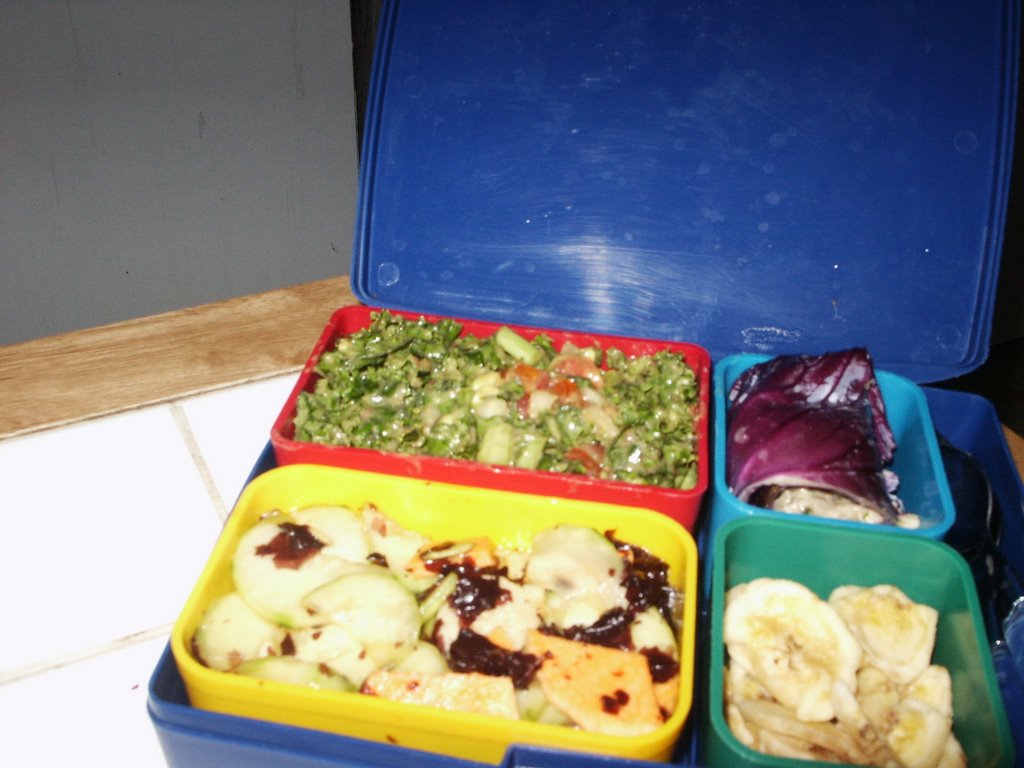
In the recent days I have been experimenting quite a bit with raw food, and one example of those things are some nice raw lunchboxes I created, of which I have pasted a picture here as well. It's quite an adventure. One extremely helpful resource is Karen Knowler's weekly eZine with lots of good articles and tips. What I like about it is that it's a very fast and also quite healthy way of eating, even though I do not think at this point that eating 100 % raw is a great idea. But more raw and unprocessed food is definitely good, and especially because it seems to reduce my cravings for sugar-heavy foods, which is really the main goal.
teachers

"Who is the outer teacher? None other than the embodiment and voice and
representative of our inner teacher. The master whose human shape and
human voice and wisdom we come to love with a love deeper than any
other in our lives is none other than the external manifestation of
the mystery of our own inner truth. What else could explain why we
feel so strongly connected to him or her?"
I decided to write a little about teachers, since teachers of all
kinds play such an important part in my life. I think it is essential
to find good teachers to teach you the art of life. In the beautiful
quote above that comes from Sogyal Rinpoche's book "Glimpse after
Glimpse" (July 27) it is shown how sometimes a teacher we meet can be a
manifestation of what we really need and want to develop. I think good
teachers are very challenging to work with, because they want only the
best you can give them, nothing less. Yet also the interactions with
them are extremely rewarding because not only do they show you the
path, but they are often also great examples. In fact I feel this
applies to not only my spiritual teacher, but also to my ballet
teachers and my thesis advisor, and many of the teachers I have had in
the past. These days, the role of the teacher often gets devaluated
and there is not a lot of respect for them, which greatly diminishes
their ability to actually confer their experience to the
students. This is quite contrary to the way it still works in ballet,
where a teacher is usually not gone against and is curtsied at the end
of every class (to just give some examples). Of course it is also
important to develop critical thinking, and not to take everything the
teacher says at face value, but this can be done after the knowledge
is tested out (this is interestingly enough also what the Buddha seems
to have said to his students: do not believe things I say just because
I say them, test them for yourself). To be pushed by a teacher and to
work very hard can in the end be a joy because it allows you to
transcend your own boundaries. This is why I believe it is so
important to meet good teachers.
Sunday, July 23, 2006
Visit to Berlin


On my summer trip to Europe I not only spent some time visiting
friends and family, and some more time working in Freiburg (Germany),
but I also decided to take the train to Berlin on my way back. Berlin
is quite an impressive city, with a lot of history, albeit somewhat
painful. After arrivinng in the brand new train station Berlin
Hauptbahnhof, I spend the night in a hostel so I could explore the
city the next morning. The first thing to visit was the Pergamom
museum, which hosts a lot of beautiful Roman, Grecian, Babylonian and
Islamic art. It's always a lot of fun to just stand there between the
statues and mosaics and imagine what it would have been like to live
in this time, especially as a woman. An even more interesting thought
experiment is to imagine how it would be to time travel there, knowing
so many more things than they did about the universe and the mind, or
what would they think of a women dancing on the tips of her toes, or
an airplane? You can almost write a novel in your head in this way!
I then went on, passing through Unter den Linden (what a beautiful
street) and the Gendarmen Markt to Checkpoint Charlie, the boundary
between East and West Berlin. Just imagine how many people tried
desparately to escape there, or to reach their friends and family on
the other side of the wall. This is really quite painful. Even more
painful was the headquarters of the Gestapo, close to there. After
walking by the Tempodrome (a very futuristic building which I read
about in the interesting novel Omega Minor by Paul
Verhaeghen) and the Potsdamerplatz, I visited the Holocaust
Monument. The latter was also very painful, with lots of stories of
people who died in this dramatic period of recent European
history. the sadder part however, and the reason why we have to keep
remembering these events is that these things are still happening
these days, think of Rwanda, Tibet and so on... A powerful reminder of
the suffering in the world and for Buddhists maybe also a reminder to
practise tonglen, giving (of happiness) and receiving (of pain and
suffering) or loving kindness and compassion. A more joyful impression
of Jewish life I got in the Jewish museum, which was a quite
interactive display of customs and culture of the Jewish people. One
nice example were the cards in the shape of pomegranates on which
visitors could write their wish. these wishes were then hung in a
tree; pomegranates symbolize something like happiness and hope for the
Jewish people and are often eaten during holidays. In short, Berlin is
quite an eventful city, for which I had way too little time, yet even
short visits are quite good (since I do not very much enjoy being a
tourist, one day was quite good for me!).

Monday, June 19, 2006
mind and life summer research institute

I Just returned from the Mind & Life Summer Research Institute 2006. It was an amazing gathering of Buddhists and scientists and combinations of the two, on the beautiful grounds of the Garrison Institute in Garrison, NY. It is quite unique in that it is a combination of a scientific meeting and a retreat. The retreat began by watching a beautiful documentary about the life of Francisco Varela, who basically started this dialogue between Buddhism and science (the film is called What is Life?). He must have been a very noble being, a rare combination of a brilliant scientist and a beautiful practitioner. At this retreat, we started and ended every day with a solid meditation practice and optional yoga (taught by Jon Kabat-Zinn!). After breakfast we broke the noble silence that was in effect every evening after the meditation practice, and started to discuss theoretical frameworks for the study of contemplative practice, new exciting data, research proposals and difficult issues in this type of research. It was really exciting to be among so many bright and interesting people, and to develop ideas for studies together. at some point I even ended up in a multi-lab lab meeting where we developed a new paradigm that all the labs present were interested in using. A really very friendly and collaborative atmosphere. Yet it was also so incredibly silent - to just simply find the silence within that is always there.

We ended with a complete day of meditation, where we simply looked at our own minds, as if in a laboratory, a laboratory of introspection. This is really what the new discipline of contemplative neuroscience would be like: not only studying meditation or any contemplative practice from the outside, but also very much from the inside, acquiring the experience itself. In here we can very much develop the tools of neurophenomenology, as proposed by Francisco Varela and Evan Thompson. We not only talked about introducing experience or the first person perspective in neuroscience and the study of consciousness, but about lots of other things as well, leading from attention and mind-wandering (discussed by Jonathan Schooler, who developed tools to measure mind-wandering) to emotion regulation and Mindfulness Based Stress Reduction as treatment for diseases like fibromalgyia or depression. Moreover, we even learnt about Christian forms of contemplation: (centering prayer and taxonomies of meditation that are starting to be developed. And finally, this summer institute was an amazing network, or mandala that has been developed of scientists who start collaborations all over - what an amazing coming together of circumstances!
Saturday, June 03, 2006
a taste of mindfulness and compassion


Last week I went to a retreat in Boston (led by one of Sogyal Rinpoche's senior students, Andrew Warr), where we focused on meditation and lojong (mind training in loving kindness and compassion), which was really quite inspiring. It's amazing how being in a quiet environment and listening to the teachings can dramatically bring you back to yourself. It was also very inspiring to see the teachings being presented by someone who clearly had done a lot of practice. In my experience, this gives people often a very profound element of lightness in their being, tranquility and yet very down-to-earth and flexible.
We studied and practiced some of the bodhicitta teachings. I thought one of the most inspiring exercises was a very simple one: putting yourself in the shoes of another person, seeing other people as a another you who also simply want happiness (this was in the context of developing the equanimity aspect of the Four Immeasurables (love, compassion, joy, equanimity)). If we could only practise this in our daily lives, the world would look so much different.
Last week I also saw the movie windhorse, an incredibly inspiring yet very sad movie about the intertwined lives of a nun, an alcoholic and a singer in Tibet (the singer is a Tibetan girl who sings Chinese songs in a discotheque), in occupied Tibet. It's a story about the Tibetan people who want to be free to practise their religion, and the ruthless suppression of that by the Chinese government. I think the most horrible part of such movies is to know that these things are now happening, in Tibet, but also in Iraq, Afghanistan... The windhorse (lungta) is the powerful symbol of being free, when your mind is in harmony with its nature.
Speaking of that, a new, and supposedly quite good, movie has come out, an inconvenient truth, which I hope I will have time to watch in the coming days.
Thursday, May 11, 2006
end of semester reflections
The semester has come to an end - what a transformation of the campus! At the same time, summer is kicking in - we're getting ready for the hot weather. The past weeks had the theme of producing lots of results and giving talks, as well as grading exams and finishing up the class I am the teaching assistant for. It is very interesting to see how people learn at the same time that you are studying human memory (the subject of the course). For your information, spaced repetition is really the best way to learn. Also, really anything you experience changes you, because it changes your episodic memory, which subsequently continues to influence your perception. Interesting how Western science of memory and Buddhism came up with these insights independently!
A recent interest of mine is trying out raw food dishes. I got this amazing cookbook by Jennifer Cornbleet called Raw food made easy, and there is also a very nice website with raw recipes. I think this diet is probably not completely balanced and feasible by itself, but it is definitely good to eat more raw fruits and vegetables, which is also a lot easier as summer comes along.
Another project these weeks has been to work with mindfulness, inspired by the rigpa study pack about meditation. One relatively easy way to develop mindfulness is to tie it for yourself to particular stereotyped actions, such as eating: just remind yourself to think of "mindfulness" as you're eating. This not only transforms your experience of that particular action, but also increases the number of times you remember to remember! The four applications of mindfulness (see "genuine happiness" by Alan Wallace for a good description of those) are also very interesting: I tried to apply the mindfulness of feelings to my hurting toes during pointe class, and it was definitely very helpful. Mindfulness is really an amazing tool!
Saturday, March 18, 2006
antigone: a story of courage and morality

Yesterday I saw a beautiful new ballet by the Rebecca Davis Dance Company. The performance was named Antigone, after the drama by Sophocles. Very interesting was the use of dialogues from the play while the dancers were dancing, which made the dancing very moving, because the story was very clear so the dancing could focus on the feeling. It was amazing to see how modern dance and pointe were combined, in a very high level performance. Also, the story of this courageous woman who decides to thwart a sure death by her father's hand for the sake of upholding her duties as a human being. She faces the lust for power of her father Creon as she goes her own way to bury her brother, and pays for it with her own death. The chase for Antigone after she commits the act of burying her brother was beautifully staged, where the first white-clad people in the court now became all dressed up in leather and their dancing was very square and aggressive. For me it was also the story of staying human, upholding your own morality in a world that sometimes seems to revolve around power, money and recognition, a world that is full of speed and agression. The innocence combined with determination that overcomes that was beautifully portrayed. The picture that goes with this post is from the ballet.
Saturday, March 11, 2006
ballet news and simple living
For ballet there were quite a few interesting challenges in the past classes: at the barre, doing a full turn, ending in the extended leg position at 90 degrees on pointe, repeating this whole exercise in all directions (i.e., en croix). It is definitely not too easy! And then today we ended class not with fouettes but with a series of consecutive turns from 5th position, 16 of them. Being a bad spotter, this was a sure recipe for diziness, so I was amazed I almost made it through 16 of these turns on pointe. But again it was a fun challenge!
During the past week, the campus was almost abandoned since it was spring break. What a transformation! But now campus is in full swing again and I am grading the second exam, woohoo!
Anyhow, i have been thinking a lot lately about leading a simple life. Especially in the US, we tend to waste so much money and stuff, believing that we get happy by buying as much as we can, and doing everything fast and easy, which creates a lot of waste. Luckily, there are some people who do not agree with that. I found this cool site vegan lunchbox, which shows how you can be very creative with lunches that you bring from home, and save a lot of money and waste to boot. Of course preparing such lunches would cost a lot of time but with creativity you can also create nice things with less time. And there are lots of other things that one can reuse, such as bringing your own cup or thermos to talks where they serve tea, or even using cotton menstrual pads of reusable tampons when you're a woman (see glad rags for this creative initiative. I wish more people here would care about the environment, using their bikes instead of cars (although it's not bad in Philadelphia I must say), doing recycling and these kinds of simple things. Especially because judging from the weather here (first 80 degrees and then within 2 days a drop to snow!) we seem to be screwing up the environment quite a bit...
Subscribe to:
Posts (Atom)